Ghanaians love their con men. It’s the national sport. There’s an appreciation for the con, for getting one over on someone, for the sweetener, for kalabule. There have been government crusades against kalabule. One military leader killed people accused of it. But Ghanaians delight in the kind of man who can talk himself out of a bind or into a fortune.
When Ghanaian children are young, their parents often tell them stories about Anansi. Sometimes a man and sometimes a spider, Anansi is a trickster. He is wise, but also greedy and lazy. As the legends have it, Anansi knew the power of stories-and his stories were so good, they changed the world. If he told a story about a mountain, the next morning people would look outside and see the mountain. If he told a story about some hidden treasure, people would dive to the bottom of the sea in search of it.
Anansi’s stories made people feel special: like they knew a great secret or were part of an amazing adventure. Sometimes he got away with his cons. More often, he got greedy. And because, in Ghana, Anansi stories are used to teach children not to be like Anansi, he would often fall into one of his own traps. There would be consequences, and Anansi would be humiliated. But after that, Anansi’s stories wouldn’t go away. The mountain would still be there. People would keep searching for the treasure.
John Ackah Blay-Miezah was Anansi. His story of Nkrumah’s secret fortune rewrote Ghana’s history and made him fabulously rich. Then it destroyed him. But the story outlived Blay-Miezah.
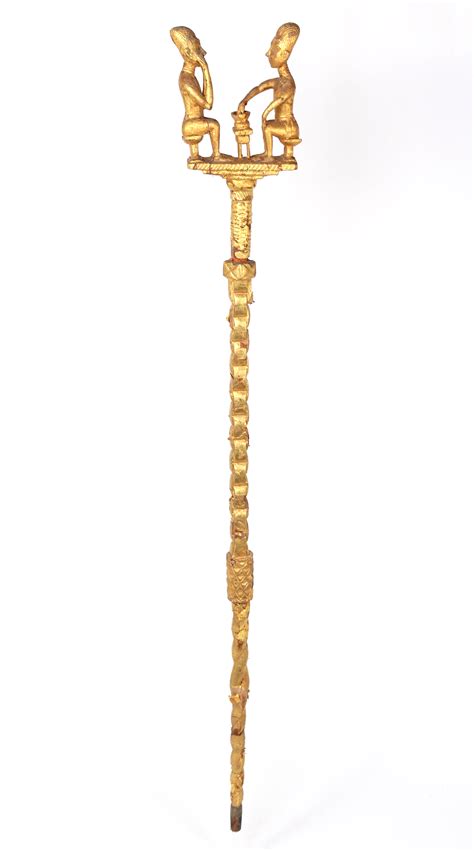
A linguist staff from the 19th century, which would have been carried by high-ranking Akan officials in the Gold Coast or Ghana, depicts Anansi.
Read also: West African Suya
The Untold Story of Kwame Nkrumah (Full Documentary)
In 1981, Peter Rigby was running a video studio in Muswell Hill, north London. One day, he was called to the penthouse of London’s Montcalm Hotel to visit a new client. The Montcalm had been converted from a series of Georgian houses. At the hotel, Rigby took in the client, in the flesh. John Ackah Blay-Miezah was bare-chested, with a large gold Star of David hanging from a gold chain around his neck. He sat on one of the three sofas in the lounge of his suite, smoking an expensive cigar.
Blay-Miezah said that his company needed to rent several pieces of video equipment and would pay handsomely. Rigby did not realize it, but that meeting was about to change his life forever. By 1981, Blay-Miezah had been scamming his way around West Africa and the United States for years, leaving a trail of angry diplomats, hotel managers, and investigators in his wake.
As Blay-Miezah told it, the fund was the best-kept secret in the history of Ghana. Nkrumah had dedicated his life to freeing Ghana from British colonial rule. While outwardly supportive of independence, the British had sabotaged him relentlessly. Informants reported his every move to the security services. Officials tried to rewrite history, whitewashing centuries of looting and exploitation.
When Nkrumah planned a speech to set the record straight-with, a panicked intelligence officer wrote in a top-secret memo, “two whole pages which dealt with such items as the slave trade and were in remarkably poor taste”-officials were so alarmed that the British governor was woken up in the middle of the night.
“At long last, the battle has ended!” Nkrumah told a cheering crowd in Accra. The early days of independence were like a gigantic cocktail party.
Read also: Mauritius West Coast Accommodation
There were grand balls in the State House, where Nkrumah, Nelson Mandela, and Oliver Tambo danced and drank far into the night with W. E. B. Du Bois, Ralph Bunche, and Martin Luther King Jr. But Nkrumah’s Ghana was fragile. From the moment independence was declared, it was under attack.
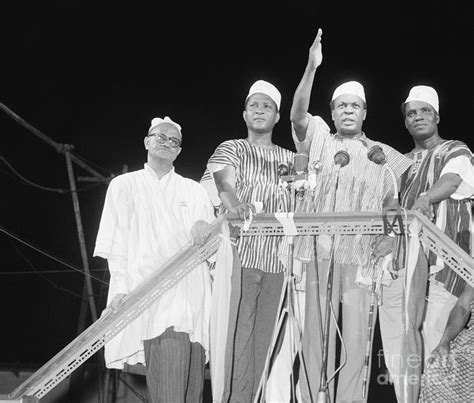
Prime Minister Kwame Nkrumah waves to a celebrating crowd in Accra on March 6, 1957, after the British colony known as the Gold Coast ceased to exist and the sovereign state of Ghana came into being.
Nkrumah’s government built the Akosombo Dam, an enormous hydroelectric power plant on the River Volta. It built an aluminum smelter, a harbor, an industrial area and a brand-new city at Tema, sugar refineries, textile plants, railways, glass factories, printworks and presses, hotels, universities and hospitals, and schools across the country. This was often a dirty business. Each project presented an opportunity for graft. Nkrumah himself lived simply and did not take bribes. But that did not matter. Corrupt businessmen descended on his ministers with envelopes full of cash. Western countries went out of their way to support the crooks who were looting Ghana-and to avoid supporting Nkrumah.
In February 1966, while Nkrumah was on his way to China, members of the military and police staged a coup d’état. Years later, Nkrumah was dying of cancer in Romania. His former friends and allies had abandoned him. As Blay-Miezah told it, this was when the president revealed that Ghana’s history had a secret chapter.
There was only one person left in the world he could count on: Blay-Miezah himself. Over his years in power, Blay-Miezah said, Nkrumah had hidden away enormous amounts of cash and gold. At that very moment, tens of thousands of gold bars were sitting in vaults in Switzerland. But Nkrumah was not a thief. He was a visionary. He hid the gold to make sure it did not fall into the wrong hands.
Read also: Explore West African Food
Nkrumah had known that he could lose power at any moment, Blay-Miezah continued. So he made a plan. Slowly, carefully, quietly, he had moved some of Ghana’s gold reserves abroad. Then he placed the gold under the control of a trust: the Oman Ghana Trust Fund.
Most of the money, Blay-Miezah said, was to develop Ghana. The rest? But, Blay-Miezah would say, there was a catch: Before the banks would release the money, Blay-Miezah had to show that he had met all the conditions Nkrumah set up to govern the trust fund. So Blay-Miezah wanted to make a deal. Anyone who helped him return the gold to the people of Ghana would earn $10 for every $1 they put in.
They’d get their money back in months-maybe weeks, guaranteed. Sometimes, Blay-Miezah would produce yellowed documents, embossed with the seal of the Office of the Prime Minister, Osu Castle, Accra, that were seemingly signed by Nkrumah himself: the deeds to the Oman Ghana Trust Fund.
Blay-Miezah was not just selling an investment, he was selling a dream. To Black people, he was selling liberation: a chance to repair the wounds of colonialism. In truth, while Nkrumah was on his deathbed in 1972, Blay-Miezah was not at his side.
Rigby was fascinated by Blay-Miezah. He found himself spending more and more time at the Montcalm. Rigby learned about Blay-Miezah from his associates, who had begun to filter into London in Blay-Miezah’s wake.
Many were former Ghanaian government ministers, including Kwesi Amoako-Atta, who had been minister of finance under Nkrumah, and Ebenezer Ako-Adjei, one of Ghana’s founding fathers, who had been minister of foreign affairs. They told Rigby that Blay-Miezah had recently run for president of Ghana on an anti-corruption platform but had been jailed before the election.
Rigby had an appetite for risk and a strong sense of adventure. When he heard about the Oman Ghana Trust Fund, he wanted to come along for the ride. In exchange, Blay-Miezah offered Rigby an opportunity. When it was all over, Blay-Miezah promised that Rigby would found Ghana’s first commercial television network. Rigby would spend over a decade at Blay-Miezah’s side.
“Most people seem to think Blay-Miezah was the world’s biggest con man,” Rigby later said. “He wasn’t."
Blay-Miezah’s investors came from all over the world: Pennsylvania and Accra, Monaco and Seoul. They were told they would be paid tomorrow. Or maybe they would be paid next week-next month at the latest. Something always came up. Someone had died. There had been some unrest. The bankers had balked. The government of Ghana had withdrawn its support. A new company had to be incorporated. The Americans had interfered.
But not to worry, the investors were told: Next time, the money would be released. On Dec. 24, 1981, Rigby was throwing a Christmas party at his flat in Hoxton. Close to midnight, he got a call from Blay-Miezah himself. Rigby was to be at the Montcalm Hotel at four in the morning, on Christmas Day, to accompany Blay-Miezah to Accra.
The next morning, a very hungover and sleep-deprived Rigby went to Heathrow Airport with Blay-Miezah and an elderly American lawyer he had never met before named Charles Lowenthal. They arrived in Accra in the evening. Rigby wondered about the mad dash to get there. On Dec. 30, Rigby and Lowenthal were having breakfast in the restaurant of the Ringway Hotel, in the heart of Accra.
As the two men waited for Blay-Miezah to summon them, the double doors leading to the restaurant swung open. A short, lean man strode in and walked past them, sitting at a table behind Lowenthal. After he sat down, Lowenthal leaned toward Rigby and asked if he had gotten a good look at the man. Rigby looked past Lowenthal to the man again, and the man caught Rigby’s look. Rigby said something innocuous about visiting friends.
Just then, Blay-Miezah’s driver came through the double doors. Rigby left immediately, but Lowenthal stayed behind. Rigby was more than happy to leave him with the man. It was a quiet drive to Blay-Miezah’s house. At one point, Lowenthal leaned in and said, in a conspiratorial tone, that he was going to leave Accra that night. If Rigby had any sense, he would join him. Lowenthal had clearly heard a rumor that something was about to happen.
As Rigby and Lowenthal were leaving Blay-Miezah’s house at about seven that evening, a truck arrived loaded with what looked like freshly printed leaflets.
When Rigby landed in Amsterdam, he went to his friend’s houseboat on Prinsengracht and settled in to sleep off the red-eye. As he dozed off, he heard a news report on the radio. Later that day, as Rigby was watching television, the screen filled with a picture of a man Rigby instantly recognized. It was the man who had strode into the restaurant of the Ringway Hotel the day before. He was Flight Lt. Jerry John Rawlings, the news reporter said.
The borders were closed, Rawlings announced. What was bad news for Ghana was good news for Blay-Miezah. In Rawlings’s regime, he saw an opportunity. In May 1982, Ghana’s new government issued Blay-Miezah with a diplomatic passport. It was a handsome red document. Blay-Miezah’s profession was listed as “Government Official.” His date of birth was given as 1924, rather than 1941. In his photograph, he posed in front of some flock wallpaper, wearing a checked suit, a striped tie, and a look of ineffable delight.
In 1974, he had sat before Col. Ignatius Kutu Acheampong, then the country’s head of state. Blay-Miezah wore polished loafers and a crisp white leisure suit. To Acheampong, Blay-Miezah’s story had sounded absurd. But at the time, Ghana was broke. Blay-Miezah’s millions would fill the country’s coffers again. With that kind of money, Acheampong could make Ghana the envy of the world.
There were, Blay-Miezah said, just two things he needed from the colonel. He needed a diplomatic passport. At the time, Blay-Miezah had been resident at Ussher Fort, the most notorious prison in Accra. He had been charged with fraud, escaped police custody via a latrine, then had been locked up again.
Left: A letter allegedly written by Kwesi Botchwey, Ghana’s minister of finance, regarding the Oman Ghana Trust Fund. Right: The alleged deed to the Oman Ghana Trust Fund.
Blay-Miezah knew that keeping his scam afloat depended on one thing: making himself indispensable to Rawlings. Soon, Blay-Miezah was brandishing letters on official government stationery, apparently signed by Kwesi Botchwey, Ghana’s minister of finance.
One stated that “the Oman Ghana Fund originated partly from Ghana and partly from contributions by financial institutions in Europe and North America.” For Blay-Miezah’s investors, it was all the confirmation they needed that Nkrumah’s gold was really out there. Many investors spent years following Blay-Miezah around the world, hoping that the money would arrive. For years, it seemed like the Oman Ghana Trust Fund was too big to fail.
After he heard the news, Blay-Miezah called Rigby into his dining room in London. Blay-Miezah flew to Accra on a Ghana Airways flight on Jan. 29, 1989. Rigby went to Heathrow to see him off. At the airport, Blay-Miezah seemed ebullient.
Later that day, CBS broadcast an episode of 60 Minutes about Blay-Miezah and the Oman Ghana Trust Fund. The presenter, Ed Bradley, had been introduced to Blay-Miezah by one of his investors, Dick Butera. Blay-Miezah had hoped that the program would be a glossy advertisement for the trust fund. Instead, Bradley called Blay-Miezah “the ultimate con man.”
When Blay-Miezah landed in Accra, he was immediately put under house arrest. Many of his strongest supporters had died or were backing away from him. Rawlings was increasingly focused on laundering his reputation, and Blay-Miezah had embarrassed him too many times. 60 Minutes was the last straw: Blay-Miezah was now a liability.
Today, Rigby still believes in the Oman Ghana Trust Fund. He still has the promissory note Blay-Miezah gave him. The Oman Ghana Trust Fund did not die with Blay-Miezah. Soon after his death, one of his investors, Gregory Frazier of Detroit, Michigan, bought a one-way ticket to Accra. In 2009, the Friends of the Oman Ghana Trust Fund successfully petitioned the Ghanaian government to look into the trust fund.
The commission formed to investigate it found no evidence that the trust fund existed. For a few years, Kobla Asamani, a Ghanaian supporter of Frazier, was the spokesman for the Friends of the Oman Ghana Trust Fund.
One evening in April 2017, Asamani sat on the veranda in the lush grounds of a boarding school in Accra’s industrial area. “The task of retrieving the money was originally given to John Ackah Blay-Miezah,” Asamani said. “But he got corrupt, he conned people, he tarnished the whole process. Greg Frazier knew him personally, and was at his deathbed, and Blay-Miezah passed the secret on to him."
