Madikwe Game Reserve is a 75,000-hectare protected wilderness reserve located in the North West Province of South Africa. This premier game reserve offers a unique and unforgettable safari experience.
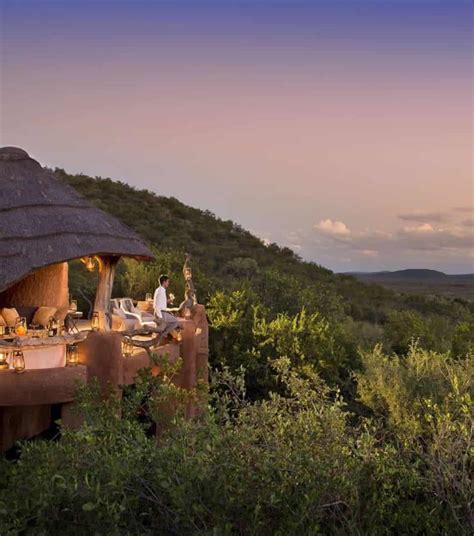
Location and Accessibility
Madikwe lies north of the small town of Groot-Marico on the Botswana border. The closest town to Madikwe in South Africa is Zeerust, some 90 kilometres from the reserve. Madikwe is also conveniently located near the popular Sun City Entertainment and Casino Complex that shares a boundary with Pilanesberg Game Reserve.
The closest international airports to Madikwe Game Reserve are Gaborone in Botswana and OR Tambo International Airport in Johannesburg. Federal Airlines offers a daily shuttle service from Johannesburg to Madikwe.
There are 5 entrance gates into Madikwe: Abjaterskop Gate, Wonderboom Gate, Tau Gate, Derdepoort Gate and Motledi Gate.
Unique Features of Madikwe
Apart from size, the big difference between Madikwe and Pilanesberg game reserves is day visitors are not permitted in Madikwe. Self-drive holidays in Madikwe are popular, with visitors arriving either in their own cars or hired cars. The roads in Madikwe are a combination of tar and gravel roads and suitable for all types of cars.
Read also: Discover Thula Thula
The Dwarsberg (thirst mountain) mountain range forms the southern boundary of Madikwe Game Reserve, running from east to west.
Safari Adventure: Southern Africa's Top Reserves
History and Development
Madikwe Game Reserve was developed and proclaimed a three-way privately-operated game reserve in the early 1990s. It was stocked with wildlife through one of the world’s most significant wildlife translocation projects, known as Operation Phoenix. Operation Phoenix was concluded in 1997. Today, Madikwe Game Reserve is home to over 10,000 animals.
Before Operation Phoenix and the transformation of the area into a premier game reserve, the land was poorly-cultivated farmlands with alien vegetation. The derelict farmlands where Madikwe Game Reserve is located were once used for low-yield cattle farming. This agricultural activity did not create many jobs or stimulate the economy in any way. The conservation model was developed to make better use of the land to benefit the local communities.
Madikwe Game Reserve was developed as a unique partnership between the local communities, private safari lodge owners and the government. Madikwe Game Reserve was created as a three-way partnership between the state (what was Bophuthatswana but is now South Africa), the private sector and the local community. The private sector play a role in developing and managing the hospitality and tourism activities in the reserve. The private safari lodges of Madikwe also provide the local people with much-needed employment, which is sorely lacking in the area.
The conservation corridor will also help the elephant population spread its gene pool and allow them to “share knowledge” between the two elephant populations.
Read also: Exploring South Africa's Game Reserves
Operation Phoenix: A Wildlife Translocation Success
Operation Phoenix is world-renowned as the largest and most successful wildlife translocation project ever undertaken. Over a period of 6 years, more than 8 000 animals were re-introduced to the newly-established Madikwe Game Reserve. Operation Phoenix accomplished many firsts in wildlife conservation including the first time entire herds of elephant were relocated and re-introduced to a new area.
Flora and Fauna
There are 350 recorded bird species in Madikwe, many of them are endemic to the dry, arid Kalahari Desert as well as the lush Lowveld region. Considering the Bop Park was once over-grazed farmlands, Madikwe Game Reserve has flourished under extensive ecological conservation efforts into a naturally-lush ecosystem. It lies in a transitional zone between the dry, arid Kalahari Desert and the high-rainfall region of the Lowveld.
The climate of the Madikwe region plays a significant role in Madikwe’s rich fauna. The bushveld is a mix of Kalahari bushveld, arid sweet bushveld and turf thornveld. Madikwe Game Reserve is particularly well-known for its interesting topography. It ranges from the scattered hills of Tshwene Tshwene to the stark granite hills on the otherwise flat north-western plains near the border of Botswana.
The splendid scenery of Madikwe is a result of billions of years of erosion. It lies alongside Pilanesberg Game Reserve which is located in the basin of an extinct non-erupting volcano. Inselbergs or monadnocks are scattered across the flat savanna grasslands in this arid region of the park. An inselberg is an isolated rock hill or small mountain that rises abruptly from the gently sloping or virtually level surrounding plain.
Madikwe Game Reserve has a bountiful collection of some 60 lions. In fact, some say that Madikwe has too many lions. Madikwe Game Reserve is also well-known for its flourishing pack of wild dogs. The founding group of 6 wild dogs was re-introduced to Madikwe Game Reserve in 1994. As mentioned, Madikwe Game Reserve is home to the famous Big 5. The term Big 5 originated in the days of big game trophy hunters who deemed these five animals to be the most dangerous to hunt.
Read also: Hunting in Africa
Archaeological History
The Madikwe and Pilanesberg region is rich in archaeological history. In 1996, archaeologists unearthed a fine collection of artefacts in the Madikwe and Pilanesberg area that date back to the early Stone Age through to the late Stone Age. Various stone tools found confirm that the Stone Age inhabitants lived and hunted in the area. Many of the artefacts were found close to rocky outcrops close to the Tweedepoort Ridge.
The Iron Age covers the past 2 000 years. The inhabitants of the Iron Age that lived in the Madikwe region came down from the Nigeria/Cameroon area between 200BC and 100AD. They cultivated sorghum and millet and farmed livestock. The Middle Iron Age inhabitants crossed over the Dwarsberg Mountains into the Marico River basin after 900AD. The one site where pottery from the Middle Iron Age is found is in the Dwarsberg area on the eastern side of the game reserve. These ancient inhabitants lived in round, mud-plastered huts with thatched conical roofs. They farmed cattle and kept them in enclosures fenced in by thorn tree branches.
The Sotho-Tswana people moved into the Madikwe region during what was known as the Little Ice Age. Sotho-Tswana pottery called Moloko has been found in the Madikwe area and is believed to date back to between the 15th and 17th centuries. The Sotho-Tswanas used the rich red soil of the area to make their pottery items. The best-preserved site from this period is found next to Phofu Dam. Several hut floors are exposed with portions of molded benches, which is a characteristic of early Moloko huts.
The Hurutshe people who formed part of the Sotho-Twana tribe settled along the Marico River. Their main settlement is known as Kaditshwene and is located south of Madikwe Game Reserve.
The Difaqane was a period of brutal unrest in what is now South Africa. The Sotho-Tswana people were forced to move their villages to the tops of the hills and live in large settlements with a defensive advantage. The Zulu clan wanted more land to grow maize and under the leadership of the brutal Shaka Zulu, embarked on a period of Zulu expansionism. In 1821, this saw a mass exodus of the Nguni people from Zululand. A crippling drought in 1810 wreaked havoc on the maize crops and wide-spread famine caused pillaging and annihilation of neighbouring clans. During the Difaqane, the rich culture of the Sotho-Tswana people was virtually destroyed.
Madikwe Game Reserve takes its name from the Marico River. The name Marico comes from the Twana word “Malico” which means “drenched with blood”.
The Boers (Afrikaans farmers) arrived and settled in the Marico River Valley thereafter. They took land off Mzilikazi, a Zulu chief who had settled in the valley. A road for the hunters was built through what is now Madikwe Game Reserve to Derdepoort. There are two water wells on the top of the pass through the Tweedepoort Ridge which were used at a mid-way point for the hunters and their wagon trains.
A smaller contingent of priests and missionaries settled in the Dwarsberg area and along the Marico River. The Vleischfontein Mission Station was a well-known landmark in the Madikwe region. A house was built for the resident Priest as well as a chapel and school. The original priest’s home, chapel, grotto, cemetery and a few garden walls are still standing today.
Conservation Efforts and Community Involvement
The proposed development of a conservation corridor known as Heritage Park has been under negotiation for the past 15 years. The Heritage Park will link Madikwe Game Reserve with the popular Pilanesberg Game Reserve and provide the animals of Madikwe a larger wilderness area that they can roam freely around. At the moment, Madikwe Game Reserve has become heavily congested with elephants.
The Madikwe-Pilanesberg conservation corridor will involve removing internal fences. This will increase the entire conservation area to 300 000 hectares (3 000 square kilometres). The elephant population in Madikwe Game Reserve has swelled to over 1 200. Pilanesberg is estimated to have about 250 elephants and has room for more elephants. It’s not only the elephants that will benefit from the Madikwe-Pilanesberg Corridor.
The Madikwe-Pilanesberg conservation corridor will form part of the Segarona Heritage Experience which is an eco-tourism initiative launched by Open Africa in 2012. The aim has always been to boost tourism in the North West Province, create jobs and create a sense of local resource ownership that will play a vital role in curbing poaching. However, the Segarona Heritage Experience has hit a snag and is close to being abandoned if key stakeholders cannot come to a compromise.
Madikwe Game Reserve has been expanded to incorporate private farms outside of the main reserve. Madikwe Game Reserve has set up Community Lodges which are owned and operated by members of the local community. All profits are used to uplift the communities and improve infrastructure. The luxury safari lodge is wholly-owned by the Balete Ba Lekgophung Community in partnership with the North-West Parks Board and The Nature Workshop.
Climate and Best Time to Visit
Madikwe Game Reserve lies on the border of Botswana which falls within the semi-arid region of the great Kalahari Desert. The Kalahari Desert is a massive semi-arid sandy savanna region in southern Africa. Interestingly, it’s not a true desert but rather what is known as a green desert. The weather in Madikwe is warm and pleasant during the day throughout the year, with summer highs of 32 °C / 90 °F and winter highs of 21 °C / 70 °F.
The best time to visit Madikwe Game Reserve is in the winter months between April and August. The daily temperatures are warm and sunny, but not too hot. The rains stop towards the end of March which means by mid-winter in Madikwe, the bushveld is dry and less dense. The summer months between September and March are very hot and humid in Madikwe Game Reserve which international tourists find quite uncomfortable. Summer is also the best time to see newborn animals in the reserve, including hundreds of young antelope.
Accommodation Options
There are 22 private safari lodges in Madikwe Game Reserve. Children of all ages are welcome at Madikwe Game Reserve but only to stay at lodges that have a child-friendly policy.
Most of the private safari lodges in Madikwe Game Reserve offer guided bush walks on top of the daily morning and evening game drives in open safari vehicles. On a walk through the Big 5 reserve with a professional guide, your senses are heightened.
Madikwe Game Reserve has an environmentally-friendly bush camp called Mosetlha Bush Camp & Eco Lodge. The family-owned bush camp offers an exclusive and private Big 5 safari experience and is designed to have minimum ecological impact on the environment. The eco bush camp sleeps up to 16 guests in 9 safari-themed wooden cabins located in pristine bushveld surrounds.
If you are looking for self-catering accommodation in Madikwe Game Reserve, you have the option of Rock Fig Lodge.
If you are looking for accommodation in Madikwe Game Reserve that is suitable for a conference or wedding, you have the option of Tau Game Lodge.
For an unbelievably special, authentic experience in Madikwe Game Reserve, you can sleep under the stars at Makanyane Safari Lodge’s sleep-out hide. Makanyane’s sleep-out hide is a rustic double-storey wooden structure that’s tucked away in a secluded part of Makanyane’s property.
Safety and Health
Madikwe Game Reserve is located in a malaria-free area in South Africa. Madikwe is located at a fairly high altitude in a region with a very dry climate. Madikwe Game Reserve is the ideal destination for families with young children because it’s located in a malaria-free region. Children under the age of 5 years and/or under 5 kilograms cannot take anti-malaria tablets.
It is safe to visit Madikwe Game Reserve as long as you follow the same rules and common sense that apply to travelling to any Big 5 safari destination in southern Africa.
Comparison with Other Game Reserves
Here's a comparison table highlighting key features of Madikwe Game Reserve and other notable game reserves in South Africa:
| Game Reserve | Size | Location | Key Features | Malaria-Free |
|---|---|---|---|---|
| Madikwe Game Reserve | 75,000 hectares | North West Province, near Botswana border | Operation Phoenix, Big Five, community involvement | Yes |
| Kruger National Park | 19,485 square kilometers | Northeastern South Africa | One of Africa's largest, diverse wildlife | No |
| Pilanesberg National Park | 550 square kilometers | North West Province | Located in a volcanic crater, high density of animals | Yes |
| Addo Elephant National Park | 1,800 square kilometers | Eastern Cape | Large elephant population, diverse ecosystems | Yes |
| Sabi Sands Game Reserve | 650 square kilometers | Adjacent to Kruger National Park | Exceptional leopard sightings, luxury lodges | No |
Popular articles:
tags: #Africa
