The flag of Ethiopia is more than just a piece of cloth; it's a symbol steeped in history and rich with meaning. Adopted on February 6, 1996, the current Ethiopian flag conforms to the specifications set forth in article 3 of the 1995 Constitution of Ethiopia.
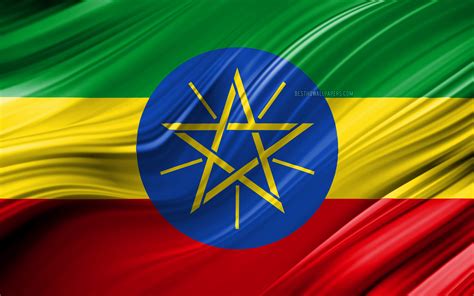
The Ethiopian flag is a horizontally striped green-yellow-red national flag with a central blue disk bearing a yellow star in outline. The flag’s width-to-length ratio is 1 to 2.
Let's delve into the colors and their symbolism:
- Green: Signifies labor, development, and fertility, and it also recalls the land of Ethiopia.
- Yellow: Symbolizes hope, justice, and equality, and it also stands for peace and hope.
- Red: Represents sacrifice for freedom and equality, and it is also symbolic of strength.
- Blue: The blue color in the Ethiopian flag represents peace.
The star is yellow on a blue disc which overlaps the green and red stripes. The star testifies to Ethiopia's bright future, while the yellow rays which it emits are equidistant and are said to represent the equality of all Ethiopians regardless of race, creed, or sex.
The emblem is intended to represent both the diversity and unity of the country. The sun's rays symbolize prosperity.
Read also: Planning Your Ethiopia Trip
Historical Evolution of the Ethiopian Flag
Ethiopian flags have a long history that predates that of many other African flags. The flag of Ethiopia has a design that can trace its heritage back to the days of the Ethiopian Empire, when Ethiopia managed to be one of the few African nations to resist European attempts to take power.
The three traditional colors (green, yellow and red) date back to Emperor Menelik (1889-1913) and were first used in a flag in 1897.
The first flag that represented Ethiopia as a unified nation was introduced during the reign of Emperor Tewodros II in the mid-19th century. It featured a simple design of three horizontal stripes: green at the top, yellow in the middle, and red at the bottom.
During the rule of Emperor Menelik II (1889-1913), the green-yellow-red tricolor remained, but a symbol known as the “Lion of Judah” was added to the center of the flag. This design continued to be used during subsequent imperial reigns, including that of Emperor Haile Selassie, who ruled from 1930 until 1974.
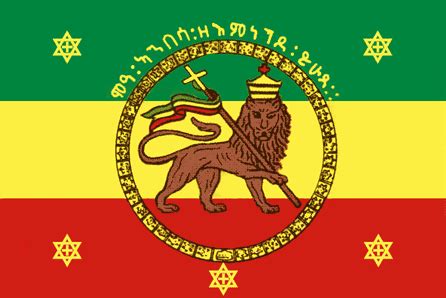
The first legal definition was given to the lion flag in November 1932, soon after the coronation of Emperor Haile Selassie. It remained in use until the overthrow of the empire in 1974, except for those years (1936-41) when the country was occupied by Italy.
Read also: CEO Opportunity: Development Bank of Ethiopia
Following the overthrow of Emperor Haile Selassie in 1974, Ethiopia entered a period of Marxist-Leninist rule under the Derg regime. During this time a new flag was adopted. The new flag featured a plain red field with a yellow emblem in the canton, consisting of a blue circle with a yellow-outlined star and rays emanating from it.
In 1975 a revolutionary government established a new coat of arms with socialist symbols. In 1987 President Mengistu Haile Mariam proclaimed the People’s Democratic Republic of Ethiopia under a flag with an even more openly Marxist design, including a red star at the top. The rebels who overthrew his regime in 1991 flew a simple green-yellow-red tricolour.
The current Ethiopian flag was adopted in 1996 following the overthrow of the Derg regime and the establishment of the Federal Democratic Republic of Ethiopia.
Prior to 1996, the plain green, yellow and red banner was commonly used as a civil flag. Although a number of different emblems were used by the government since 1974, flags with emblems were uncommonly used in public outside of government usage.
Interesting Fact: Ethiopia has traditionally identified its green-yellow-red national flag with the rainbow that, according to the book of Genesis in the Bible, God set in the heavens after the Flood.
Read also: Hotel Expansion in Ethiopia
Pennants of those three colours had been displayed before the first official flag was established by Emperor Menilek II on October 6, 1897; his flag bore on the yellow stripe the first letter of his name in Amharic script. Later the imperial coat of arms-consisting of the “Conquering Lion of Judah,” a lion holding a staff topped by a cross with ribbons in the three national colours-appeared on the flag when it was used for official purposes. The lion symbolically asserted that Emperor Menilek I had been the son of the Queen of Sheba and the biblical King Solomon.
The three primary colors of green, yellow and red are symbolic of richness and fertility of the land as well as hope, religious freedom and peace and the "sacrifice of our fathers, who spilled their blood in defence of Ethiopia". More importantly, these colors have played an extremely important part in influencing the colors of the flags of several other African countries and important movements such as Rastafarianism, Pan-Africanism, Black Lives Matter etc.
The Flag of Ethiopia consists of a green, yellow, and red tricolour with the national emblem, a golden pentagram on a blue disc, superimposed at the center. The colors of green, yellow and red were used for the flag of the Ethiopian Empire in 1914.
On 11 October 1897, a year after Ethiopia decisively defeated the Kingdom of Italy at the Battle of Adwa, emperor Menelik II ordered the three pennants combined in a rectangular tricolour from top to bottom of red, yellow, and green with the first letter of his own name (the Amharic letter "ም") on the central stripe. The letter of Menelik's name was removed from the flag after his death in 1913. The royal flag often featured the emblem of a Lion of Judah, a crowned lion carrying a cross centered in the banner's yellow midsection. The flag is understood to be a link between the Ethiopian Orthodox Tewahedo Church, the peoples, and the nation that was united. The processional cross carried by the lion was the former flag or symbol of Ethiopia, and has likewise been in use since at least the early 17th century.
)
Whilst red is currently featured at the bottom of the horizontal tricolour, it was on top until the mid-19th century. What the colors symbolise varies depending on point of view. Upon gaining independence from colonial rule, several newly-established countries in Africa adopted these three colors in homage to Ethiopia's resistance against foreign occupation.
The civil flag of Ethiopia until it was outlawed by the ruling coalition EPRDF in 2009. Used by diaspora at community events, by some government opposition groups, during Ethiopian Orthodox Christian holidays, and by transitional governments.
In recent years, the government of Ethiopia has taken a conscious effort to increase the usage of the flag with the emblem, which had been seen far less than the plain tricolour.
Color Codes of the Ethiopian Flag
Here are the common color codes for the Ethiopian flag:
| Color | HEX | RGB | CMYK | Pantone (PMS) | RAL | NCS |
|---|---|---|---|---|---|---|
| Green | #009B76 | 0, 155, 118 | 92, 15, 68, 4 | 347 C | 6029 | 5030-G30Y |
| Yellow | #FCD116 | 252, 209, 22 | 2, 17, 97, 0 | 109 C | 1021 | S 0580-Y10R |
| Red | #DA121A | 218, 18, 26 | 8, 100, 100, 0 | 186 C | 3028 | S 1085-R |
| Blue | #00529B | 0, 82, 155 | 100, 68, 0, 39 | 280 C | 5005 | 5040-R90B |
These are the suggested colors to be used for digital media. For print and spot color values, please refer to the information above.
Meaning of Ethiopian Flag
Popular articles:
tags: #Ethiopia
