Nigeria, often called the "Giant of Africa," boasts a vast land, diverse peoples and languages, a large population, and abundant natural resources. This West African nation is a patchwork of distinctive regions, including deserts, plains, swamps, mountains, and steamy jungles.
Nigeria is bounded by Benin to the west, Niger to the north, Cameroon to the east, and the Atlantic Ocean to the south. The country consists of several large plateaus separated by the valleys of the two major rivers, the Niger and the Benue, and their tributaries. The Niger Delta, the third-largest delta on Earth, is part of one of the largest river systems in the world. The highest mountain is Chappal Waddi (2,419 m (7,936 ft)) on the Mambilla Plateau in the southeast of the country near the border with Cameroon. Major lakes include two reservoirs, Oguta Lake and Kainji Lake, and Lake Chad in the northeast.
The wet season lasts from March to October, with winds from the southwest. The rest of the year is dry, with northeasterly harmattan winds blowing in from the Sahara.
The diverse landscape makes it ideal for a broad range of plants and animals. Many species live nowhere else on Earth.
Nigeria is home to 4 major ecosystems: rainforests, montane areas, savannahs, and grasslands.
Read also: Comprehensive Guide: Uganda Wildlife
Covering an estimated area of 923,764 sq. km, Nigeria has a recorded number of over 940 species of birds and 290 mammals in the different habitats.
To preserve wildlife and biodiversity, Nigeria, through the national government and conservational bodies, has set up about 7 national parks and reserves.
Hunting and human settlement are strictly prohibited in the national parks.
Nigeria's wildlife has taken a beating from the rampant hunting for bush meat and trophies.
Bush meat is a thriving business in Nigeria and generally West Africa. Large game animals such as elephants and lions have been found shot and their parts sold on these markets.
Read also: Ohio Wildlife Adventure
The most southerly part of the country is classified as "saltwater swamp" or "mangrove swamp" because the vegetation consists primarily of mangroves. The mangrove swamps of the Niger Delta are estimated to be the breeding ground of 40% of the fish caught offshore.
North of this is a freshwater swamp area containing salt-intolerant species such as the raffia palm, and north of this is rainforest. The rainforest zone stretches inland for about 270 km (170 mi) but its composition varies considerably, with rainfall decreasing from west to east and from south to north.
About one-half of Nigeria is classified as Guinea savanna in the Guinean forest-savanna mosaic ecoregion, characterized by scattered groups of low trees surrounded by tall grasses, with strips of gallery forest along the watercourses.
Here's a map detailing Nigeria’s National Parks and Reserves.
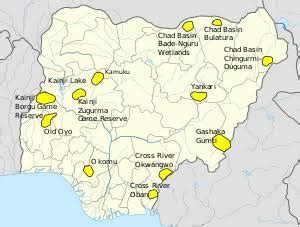
A large number of mammal species are found in Nigeria with its diverse habitats. These include lions, leopards, mongooses, hyenas, side-striped jackals, African elephants, African buffaloes, African manatees, rhinoceroses, antelopes, waterbuck, giraffes, warthogs, red river hogs, hippopotamuses, pangolins, aardvarks, western tree hyraxes, bushbabies, monkeys, baboons, western gorillas, chimpanzees, bats, shrews, mice, rats, squirrels, and gerbils.
Read also: Wildlife Adventure
About 940 species of bird have been recorded in Nigeria, five of them endemic to the country. Each geographical zone has its typical bird species, with few being found in both forest and savanna.
Here is a list of some of the animals in Nigeria.
- African elephant
- Hippopotamus
- Nile crocodile
- African buffalo
- Giraffe
- Pangolin
- Hyraxes
- Cuckoos
- Puff adders
- Hoopoes
Endangered Species in Nigeria
Unfortunately, many of these animals are facing threats of endangerment or extinction.
Nigeria is home to a variety of unique and rare animal species, many of which are found nowhere else in the world. Efforts are being made to protect these and other rare species in Nigeria through conservation initiatives and education campaigns.
Some endangered animals in Nigeria include:
- Cross River gorilla
- Nigerian-Cameroon chimpanzee
- African manatee
- African forest elephant
- Pangolin
At least 21 bird species may become extinct as a result of deforestation for agricultural benefits.
The Black-Crowned Crane: Nigeria's National Animal
The official national animal of Nigeria is not the eagle, but rather the black-crowned crane. This magnificent bird is found in grasslands and wetlands across Africa and is known for its striking appearance, with a black crown, white cheeks, and a bright red throat pouch.
The black-crowned crane is highly revered in Nigeria, where it is a symbol of beauty, grace, and strength. It is often depicted in art, textiles, and sculptures, and its image is used in many official government logos and emblems. The bird also plays an important role in traditional African folklore and is seen as a messenger of the gods. Despite being a national symbol, the black-crowned crane is considered endangered due to habitat loss and hunting.
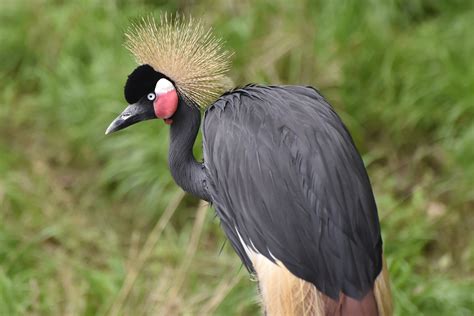
Two different species of black-crowned cranes live in Nigeria.
Where to See Wildlife in Nigeria
There are many types of animals in Nigeria. Therefore, you may want to spend some time exploring the different ecosystems to see the many unique animals and birds that exist in very few other places in the world.
Here are some locations where you can see wildlife in Nigeria:
- Cross River gorillas: Head to Afi Mountain Wildlife Sanctuary, the Mbe Mountains, or the Okwangwo Division of Cross River National Park to see Cross River gorillas in their natural habitat.
- Forest elephants: These elephants live at five different sites in Southern Nigeria, including the Omo Forests in Ogun State, the Okomu National Park, the Cross River National Park, Idanre Forests and Osse River Park, and on Andoni Island.
- Savannah Elephants: See savannah elephants at Yankari National Park and the Yankari Game Reserve, but there are less than 500 remaining in the wild.
- Nigeria-Cameroon chimpanzees: These are the most threatened and least distributed of all chimpanzees, and you can see these unique animals at Gashaka-Gumti National Park and Ngel Nyaki Forest Reserve.
- African lions: Hear the roar of African lions at Yankari and Kainji-lake national parks before they go extinct.
Potential Dangers
While most wild animals in Nigeria are perfectly safe, some dangers do lurk around the country, occasionally in the form of venomous snakes.
A few venomous species native to the country actually has a low chance of envenomation, such as stiletto snakes, mole vipers, and burrowing asps. Non-venomous snakes include members of the python family, such as the African Rock Python. File snakes and thread snakes are non-venomous species endemic to Nigeria.
Here is a list of some of the more dangerous animals in Nigeria:
- Puff adder
- Mosquitoes
- Dogs
- Hippopotamuses
Avian Diversity
Around 1,000 bird species make their home in Nigeria. Four of these species are endemic to the country and 31 are under threat of population decline. Endemic species include Ibadan malimbe, Anambra waxbill, Rock firefinch, and Jos Plateau indigo bird.
Supporting multitudes of beautiful and unique species across diverse environments, Nigeria is around 34th in the world for birdwatching, drawing in avian fanatics from all over the world.
Some of the locations where you can view the diverse bird species in Nigeria:
- Amurum Forest
- IITA Forest Reserve & Lake
- Yankari Game Reserve
- Afi Mountain Wildlife Sanctuary
In addition to the aforementioned areas, countless wildlife reserves and natural areas can be found in Nigeria, all bearing refuge to various avian visitors and residents.
The Fishing Industry
Nigerian people are dependent upon fish as their main source of protein, contributing to an extensive fishing industry. Along the coastline lie many fishing villages along with inland fishing in freshwater sources.
Because of the necessity of fishing for the survival of local people, fishing is under the regulation of state and federal governments. However, the country continues to lose an estimated $70 million each year to illegal fishing.
Nigeria is the largest producer of catfish in the world, a fish popular in both commercial and local markets. Crayfish, sardines, tilapia, and salmon are also common species to find in fish farms in Nigeria.
Sport fishing is also popular in the country with charter trips available off the coast.
When visiting any country it is important to follow its rules and regulations regarding hunting and fishing. Nigeria, in particular, depends upon profitable fishing which is crucial to their economy and survival.
Zoos and Conservation
There are many endangered animals in Nigeria. Some are threatened everywhere in the world while others are more locally threatened. Across the country, important work is being done to protect animals.
Along with many natural reserves and wildlife management areas, a handful of zoos exist in several Nigerian states.
- Audu Bako Zoo
- The National Children’s Park and Zoo
- Jos Wildlife Park
Many of these zoos and parks are highly involved in wildlife conservation and protection, working towards combatting threats to natural species and their habitats.
Nigeria has a diverse range of fish species, with over 250 freshwater and marine fish found in its rivers, lakes, and coastal waters. Other fish species found in Nigeria include bream, croaker, carp, eel, grouper, and tuna.
The fishing industry is an important source of livelihood for many Nigerians, both as a means of subsistence and as a commercial enterprise.
Nigeria has a rich marine life with countless extraordinary fish species roaming its lakes, rivers, and coastal waters.
Nigeria Strengthens Efforts to Conserve Endangered Species and Biodiversity
Popular articles:
tags: #Nigeria
