"I had a farm in Africa at the foot of the Ngong Hills" - is there any line more perfectly delivered than this one, especially when delivered by Meryl Streep? The 1985 film "Out of Africa," directed by Sydney Pollack, offers a complex portrayal of Baroness Karen von Blixen-Finecke, played by Meryl Streep, and her experiences running a coffee plantation in colonial Kenya.
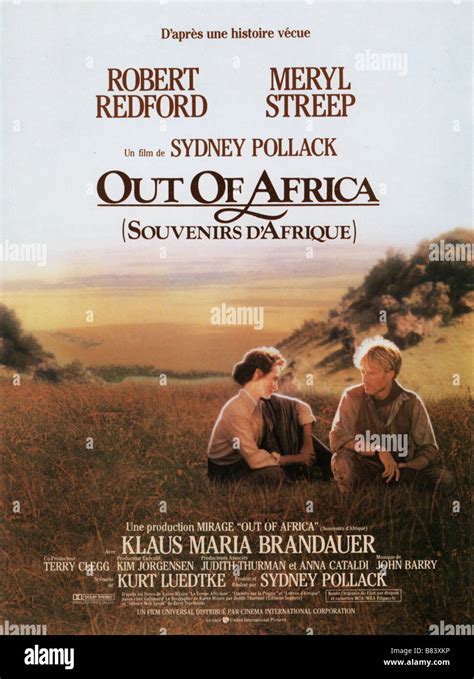
Movie poster for "Out of Africa"
The film is based on the memoir of Isak Dinesen, the pen-name of Baroness Karen von Blixen-Finecke, about her 17 years running a coffee plantation outside Nairobi in Kenya. The cinematography is truly breath-taking, especially in the scene with the biplane.
The Real Karen Blixen vs. The Film's Portrayal
It's important to note that the film is only ‘very loosely based on’ the book. Unlike the movie, the book is not a simple narrative. It has five sections in which she reflects on various facets of her time in Africa, but in no particular order and without a strong chronology. The title of the book and film, incidentally, is usually thought to be a reference to a phrase from the Roman author Pliny, Ex Africa semper aliquid novi, meaning “There’s always something new coming out of Africa”. The sentiment itself goes back to Ancient Greece.
Right off the bat, two major details of the film demonstrate that it is not closely based on the book. Bror comes off quite poorly in the film, as a womanizing cad who leeches off of Blixen financially. That may be true, but he was more than that. He was an extremely skilled hunter and was renowned for his abilities as a safari guide. Second, and rather more jarring, the book makes no clear mention of the romantic relationship between Blixen and Denys Finch Hatton, played of course by Robert Redford. She speaks adoringly of him, and says that he used her farm as a base for his various safaris and journeys, but discretely passes over whatever sexual elements their relationship had.
Read also: Karen Blixen's character analysis
The relevant dates for Blixen’s life in Africa are quite clear. She emigrated to Africa in 1914, where they purchased a coffee plantation. She returned to Europe in 1915 to seek treatment for the syphilis she contracted from Bror, and returned to Africa the next year. She met Finch Hatton in 1918, close to the end of the war, and soon after he completed his pilot training. In 1921, she and Bror separated and by 1922, she and Finch Hatton had begun sleeping together (although this could have started two years earlier). She divorced Bror in 1925, by which point she and Finch Hatton had been living together quite openly.
However, in typical Hollywood fashion, the chronology of the film is quite vague, confused, and compressed. Blixen arrives in Africa in 1913, a year too early, and meets Finch Hatton immediately. Then the war comes, and her interest in Finch Hatton slowly develops. Then she is diagnosed with syphilis and returns to Denmark. The war ends in 1918. When Kenya achieves full Crown Colony status in 1921, she and Finch Hatton kiss for the first time; the same evening, she tells Bror to move out. After this, the film loses all sense of time. Finch Hatton moves in, he takes her flying (having learned to fly the day before), they have sex for the first time, she and Bror divorce, and she and Finch Hatton quarrel about marrying and break up. Then the coffee factory burns down, she sells the farm, and Finch Hatton is killed.
The effect of all these chronological distortions is to give the viewer the sense that she turned to Finch Hatton romantically only after her marriage had irretrievably broken down because of Bror’s personality. The reality seems to have been more complex. By 1920, she was already deeply interested in Finch Hatton because she began to see herself in competition with Bror for Finch Hatton’s attention.
Challenges and Contradictions in Africa
The decision to farm coffee at Ngong was a bad one, because the climate was not really suitable for coffee. The farm took five years to mature and bear coffee, and while the Great War drove up the price of coffee, over the 1920s, the price of coffee dropped, so that the farm was never truly profitable.
In the film, the thing that triggers the sale of the farm is a fire that destroys the coffee factory. The coffee factory did burn down once, but much earlier, and was rebuilt. The scene where Kamante wakes her to tell her about the fire actually happened, but he was telling her about a brush fire, not a fire on her property.
Read also: Property Practitioners Regulatory Authority
By concentrating so tightly on the romance, the film glosses over another issue. The European community in Kenya in the 1920s and 30s was notoriously libertine. Blixen was not a member of the Happy Valley set, but when you watch the film you can see hints of the sexual goings-on in the period. At the start of the film she married Bror after a failed love affair with his brother.
"Out of Africa" is a great movie to look at, breathtakingly filmed on location. It is a movie with the courage to be about complex, sweeping emotions, and to use the star power of its actors without apology. Sydney Pollack has worked with Redford before - notably in another big-sky epic, “Jeremiah Johnson.” He understands the special, somewhat fragile mystique of his star, who has a tendency to seem overprotective of his own image. In the wrong hands, Redford can look narcissistic.
Karen Blixen: A Woman Defying Conventions
Character Analysis "You do like to change things," Denys says, as a smile stretches across his face. He's not kidding. Karen Blixen wasn't a woman who colored inside the lines. She fled the confines of European society, where women were expected to look pretty and keep quiet, for the space of Africa, where being eaten by a lion was an actual possibility. There, she established a school for the native Kikuyu people who lived on and worked her land. She ran an entire coffee plantation on her own at a time when it was still unusual for women to wear pants.
From the beginning, she's ready to break out of the role everyone wants to put her in. Except…she badly wants to be married. That's why she ends up with Bror. She was actually sleeping with his brother at the time, but he didn't love her back, and Bror offered her a way out of the big walls Denmark was forcing her to live behind. She was nothing if not practical, and knew an easy out when she saw it.
So, with a handshake, rather than a declaration of eternal love, she and Bror flee the conventional life and trade it for the freedom of early colonial Africa.
Read also: Amazing Facts About Africa
The Complexities of Colonialism and Personal Growth
Africa was very attractive to many wealthy Europeans around the time that Karen and Bror Blixen moved there. It was exotic, peaceful, and there were plenty of servants available to keep them in the lifestyle they were used to. Still, most of them didn't have a clue about what they were getting themselves into.
Much of the film is about Karen's coming to appreciate the unique landscape and culture of Africa, and her growing recognition that, white lady boss aside, she doesn't really own or control the land and the people. Even though she has a big house filled with all her imported stuff from home, she learns to feel part of the place.
The film has been criticized for romanticizing colonial rule in Kenya, as well as for a condescending attitude towards the locals. Sure, she goes to the local authorities to plead on their behalf when she has to sell her land, but she calls them "my Kikuyu."
Director Sydney Pollack struggled with how to convey the built-in racism of the colonial era in Africa. He didn't want to misrepresent it by giving the characters more modern, tolerant attitudes-that would be revising history-but he wanted to paint a respectful portrait of the African characters. Even though Karen and her European buddies assume the roles of the superiors, the servants and workers are portrayed as smart, capable, and pretty tolerant themselves.
Love and Loss: The Romantic Chess Game
It's a good thing Karen's so tough and resilient. Bror has a hard time keeping his fly zipped, for starters. Half of the movie encompasses only a year of their life together, but we see Bror in several implied affairs in little over an hour of movie. If her philandering husband weren't enough, Karen's left alone on the farm for long periods of time, a farm which turns out to be a coffee plantation instead of a dairy farm like Bror promised.
She's also pretty aware that men and women play by different rules, and she's not exactly happy about it. Still, she's definitely the sort to make lemonade out of lemons… until one of those lemons gives her syphilis and she has to go back to Denmark for treatment.
Even so, she's looking for that escape from all those typical expectations of women, and wants a man who gets it enough to be with her. She figures that might come in the shape of Denys Finch Hatton, the super-hunky big game hunter. The second half of the film turns into a game of romantic chess: she wants him, but while he's clearly into her, he has a thing about being tied down.
It doesn't work out. He won't commit, she throws him out, and just when it looks like he might change his mind and come back to her, he's killed in a plane crash. When Denys dies tragically, crashing his plane in Voi, there's truly nothing left for her in Kenya. Even then, she departs on her own terms.
Out Of Africa Behind the Scenes - An Eager Spirit (1985) - Meryl Streep, Robert Redford Movie HD
Karen chooses a spot in the hills to have Denys buried with a view of the countryside that they loved so well together, looking the lost romance right in the eye and taking it for what it is.
From Tragedy to Triumph: The Birth of Isak Dinesen
There's a saying: it doesn't matter that you are knocked down; it only matters that you get back up again. Perhaps "Out of Africa", and the life of Karen Blixen, still resonates for this reason. We might even have Denys to thank for encouraging her to write down stories.
Karen picked up the tattered remnants of a life denied and she published her first novel, Seven Gothic Tales, in 1934 under the name Isak Dinesen. As a writer, she crushed it: mixing autobiographical prose with the poetry of descriptive verse into some of the best literature of the 20th century that have lasted the ages.
In her writing-and in the film-we see her pain and her joy, but most importantly, we see her unique manner of standing back up under the weight of unspeakable loss and tragedy. Her strength in "Out of Africa" is a wall of determination in a world filled with loss.
The Film's Reception and Legacy
"Out of Africa" won as a historical epic, but the eighties were a lean time for the Oscars. Also nominated for best picture that year were Spielberg’s The Color Purple, Kiss of the Spider Woman, Prizzi’s Honor, and Witness. The film got a total of eleven nominations, taking home seven. Pollack beat out some of the greats including John Huston and Akira Kurosawa for the best director trophy. Its other five wins were for cinematography, art direction, adapted screenplay, sound, and original score.
The grandiose sets of colonial Kenya in the early part of the 20th century are pleasing to the eye, and Meryl Streep’s performance as Dutch Baroness, Karen Blixen, is on point.
Roger Ebert of the Chicago Sun-Times gave the film four stars out of four and called it "one of the great recent epic romances," adding, "What we have here is an old-fashioned, intelligent, thoughtful love story, told with enough care and attention that we really get involved in the passions among the characters."
However, Vincent Canby of The New York Times described it as "a big, physically elaborate but wispy movie" with Redford's character "a total cipher, and a charmless one at that. It's not Mr. Redford's fault. There's no role for him to act."
James Berardinelli wrote: "Watching "Out of Africa" a quarter of a century after its release, it's almost impossible to guess how it won the Oscar for Best Picture ... Sydney Pollack's direction is quietly competent and the acting by Meryl Streep and Robert Redford is top notch. But the lazy story is little more than an ordinary melodrama that simmers without ever reaching a boil.
When her farm was sold, it was bought by a developer who turned it into a subdivision of the sprawling Nairobi. He named the subdivision Karen in her honor.
The making of "Out of Africa" revived Kenyan interest in Blixen. Her house, which was quite dilapidated, was repaired, and the furniture used in the film was donated to establish a museum in the house.
You should read Isak Dinesen’s wonderful memoire, Out of Africa: and Shadows on the Grass. You just should. Judith Thurman’s Isak Dinesen: The Life of a Storyteller is a prize-winning biography of this important writer. You might also consider Linda Donelson’s Out of Isak Dinesen in Africa: Karen Blixen’s Untold Story. Finally, since I mentioned Beryl Markham, I would be remiss if I didn’t mention her West with the Night, which has been called one of the best memoires ever written.
Awards Won by "Out of Africa"
| Award | Category | Recipient |
|---|---|---|
| Academy Awards | Best Picture | Sydney Pollack |
| Academy Awards | Best Director | Sydney Pollack |
| Academy Awards | Best Cinematography | David Watkin |
| Academy Awards | Best Art Direction | Stephen Grimes, Josie MacAvin |
| Academy Awards | Best Adapted Screenplay | Kurt Luedtke |
| Academy Awards | Best Sound | (Various) |
| Academy Awards | Best Original Score | John Barry |
Popular articles:
tags: #Africa
