The Himba tribe, located in the north-western part of Namibia, in the Kunene Region (formerly Kaokoland) and on the other side of the Kunene River in southern Angola, is one of the most isolated and culturally rich tribes in the world. With a population of around 50,000, the Himba people have managed to preserve their traditional way of life while facing the challenges of modernity. Their unique customs and beliefs have attracted the attention of many travelers and researchers, making them a fascinating subject of study.
The Himba people of Namibia are a semi-nomadic tribe that have a unique culture that has been passed down for generations. The Himba are of Bantu heritage, and there are only approximately 50,000 Himba left. The Himba are, historically speaking, distant cousins of the Maasai and migrated to Southern Africa many centuries ago.
It is only when the Himba settled in the Kaokoland (meaning ‘faraway land’) region, that they had to adapt to the continual strife around them and become hunter gatherers, which is seen as a humiliating occupation for these pastoralists. Despite facing many challenges, such as drought and loss of land, the Himba people have managed to maintain their traditional way of life and culture. Their strong sense of community and tradition has helped them to survive and thrive in a changing world.
The Himba tribe is believed to have migrated to Namibia from Angola in the 16th century. They are closely related to other traditional groups, including the Herero and Tjimba tribes. The Himba people are semi-nomadic, which means they move from one place to another in search of water and grazing land for their livestock.
Visiting a Himba community is a truly unforgettable experience. You'll be welcomed into the heart of the tribe and have the opportunity to learn about their way of life and beliefs. You'll witness traditional practices such as the making of ochre body paint and jewelry, as well as the tending of their livestock. A visit to the Himba community should definitely be on your itinerary if you're planning a Namibian safari.
Read also: Himba Culture and Traditions
Namibia has some of the most beautiful landscapes in the world, in addition to the cultural experience. There is something for everyone, from the towering red sand dunes of Sossusvlei to the rugged terrain of Damaraland. A visit to the Himba people and Namibia is a must for those looking for a unique and authentic cultural experience, as well as the opportunity to explore some of the world's most breathtaking landscapes. On this luxury flying safari in Namibia and discover the captivating wilderness the country has to offer.
Explore the wildlife haven of Etosha National Park, where you can track the black and white rhino and learn about innovative conservation projects. Immerse yourself in the iconic red dunes of Sossusvlei and witness the breathtaking beauty of the Kaokoland. This exclusive safari also offers the opportunity to interact with the fascinating Himba tribes and stay in one of Africa's most unique accommodations, Shipwreck Lodge, surrounded by the magnificence of nature.
The Himba people have a rich cultural heritage that is deeply rooted in their traditions and customs. Their customs and beliefs serve as a reminder of the importance of cultural diversity and the need to preserve indigenous communities.
Discovering the Vibrant Culture of the Himba Tribe in Namibia |Women of the Himba Tribe | @mind-ful
Traditional Clothing and Adornments
Both the Himba men and women are accustomed to wearing traditional clothing that befits their living environment in the Kaokoland and the hot semi-arid climate of their area. In most occurrences this consists simply of skirt-like clothing made from calfskins and sheep skin or, increasingly, from more modern textiles, and occasionally sandals for footwear. Women's sandals are made from cows' skin while men's are made from old car tires. Women who have given birth wear a small backpack of skin attached to their traditional outfit.
The Himba people's traditional clothing is made from animal skins, such as sheepskin and goat hide. The clothing is often decorated with intricate beading and other decorative items. Another significant aspect of Himba culture is their body decoration. Both men and women adorn their bodies with different types of jewelry, including necklaces, earrings, and bracelets. These adornments are not just for aesthetic purposes but also hold symbolic meaning within their community.
Read also: Culture and Challenges for Nigerian Women
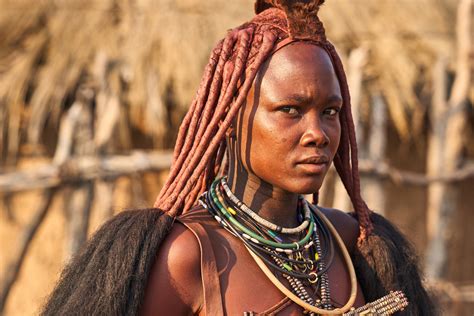
The Himbas’ characteristic red tinged skin comes from the mixture of ochre and animal fat called ‘otjize’ that they rub on their skins. The Himba people, especially women, are famous for covering themselves with otjize paste, a cosmetic mixture of butterfat and ochre pigment. Otjize cleanses the skin over long periods due to water scarcity and protects from the hot and dry climate of the Kaokoland, as well as from insect bites. One of the unique aspects of Himba culture is the use of "otjize", a mixture of butterfat and ochre powder, which is applied to the skin, hair, and clothing. The ochre powder gives the skin a reddish color and is said to have protective properties against the sun. The Himba's long-held use of the paste in this manner demonstrates a strong connection with the earth and a deep understanding of its properties that helps them survive in water-starved surroundings where others might have perished.
We have all likely seen images of Namibian Himba women, but most of us do not recognize them. For many, the women in desert regions, with skin and hair coated with red clay, are quite simply “African.” There is little attempt to go beyond that label, ignoring the simple fact that Africa is a vast continent. Also, geography unites Africans, not cultures. The homogeneity expected of inhabitants of the African continent is bewildering.
This cultural generalization is just one of the many thoughts that struck me when reading Binti. Like many, I had seen images of Himba women but had no idea about their identity.
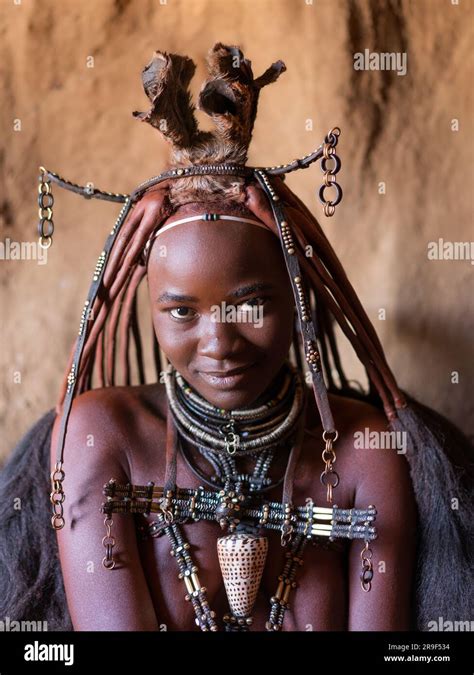
Himba Woman
Hairstyles
One of the most striking features of the Himba tribe is their traditional hairstyles, which hold great significance in their culture. Their traditional clothing and hairstyles are a striking feature that sets them apart from other tribes in the region. The Himba women are particularly known for their intricate hairstyles, which are adorned with beads and other decorative items. The hairstyles are a symbol of their status and are a way for women to express their individuality. The hairstyles are often braided and twisted into intricate patterns, which can take hours to complete.
Read also: Egyptian Society Through Cartoons
Himba women’s hairstyles change according to their age and marital status. Young girls usually have two braids with long strands of hair left loose at the front, symbolizing their innocence and carefree spirit. Upon marriage, women braid their hair into a single plait, which is then twisted into a large, adorned bun. The distinctive red color of the Himba women’s hair is achieved by mixing red ochre, butter, and animal fat. This mixture is used not only for its aesthetic value but also for its nourishing and protective properties.
In Himba culture, hairstyles also hold symbolic meanings. For example, unmarried women wear a headband made of cowrie shells, signifying that they are not yet ready for marriage.
From pubescence, boys continue to have one braided plait, while girls will have many otjize-textured hair plaits, some arranged to veil the girl's face. In daily practice the plaits are often tied together and held parted back from the face. Women who have been married for about a year or have had a child wear an ornate headpiece called the Erembe, sculptured from sheepskin, with many streams of braided hair coloured and put in shape with otjize paste. Unmarried young men continue to wear one braided plait extending to the rear of the head, while married men wear a cap or head-wrap and un-braided hair beneath. Widowed men will remove their cap or head-wrap and expose un-braided hair.
A young girl typically has two plaits of braided hair (ozondato), the form of which is decided by the clan she descended on her father’s side. A young girl who hasn’t reached puberty will display two braids at the front of her head. At puberty, the girl will wear braids up front, covering her face, letting males know she isn’t ready to marry. When a young woman is ready to marry, the same locks will be braided toward the back of the head, allowing potential suitors to see her face. First, the hair is lengthened with a straw woven together with the hair extensions to create dreadlocks, which are subsequently covered in otjize and finished with goat hair, added to give the distinct pom-pom look.
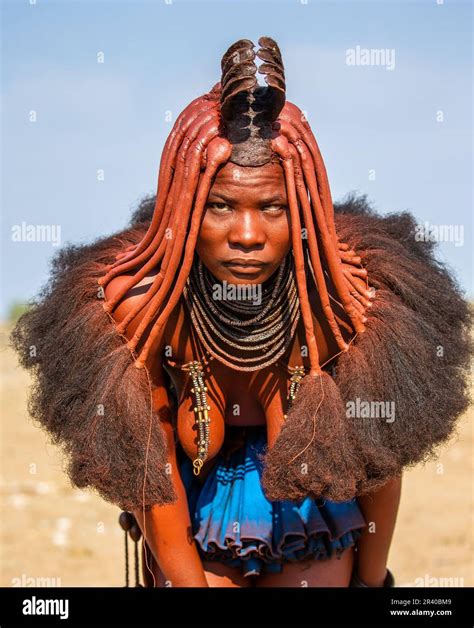
Himba Hairstyles
Social Structure and Traditions
Himba society is patriarchal, with a strong emphasis on the role of men as leaders and providers. However, women have a significant role in the society as well. They are responsible for the upbringing of children, the care of the home, and the production of craft goods.
The Himba people have a patriarchal social structure, with men being the head of the family and decision-makers. Women, on the other hand, are responsible for household chores, such as cooking, cleaning, and caring for the children. However, women also play a significant role in the economic activities of the tribe, such as milking and herding the livestock.
Marriage is an essential part of Himba culture, and there are specific customs and traditions associated with it. Traditionally, marriages in the Himba tribe are arranged by the elders of the community. When a man is ready to get married, he will seek the advice and approval of his parents and other elders. Polygamy is widely practiced in the Himba tribe, with men allowed to have multiple wives. The marriage ceremony in the Himba tribe is a significant event, involving various rituals and ceremonies. On the wedding day, the bride will be adorned with traditional jewelry and dressed in a formal attire made of animal skin.
The OvaHimba are polygamous, with the average Himba man being husband to two wives at the same time. They also practice early arranged marriages. Young Himba girls are married to male partners chosen by their fathers. This happens from the onset of puberty, which may mean that girls aged 10 or below are married off. Among the Himba people, it is customary as a rite of passage to circumcise boys before puberty. Upon marriage, a Himba boy is considered a man. Marriage among the OvaHimba involves transactions of cattle, which are the source of their economy. Bridewealth is involved in these transactions; this can be negotiable between the groom's family and the bride's father, depending on the relative poverty of the families involved. In order for the bride's family to accept the bridewealth, the cattle must appear of high quality.
Under bilateral descent, every tribe member belongs to two clans: one through the father (a patriclan, called oruzo) and another through the mother (a matriclan, called eanda). Himba clans are led by the eldest male in the clan. Sons live with their father's clan, and when daughters marry, they go to live with the clan of their husband. However, inheritance of wealth does not follow the patriclan but is determined by the matriclan, that is, a son does not inherit his father's cattle but his maternal uncle's instead. Along with the inheritance of wealth, moral obligations are also important within the tribal structure. When a person dies, the OvaHimba evaluate the care of those who are left behind, such as orphans and widows.
Belief System
The Himba people also have a unique belief system that centers around ancestor worship. They believe in a single god, Mukuru, who is responsible for the creation of the world and all living things. They also believe in the importance of ancestor spirits, who they believe can influence the living.
The Himba practice ancestor worship and maintain the sacred fire ‘okoruwo’, which is always kept burning and considered to be a vital link between the living and the dead. The Headman is responsible for all of the religious and traditional aspects of Himba life.
The Himba People are a monotheistic and they have a strong spiritual connection to nature and believe in a higher power known as Mukuru. They also believe in ancestral spirits that play a crucial role in their daily lives. Kalunga, the god of rain, is worshiped during periods of drought, while Himba women pray to the goddess of fertility for healthy pregnancies and safe childbirth.
The OvaHimba are a monotheistic people who worship the god Mukuru, as well as their clan's ancestors (ancestor reverence). Mukuru only blesses, while the ancestors can bless and curse. Each family has its own sacred ancestral fire, which is kept by the fire-keeper.
Daily Life
The Himba people's way of life is closely tied to their environment, and they have a deep understanding of the land and animals that surround them. They are skilled hunters and herders, and they rely on their livestock for food and income.
The OvaHimba are predominantly livestock farmers who breed fat-tailed sheep and goats, but count their wealth in the number of their cattle. They also grow and farm rain-fed crops such as maize and millet. Livestock are the major source of milk and meat for the OvaHimba. Their main diet is sour milk and maize porridge (oruhere ruomaere) and sometimes plain hard porridge only, due to milk and meat scarcity. Their diet is also supplemented by cornmeal, chicken eggs, wild herbs and honey.
Women and girls tend to perform more labor-intensive work than men and boys do, such as carrying water to the village, earthen plastering the mopane wood homes with a traditional mixture of red clay soil and cow manure binding agent, collecting firewood, attending to the calabash vines used for producing and ensuring a secure supply of soured milk, cooking and serving meals, as well as artisans making handicrafts, clothing and jewelry. The responsibility for milking the cows and goats also lies with the women and girls.
Members of a single extended family typically dwell in a homestead (onganda), a small family-village, consisting of a circular hamlet of huts and work shelters that surround an okuruwo (sacred ancestral fire) and a kraal for the sacred livestock. The OvaHimba use a heterogeneous pasture system that includes both rainy-season pastures and dry-season pastures.
Himba homes are simple huts made from earth and cattle dung. They contain little beyond a bed and a collection of useful implements such as kitchen tools. Women and men wear their traditional dress, loincloths, and sandals for a man, often with foot soles made from old car tires; women dress in goat-skinned skirts and jewelry.
Challenges and Preservation Efforts
As with many indigenous communities, the Himba tribe faces various challenges, including lack of resources, access to education, and displacement from their land. In recent years, there have been efforts to preserve their traditional way of life by promoting eco-tourism and cultural tourism in the region.
Despite the fact that a majority of OvaHimba live a distinct cultural lifestyle in their remote rural environment and homesteads, they are socially dynamic, and not all are isolated from the trends of local urban cultures. The OvaHimba coexist and interact with members of their country's other ethnic groups and the social trends of urban townsfolk. Because of the harsh desert climate in the region where they live and their seclusion from outside influences, the OvaHimba have managed to maintain and preserve much of their traditional lifestyle.
As such, the OvaHimba have worked with international activists to block a proposed hydroelectric dam along the Kunene River that would have flooded their ancestral lands. In 2011, when Namibia announced its new plan to build a dam in Orokawe, in the Baynes Mountains. The governments of Norway and Iceland funded mobile schools for Himba children, but since Namibia took them over in 2010, they have been converted to permanent schools and are no longer mobile.
In February 2012, traditional Himba chiefs issued two separate declarations to the African Union and to the OHCHR of the United Nations.The first, titled "Declaration of the most affected Ovahimba, Ovatwa, Ovatjimba and Ovazemba against the Orokawe Dam in the Baynes Mountains" outlines the objections from regional Himba chiefs and communities that reside near the Kunene River.
In September 2012, the United Nations special rapporteur on the Rights of Indigenous Peoples visited the OvaHimba and heard their concerns that they do not have recognized traditional authorities and that they are placed under the jurisdictions of chiefs of neighboring dominant tribes, who make decisions on behalf of the minority communities.
On March 25, 2013, over 1,000 Himba people marched in protest again, this time in Opuwo, against the ongoing human rights violations that they endure in Namibia. They expressed their frustration over the lack of recognition of their traditional chiefs as "Traditional Authorities" by the government; Namibia's plans to build the Orokawe dam in the Baynes Mountains at the Kunene River without consulting with the OvaHimba, who do not consent to the construction plans; culturally inappropriate education; the illegal fencing of parts of their traditional land; and their lack of property rights to the territory that they have lived upon for centuries.
In March 2014, OvaHimba from both countries, Angola and Namibia, marched again in protest against the dam's construction plans and against the government attempt to bribe their regional Himba chief.
Himba Protest
Himba Culture in Africanfuturism
Binti, an Africanfuturist novel, is a beautiful work that provides much-needed exposure to a culture not very well known. By pivoting around a Himba character, Okorafor sows interest in the reader by exploring the themes of race, culture, and discrimination.
While the Namibian Himba are semi-nomadic, the community in the book is sedentary with deep roots in their native lands. This sedentariness makes Binti an outsider when she travels off her home planet to study at Oomza Uni. As she boards the spaceship - called Third Fish, she encounters taunts and discriminatory comments from the lighter-skinned Khoush people.
The Khoush comment on Binti’s skin, clothes, jewelry, and otjize - the paste made of red clay and perfumed oils traditionally applied by the Himba on their skin and hair. It is understandable that Binti - the first of her people traveling to space, creates curiosity for the others. But this attitude of looking down upon cultures is reminiscent of the racism that the world struggles with today. Also, the Himba are technologically advanced people who invent the astrolabe - a commonplace to everyone on this futuristic earth. It is also a piece of compulsory equipment for those who travel. Their reputation and vast repository of knowledge are completely forgotten by the predominant Khoush who use their technology, even as they look down upon them.
The most obvious connection between the Himba in the book and the real-life Himba is the use of otjize. It also has similar purposes: protecting the wearer’s skin and hair from the harsh climates they inhabit. What is also similar to real life is the portrayal of the non-Himba perception of otjize. Ingrained notions equate mud and clay with dirt, and these ideas color their opinion of the Himba. A Khoush woman calls Binti’s people - dirt bathers and filthy - even claiming that the otjize on her body stinks while it is perfumed. The prejudiced flaw in these beliefs is exposed as soon as one invests just a little time researching the uses of otjize. It not only protects from the sun and extreme heat but also helps keep away troublesome mosquitos. It acts as a sort of make-up, beautifying women’s skin. This last function has only lately begun to garner acknowledgment by the Western world, as research reveals the inherent benefits for skin health in clay and ochre.
Popular articles:
tags: #Africa
