The lion (Panthera leo), an iconic animal renowned for its majestic appearance and often referred to as “the king of beasts”, possessing both beauty and strength. Lions, particularly male lions, have been an important symbol for thousands of years and appear as a theme in cultures across Europe, Asia, and Africa. They are commonly employed as an emblem in heraldry, and have been widely featured in sculpture and statuary to provide a sense of majesty and awe, especially on public buildings. We even use ‘lionize’ as a term of adulation, celebration and admiration.
Once widely distributed across most of Africa and parts of Europe and Asia, the lion is now confined to a number of isolated areas, amounting to only about 20% of its historic range. This dramatic reduction in habitat and population size highlights the urgent need for conservation efforts.
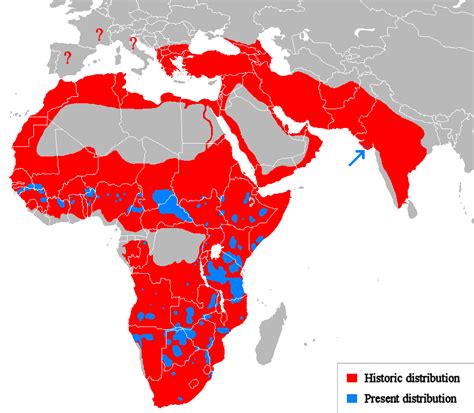
Lion historical range (orange) and current range (red).
Historical vs. Current Range
Lions once roamed throughout most of Africa, including in north African countries like Morocco and Egypt. They also lived in southeastern Europe, the Middle East, and Asia, from Greece, through Iraq and Iran, all the way to India. Today, that distribution has been dramatically reduced to just 7% of their historic range. Now, they mostly survive in sub-Saharan Africa, with one small population remaining in Gir National Park, India.
Pre-historic lions were even more widespread than the maximum range of modern lions shown on the map. The Eurasian cave lion (Panthera leo spelaea), evolved around 370,000 years ago and ranged widely across Europe and Asia. It is depicted in Paleolithic cave paintings, such as those found in the Lascaux and Chauvet Caves in France. It was somewhat larger than the modern lion. The American lion (Panthera leo atrox) evolved around 340,000 ago and ranged throughout much of the Americas from Yukon to Peru. It was about 25% larger than the modern lion. Both of these lions became extinct at the end of the Pleistocene Epoch, around 11,000 years ago. Paleontologists are divided on whether to classify these pre-historic lions as sub-species of modern lions or as separate species.
Read also: Unforgettable Safari at Lion Sands
Although lions have long since disappeared from Europe, according to reports by Ancient Greek writers such as Herodotus and Aristotle, they were common in Greece around 480 BCE. They became endangered around 300 BCE, and finally became extinct in Greece around 100 BCE. Lions feature heavily in Ancient Greek mythology and writings. These include the myth of the Nemean lion, a monstrous supernatural beast with armour-piercing claws and golden fur that could not be penetrated by mortals’ weapons. In the Middle East increased use of firearms in the nineteenth century led to the extinction of lions over most of the region. Lions survived in parts of Mesopotamia and Syria until the middle of the 19th century. By the late 19th century, they had been eradicated in Turkey. They survived much longer in Persia, where the last pride of five was hunted as recently as 1963.
By the late 19th century lions had disappeared from most of India, largely due to hunting. Today, the only place outside Africa where “wild” lions are found is in the Gir Forest in the Indian state of Gujarat, which was “protected” in 1900 by the Nawab of Junagadh, Sir Muhammad Rasul Khanji Babi, as his private hunting grounds. However, he did not put a stop to trophy hunting and at one point the lion population was reduced to around 20 animals and faced imminent extinction. His son, Muhammad Mahabat Khanji III, who succeeded him as Nawab, helped to forestall this by preserving vast tracts of the forest in order to provide the lions with a stable habitat. This led to the establishment of the Gir Forest National Park and Wildlife Sanctuary in 1965, which includes a number of areas where the lions are fully protected. As a result, the population has rebounded, reaching 359 in 2005, 411 in 2010 and 523 in 2015. The lions have now spread beyond the boundaries of the park where they seem to have reached a modus vivendi with local farmers many of whom are willing to tolerate the occasional loss of livestock in exchange for lions helping to curb the activities of crop-eating ungulates.
Population Decline
Around a hundred years ago there were likely as many as 200,000 lions living wild in Africa. Recent surveys put the number of wild lions at around 30,000 or even as low as 20,000. Around a third of African lions are thought have disappeared in the past 20 years. Unfortunately, African lion numbers have plummeted by over 40% in the last three generations due to loss of habitat and conflict with people, and they have been pushed out of 94% of their historical range. Three-quarters of African lion populations are in decline, and with only around 20,000 in the wild, they’re now officially classified as "Vulnerable" by the IUCN.
Lions once roamed across most of Africa, but are now only found in sub-Saharan Africa. They have disappeared from 12 sub-Saharan countries in recent decades, and eighty percent of remaining lions now live in the eastern or southern parts of the continent. Already near extinction in both western and central Africa, lions are on the losing side of a battle with locals, who view them as a threat to their livelihood.
Did you know? Lions can eat up to 40kg of meat in a single meal - around a quarter of their body weight. Their tongues have sharp-pointed rasps, called papillae, which are used to scrape meat off the bones.
Read also: Discover Wildlife
Subspecies of African Lions
Eight sub-species of modern lions have been identified, each with its own unique characteristics and geographic distribution:
- The Barbary Lion (Panthera leo leo): Once found across North Africa, the last recorded killing of a wild Barbary lion was in Morocco in 1920, although small groups may have survived into the 1960s. Some may remain in captivity, but it is not clear if these are true Barbaries.
- The West African Lion (Panthera leo senegalensis): This is found in isolated areas in west and central Africa and is considered to be critically endangered.
- The Masai Lion (Panthera leo massaica): This is found in East Africa, from Ethiopia and Kenya to Tanzania and Mozambique.
- The Congo Lion (Panthera leo azandica): This lion is found in northeastern parts of the Democratic Republic of the Congo and western parts of Uganda.
- The Southwest African Lion (Panthera leo bleyenberghi): This is among the largest subspecies of African lions and is found in Namibia, Angola, Zaire, western Zambia, western Zimbabwe and northern Botswana.
- The Transvaal Lion (Panthera leo krugeri): It is found in the Transvaal region of southeastern Africa, as well as in the Kalahari region.
- The Ethiopian Lion (Panthera leo roosevelti): This subspecies was recently identified through genetic analysis of captive lions in Ethiopia’s capital city of Addis Ababa They were part of a collection of the late Haile Selassie I of Ethiopia.
Threats to Lion Populations
Several factors contribute to the decline of lion populations across Africa:
- Retaliatory or Pre-emptive Attacks: According to the International Union for Conservation of Nature (IUCN), retaliatory or pre-emptive attacks against lions are the worst threats the species faces.
- Poaching: Poaching also poses a major threat since lion bone is used for medicinal purposes in countries such as Laos, Vietnam and China.
- Habitat Loss: Habitat loss is another significant threat. African lions have been reduced to living on only 8% of the land they once occupied, as their habitats are destroyed for agriculture and development. The human population of sub-Saharan Africa is expected to double by the year 2050, which will result in more conversion of habitat to agriculture, more hunting of the wild ungulates the lions depend upon for prey, and more instances of hungry lions attacking livestock and then being killed in retaliation.
- Snaring: Lions are also threatened by snares, which are indiscriminate killers. Though poachers who set snares usually aim to catch edible species, lions are often killed as bycatch.
- Legal Sport Hunting: Legal sport hunting of lions is also viewed by many conservation groups as a significant threat, although it is more controversial. Fish and Wildlife Service, are willing to tolerate it, but only if the revenues generated are used to support conservation efforts.
One of the reasons for the lion's decline in Africa is poisoning by local ranchers, whose livestock are frequently killed by lions, as well as other human-related conflicts. In 2018, for example, three lionesses and eight cubs were found dead near Hamukungu fishing village inside Queen Elizabeth National Park, and are suspected to have been poisoned. This is not a new phenomenon: Between May 2006 and July 2007, 15 lions were killed in the area in attacks blamed on landless herdsmen defending their cattle. In May 2010, five lions were killed in the park in another possible poisoning case.
Preliminary results of the WCS lion study in MFNP show that most mortality (71%) in adult lions is a result of human-related incidences, mainly snares and other traps. Efforts are ongoing to reduce illegal traps in the park.
Conservation Efforts in Uganda
Researchers from the New York-based Wildlife Conservation Society (WCS) and the University of St. Andrews in Scotland analyzed the density and population distribution of the African lion in three of Uganda's national parks. In two of the parks surveyed - Queen Elizabeth National Park and Murchison Falls National Park - lion populations have decreased by 30 and 60 percent, respectively, over the past 10 years. These significant declines can largely be attributed to accidental snaring in traps set for antelopes and conflict with communities neighboring the parks.
Read also: Controversies Surrounding Lion Hunting
Only in Kidepo Valley National Park, in the northeastern part of Uganda, was the number of lions found to be increasing, climbing from 58 to 132 in the last decade.
"Conservation areas, such as Queen Elizabeth and Murchison Falls, which formerly contained the highest biomass of mammals on Earth, depend on the delicate balance between predators and prey," James Deutsch, executive director of WCS' Africa Program, said in a statement. A lion injured by a snare wound across the chest in Murchison Falls National Park.
Reducing Illegal Traps
Using GIS and UWA ranger patrol data, snare-prone areas on the northern bank have been identified and zoned according to the type of traps. This was followed by a snare removal exercise in part of the 550 square km snare-prone area. So far over 2,000 wire snares, 60 spears and 15 elephant traps have been collected and 38 animals rescued from wire snares. Working with the UWA community conservation department, WCS trains and enables ex-poachers to retrieve wheel-traps at homes and in the park. The snare removal exercises need to continue as more than 80% of the snare zone has yet to be surveyed. In order to do this, WCS and UWA need more resources to pay for the basic supplies the removal team requires in order to conduct frequent snare removal exercises of the entire wire snare zone.
Construction of a Law Enforcement Center
It was imperative to bring Murchison's network of resources and capabilities together into a coordinated and well-managed system. Consequently, Murchison Falls Law Enforcement and Operations Centre (LEOC) was designed and built to integrate a Joint Operations Command Centre (JOCC), Armory, police station and cell block, guard room, storage facility, radio and internet towers, and operational assets and supplies.
The LEOC was designed and built to ensure the facility supports the UWA Law Enforcement and Security Strategy, integrating UWA Law Enforcement departments and inter-agency partnerships (e.g. with police). The LEOC is the first of its kind in Africa, integrating all relevant departments and providing for interagency requirements. Solar power facilities, including transmission to other ranger posts. Two Radio Towers and repeaters. Digital radio distribution to all ranger posts, marine ranger stations, cars, and patrols. Internet in Park HQ. Thuraya Satellite phone deployment to areas of little to no communications coverage.
Community Development Program
In 2019, 100 youth from the north of the park were selected to undertake vocational college courses. All of the youth came from different families, but each came from families who interact with the park - e.g. some from serious poaching communities, and others who experience high levels of elephant crop raiding. Courses included hydraform brick making, industrial painting, tractor operations, installation of water tanks and guttering, fencing, tree nursery set-up and tree management.
Lion conservation in private reserves with Simon Naylor
Carnivore & Scavenger Program
The UCF Carnivore & Scavenger Program is another important initiative that is integrated into the programmes UCF/UWA runs in Murchison. WCS is monitoring four lion prides on the northern back on Murchison Falls, looking at ranging and foraging habits using GPS and GSM enabled collars.
All satellite collars put on are registered on the EarthRanger system, so we can always monitor where the lions are and how they are using the habitat. If the collar stays static for a while, an alert will be made to deploy to see what has happened to the lion.
The team is currently tracking six lions that have left the park in the north - and into communities that may poison them. We know nothing about the home ranges of these lions - we need to learn, and fast.
In recent years conservation efforts have also resulted in an 11 percent growth in lion populations in Botswana, Namibia, South Africa and Zimbabwe.
Lion Behavior and Ecology
African lions (Panthera leo) are the largest and most imposing carnivore in Africa. They are the only truly social cats and have special cultural significance in most countries on the continent. In Uganda, lions enjoy a reputation as ‘king of the beasts’ and are popular symbols of royalty, strength and bravery.
Lions live in a ‘fission-fusion’ society which is a fairly rare social system where groups regularly come together and split. Males are thrown out of the group at the age of 3-4 years by the dominant male(s) and will try to take over a pride when they get to 7-10 years old. Males usually hold a pride for 2-3 years before being ousted by another male or coalition of males. Females generally stay in the same area as their mothers, occasionally moving to an adjacent pride when subadult, and rear a litter of cubs every two years.
Lions are top predators in their environment, whether that’s grasslands, desert or open woodland. It means they play a crucial role in keeping a healthy balance of numbers among other animals, especially herbivores like zebra and wildebeest - which in turn influences the condition of grasslands and forests.
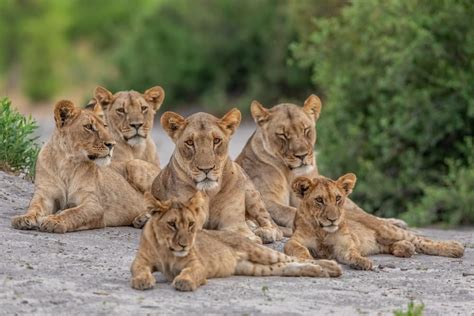
A lion pride in their natural habitat.
IUCN Red List Status
Southern and East African lions are listed as being Vulnerable according to the IUCN Red List, though the northern sub-species is considered to be Endangered. The LRF is the major funder of the African lion database.
| Category | Criteria | Description |
|---|---|---|
| Extinct (EX) | No reasonable doubt that the last individual has died. | Species no longer exists. |
| Extinct in the Wild (EW) | Known only to survive in captivity or as a naturalized population well outside its past range. | Species exists only in captivity. |
| Critically Endangered (CR) | Facing an extremely high risk of extinction in the wild. | Extremely high risk of extinction. |
| Endangered (EN) | Facing a very high risk of extinction in the wild. | Very high risk of extinction. |
| Vulnerable (VU) | Facing a high risk of extinction in the wild. | High risk of extinction. |
| Near Threatened (NT) | Close to qualifying for or is likely to qualify for a threatened category in the near future. | Likely to become threatened. |
| Least Concern (LC) | Does not qualify for a more at-risk category. Widespread and abundant taxa are included in this category. | Widespread and abundant. |
| Data Deficient (DD) | Inadequate information to make a direct, or indirect, assessment of its risk of extinction based on distribution and/or population status. | Insufficient data for assessment. |
| Not Evaluated (NE) | Has not yet been evaluated against the criteria. | Not yet assessed. |
Popular articles:
tags: #Africa
