The South African National Space Agency (SANSA) is the national space agency of South Africa, established to foster a national space program and coordinate existing space activities. Its headquarters are located in Pretoria. SANSA is managed by a chief executive officer, with its operations divided into four divisions: space operations, space science, Earth observation, and space engineering.

SANSA was founded in 2008 and commenced operations two years later. Before SANSA's establishment, South African space activities were overseen by the Council for Scientific and Industrial Research.
Early Space Activities and Programs
South Africa was home to a ground tracking station outside Johannesburg at Hartebeesthoek that played a role in NASA’s Apollo missions to the Moon in the 1960s. South African astronomy started an important journey two decades ago, when an initiative to attract and train future scientists in the field welcomed its first group of students under the National Astrophysics and Space Science Programme.
World class facilities have been established during this period, the most notable of which are the Southern African Large Telescope (SALT) and the MeerKAT radio telescope, a precursor to the international Square Kilometre Array. The National Astrophysics and Space Science Programme has played a vital role in ensuring that these facilities were not simply operated for the benefit of international partners.
South Africa’s astronomical history, spanning over 200 years, took a leap in 2000 with the cabinet’s approval for the construction of the Southern African Large Telescope. At the time, there were only about 40 astronomers with PhDs in the country. All were white. In 2001, astronomers began preparing for SALT and future projects. The Square Kilometre Array (SKA) emerged as an opportunity to host a big international radio telescope which could, among other things, investigate the beginnings of the Universe.
Read also: Property Practitioners Regulatory Authority
It became clear that universities needed to start co-operating if the landscape was to change. The country’s small astronomical community was spread across eight universities and two national facilities. A decision was taken to pool resources to establish the National Astrophysics and Space Science Programme. In this way, university lecturers and professionals at the national observatories could all contribute to teaching, while students could choose from a wide range of research projects.
This collaboration, including the organisation that became the South African National Space Agency, focused on guiding students through honours and master’s degrees. Bursaries covering basic needs were crucial to attract smart students from disadvantaged backgrounds. Funding from private foundations, particularly from the Ford Foundation, the Mellon Foundation and the Canon Collins Trust, added to very basic grants from the National Research Foundation. Today, the government’s Department of Science and Innovation is the primary funder. Grants are adequate, rather than generous.
By mid 2023, the National Astrophysics and Space Science Programme had produced 439 honours graduates and 215 master’s degrees in astrophysics and space science. Another 27 honours and 21 master’s students are set to graduate shortly, and similar numbers of students will complete their degrees in 2024.
A 2023 survey of programme graduates had 230 respondents, including 53 graduates from 19 other African countries. The largest numbers were from Uganda, Madagascar, Ethiopia, Kenya, Zambia and Sudan. The impact of the programme’s graduates extends far beyond academia. Many have embarked on successful careers across diverse sectors, including industry, education and government.
Graduates have participated in exciting astronomical discoveries. These include producing the first images of black holes with the Event Horizon Telescope, finding some of the most distant galaxies yet known, and using SALT to investigate the remnants of some very massive binary stars and unusual active black holes at great distances.
Read also: Discover Thula Thula
The work of many individuals has been recognised by national and international bodies and programme graduates are in key teaching and research posts in South African universities. Over 30 are employed in the astronomy national facilities and the national space agency, while some have prestigious positions elsewhere in the world.
Past and Future Satellite Programs
South Africa conducted space missions until 1974, when it transitioned into a radio astronomy observatory. In the 1980s, the country planned to launch its own military reconnaissance satellite, but the program was discontinued in 1994. Two satellites built by South Africa, SunSat and SumbandilaSat, were launched by the United States and Russia in 1999 and 2009, respectively.
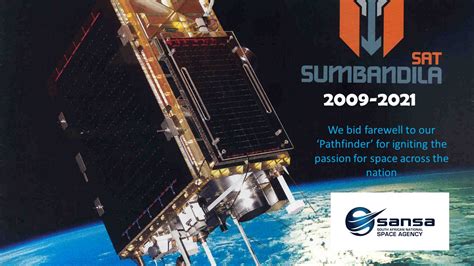
SANSA subsequently planned to develop other satellites based on SumbandilaSat and to work with the space agencies of other African countries, such as Nigeria and Kenya, on the development of Earth-observation satellites.
International Collaboration
Highlighting international cooperation, Badri Younes, deputy associate administrator and program manager for NASA’s Space Communications and Navigation (SCaN) program, joined with SANSA officials Nov. 8 in Matjiesfontein, South Africa, for a groundbreaking ceremony at the future site of a new Lunar Exploration Ground Sites (LEGS) antenna. Matjiesfontein will join future LEGS facilities at NASA’s White Sands Complex in Las Cruces, New Mexico and a still-to-be-determined location in Australia.
“Location, weather, and existing infrastructure make Matjiesfontein an ideal place to build an antenna,” said Younes. “We see this partnership as mutually beneficial,” said Dr. Phil Mjwara, DSI director general. “We are pleased that this project has reached a significant milestone with the support of the Department of Science and Innovation, as well as the partnership of NASA,” said Tiaan Strydom, SANSA acting commercial services executive. “The Moon brought our nations together 60 years ago,” said Younes.
Read also: Traditional South African Bread
South Africa’s National Space Agency (SANSA) and its US counterpart, NASA, collaborate closely on space programming. Having previously cooperated on the Apollo Space program, the two agencies renewed their lunar exploration partnership in November 2022, breaking ground on a new communications site at Matjiesfontein in the Western Cape province. The center will support NASA’s Artemis spacecraft.
Since 2016, South Africa has also been working on a legal framework for sharing satellite data with its BRICS partners in the first phase of an initiative that includes commercial space operations.
African Space Industry
Kenya sent its first nanosatellites into orbit in 2018. The satellite, which cost $320 million, was built in Russia and launched into space from the Baikonur Cosmodrome in Kazakhstan. The African space industry was valued at approximately $20 billion (€27 billion) in 2021. The continent is currently home to more than 270 NewSpace companies that are developing space technologies and offering space-based services, including in the fields of telecommunications, defense, security, shipping, aviation, mining, agriculture, environment, development, education and health.
Africa is the only continent that has not built a launch site for space rockets. But this time, they seem to be serious: Construction is about to start in Djibouti in the Horn of Africa. For this $1 billion spaceport - which will be built over a period of five years - Djibouti is relying on its ideal geographic location: Namely its proximity to the equator and its strategic location at the entrance to the Red Sea, which is one of the world's busiest trade routes.
The following table provides a summary of the upstream activities in each African country, including ground stations, launch systems and satellites, across the continent.
| Country | Upstream Activities |
|---|---|
| South Africa | Ground stations, launch systems, satellites |
| Egypt | Satellites |
| Algeria | Satellites |
| Nigeria | Satellites |
| Morocco | Satellites |
| Ethiopia | Satellites |
| Kenya | Satellites |
While space programmes in the USA, Europe, and some cases, Asia, may be directed towards defence and planetary exploration, Africa’s space identity is forged around the use of space technologies and infrastructures to solve socio-economic problems.
Here a short video about how space tech helps Africa:
