For a significant portion of ancient Egyptian history, there is scant evidence of footwear use. Hieroglyphs, the primary source of information from that era, depict individuals from all social strata, including pharaohs and common laborers, walking barefoot. While this doesn't definitively rule out the existence of foot protection, it suggests that footwear held minimal importance.
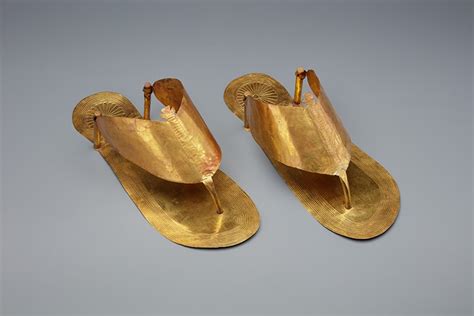
Historians remain uncertain about the reasons behind the introduction of sandals. However, around 1500 BCE, during the New Kingdom period, sandals began to appear in hieroglyphic representations of Egyptian life.
The Rise of Sandals
Egyptians developed advanced shoemaking skills for their time, crafting sandals from reeds or leather with designs remarkably similar to modern sandals. Though the design of Egyptian sandals was simple, the wealthy still found ways to adorn them. Some had buckles on the straps made of precious metals, while others had jewels embedded in the woven soles. Some sandal designs had turned up toes, probably to keep sand out of the shoe as the wearer walked.
There is very little evidence of the use of covered shoes in ancient Egypt. The few that have been found were woven from palm fiber and grass. Such shoes seem to have been prized possessions. Sometimes travelers removed their shoes to keep them safe while they were on the road and then put them on again at journey's end. Other shoes have been found in tombs, indicating that they were important items to the dead person.
Symbolism and Social Status
In ancient Egypt, some garments differentiated the social classes of those who wore them. Discovered in the tomb of the young pharaoh Tutankhamun were shoes made of gold, wood, ivory, and leather. In the last trip, taking into account the belief of life beyond, footwear conserved certain signs of rank.
Read also: Types of Ancient Egyptian Shoes
Sandals, gold leaf, New Kingdom, 1479-1425 BC. A gold guard or toecap, New Kingdom, 1479-1425 BC. Sandals and gold toes, 1479-1425 BC. Children’s leather sandals, New Kingdom, 1479-1458 BC. Pair of sandals from the tomb of Amenophis III, New Kingdom, 1479-1458 BC. Sandal maker, Rejmira Tomb, New Kingdom, 1504-1425 BC.
| Object | Period | Details |
|---|---|---|
| Sandals with Gold Leaf | New Kingdom (1479-1425 BC) | Indicates high status and wealth |
| Gold Guard or Toecap | New Kingdom (1479-1425 BC) | Protective and decorative element |
| Children’s Leather Sandals | New Kingdom (1479-1458 BC) | Smaller versions of adult sandals |
| Sandals from Amenophis III's Tomb | New Kingdom (1479-1458 BC) | Burial artifacts signifying status in the afterlife |
The exhibit focussed on the colour gold, a material that had special importance in Egyptian culture and religion. Egypt contains many gold mines even today, but the majority of their gold came from their southern neighbour: Nubia (modern Sudan). The modern name of Nubia, first used in the Roman Period, may in fact be related to the ancient Egyptian word for gold (nebu). Gold’s brilliance and permanence gave it solar associations and the Egyptians believed the flesh of the gods was made of this previous metal.
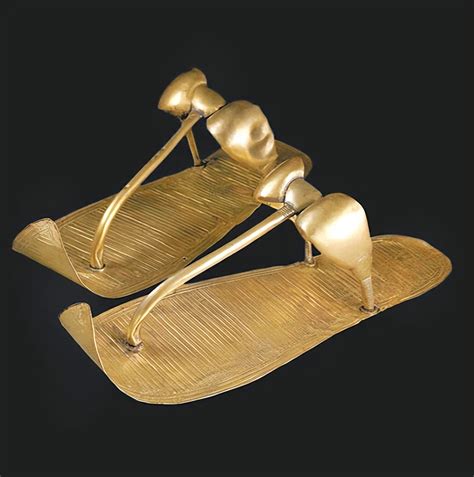
Sandals of Tutankhamun
Footwear in Museums
As you make your way north on St. George Street in downtown Toronto towards the similarly named subway station, you may notice a building shaped like a shoebox. The Bata Shoe Museum is dedicated to the cultural and creative uses of shoes throughout the world: from heels and seal fur boots to astronaut footwear. Their collection also includes sandals from ancient Egypt.
The story of the museum began with its founder, Sonja Bata. Married to Thomas Bata, who immigrated from the Czech Republic to Canada and came from a shoemaking family, she began collecting shoes in the 1940s. Sonja Bata’s collection grew along with her travels around the world, where she would acquire local styles. After many years, her private collection grew large enough to prompt the creation of the Bata Shoe Museum Foundation in 1979. The foundation sponsored research trips to far-away places to study the different styles of footwear among local populations. Finally, on May 6, 1995, the doors opened to a dedicated space known as the the Bata Shoe Museum.
Read also: The Skytop's Cultural Impact
The special exhibit’s theme took a look at the many golden shoes in the museum’s collection and explored their meanings and significance around the globe. The sole Egyptian object featured in the exhibit was a mummy case made of cartonnage (a material made from plastered papyrus and/or linen). The head shows the face of the deceased wearing an elaborate wig and a beard - its idealised elements do not reveal the person’s identity. These types of gilded cartonnage cases were an innovation of the Late Period (722-332 BC). When we look at the second part of the case, designed to house the feet of the mummy, two golden sandals are attached to the bottom. The soles of these sandals show depictions of two bound foreigners: a Nubian (right) and an Asiatic (left). This motif is not new, but originated in the royal ideology of the New Kingdom (1,539-1,077 BC). We find this motif, for example, on the famous sandals of Tutankhamun that show in stunning detail the subjugation the Egyptians expected of their foreign neighbours. During the Late Period, private individuals adopted this royal iconography for themselves.
After we visited the special exhibit, we then made our way to the permanent galleries: All About Shoes: Footwear Through the Ages. Objects from a vast array of cultures highlight the long history of footwear and shoemaking around the world over the last 4,500 years. Starting in antiquity, the displays contain a replica of the shoe that belonged to the famed Oetzi the Iceman. The first Egyptian object on display here is another cartonnage foot of a mummy case. Dating to Ptolemaic (332-30 BC) times, it has bands of decoration around the central motif of two feet. Bottom of a mummy case showing two feet wearing sandals (Obj. No. What the sole of such a sandal looked like is shown in another object to its right. There, well-preserved sandals made of basketry take on the shape that we have seen already above in the Roman mummy case. These sandals are simple and decorated, as well as missing their straps . These would have been attached in ancient times on the sides. Two sandals without straps made of basketry (Obj. No. The two examples already described were made for funerary purposes, meaning the deceased took them with him/her into the afterlife for eternal use. The sandals, however, reflect what Egyptians actually wore in their daily life. Mummy case with gilded sandals (Obj. No. In addition to these two objects is another fragmented mummy case worn by the deceased on their feet. The individual’s skin color was painted with a pale color and the golden sandal straps seem to connect to an anklet above. While the front is damaged, it bears similar geometric designs as the first one. Here, the golden strap was tied in a knot in the middle of the foot. With an entire focus on footwear, the Bata Shoe Museum traces well the history of global footwear through its collection. We were happy to see some Egyptian objects within its collection as well as the gilded cartonnage case that was highlighted as part of the special exhibit.
Most children and adults went barefoot and did not wear shoes very often. The type of shoe worn by an ancient Egyptian was a sandal. Sort of like the flip-flops you wear today. The ordinary person wore sandals made of straw. Wealthier people wore sandals made of leather, usually for special occasions. Here is a picture showing the difference. The small straw sandals on the left belong to children.
Sandals for a child and an adult. The Metropolitan Museum of Art.
During the winter, Egyptians wore socks to keep their feet warm. Here is a picture of a sock for a child’s left foot. It is not quite as old as the sandals pictured above. Its very colorful, isn’t it!The Evolution of 👢👢Footwear 👟👞: From Ancient Sandals to Modern Sneakers
Read also: Moroccan Raffia Shoe History
Popular articles:
tags: #Egypt
