Malaria is a life-threatening infectious disease caused by protozoan pathogens of the Plasmodium parasite. It's a mosquito-borne disease that spreads from person to person through the bite of an infected female Anopheles mosquito. Transmission to humans occurs through the bite of an infected female Anopheles mosquito. While there has been a significant reduction in the global burden of this disease, malaria remains a public health issue in South Africa. As such, the implementation of effective preventative measures and strategies, early diagnosis, and appropriate treatment regimens are crucial to reducing the malaria burden in South Africa. In 2023, around 263 million people were infected with malaria.
According to the latest World malaria report, there were 263 million cases of malaria in 2023 compared to 252 million cases in 2022. The estimated number of malaria deaths stood at 597 000 in 2023 compared to 600 000 in 2022.
Global Impact of Malaria
According to the World Health Organization (WHO), an estimated 247 million cases of malaria were recorded worldwide in 2021, with approximately 619 000 malaria deaths. In 2021, approximately half of the global population was at risk for malaria, with the World Health Organization (WHO) African region accounting for 95% of the global malaria burden. In addition, malaria was responsible for approximately 80% of deaths in children under the age of five on the WHO African continent. The WHO African Region continues to carry a disproportionately high share of the global malaria burden. In 2023 the Region was home to about 94% of all malaria cases and 95% of deaths. Children under 5 years of age accounted for about 76% of all malaria deaths in the Region. Over half of these deaths occurred in four countries: Nigeria (30.9%), the Democratic Republic of the Congo (11.3%), Niger (5.9%) and United Republic of Tanzania (4.3%).
It is important to note that while there are several different species of the Plasmodium parasite, only five are known to cause malaria in humans, namely, Plasmodium falciparum (P. falciparum), Plasmodium vivax (P. vivax), Plasmodium malariae (P. malariae), Plasmodium ovale (P. ovale), and Plasmodium knowlesi (P. knowlesi). Of these, P. falciparum is the most common in humans, with African countries, including South Africa, bearing the burden of P. falciparum infections, due to factors such as high transmission rates and socioeconomic challenges that limit their access to healthcare services. Of note, P. falciparum is widely considered to be the most virulent and potentially fatal if not promptly diagnosed and treated.
Malaria — Epidemiology, Treatment, and Prevention | NEJM
Malaria in South Africa
The initial signs of malaria can be mild and challenging to diagnose due to the signs and symptoms being similar to those of other illnesses. As such, this review will focus on the malaria burden in South Africa, a country located in the southernmost part of the African continent in sub-Saharan Africa, which has been stricken by at least two major outbreaks in the last two decades, resulting in numerous people succumbing to the disease. This review aims to contribute to the existing knowledge on malaria in South Africa, a region within sub-Saharan Africa, focusing on the epidemiology and life cycle of the malaria parasite as well as diagnostic approaches for detecting malaria. In addition, nonpharmacological and pharmacological interventions for treating and preventing malaria infections will also be discussed herein. By providing an in-depth understanding of the malaria burden in South Africa, this review aims to contribute to the ongoing global efforts in the fight against this devastating disease.
Read also: Fighting Malaria in Nigeria
The transmission of malaria is closely linked to specific ecological conditions. In South Africa, malaria infections are almost exclusively caused by P. falciparum.
For many years, annual malaria cases in South Africa were maintained below 10,000 due to vector control and case management efforts, with approximately 8750 reported cases in 1995. However, beginning in 1996, the effectiveness of insecticides and treatments decreased, leading to a sharp increase in malaria cases and deaths that peaked in 2000. During this period, malaria cases rose by 67% in 1996 and reached over 60 000 in 2000, resulting in more than 400 deaths. In 2000, when the first-line malaria drug sulphadoxine-pyrimethamine failed in South Africa, they reintroduced dichlorodiphenyltrichloroethane (DDT) for traditional structures while maintaining pyrethroids for modernised housing, using a mosaic strategy for resistance management. Artemisinin-containing combination treatment (ACT) was also introduced for malaria treatment. Despite global pressure against insecticide use, South Africa decided to bring back DDT to control the malaria epidemic.
Following the adoption of regional malaria control strategies in South Africa, Swaziland, and Mozambique, the implementation of ACTs and the introduction of an effective insecticide, national case numbers decreased to 26 506 in 2001. In 2007, South Africa reported fewer than 6000 malaria cases and subsequently started internal discussions on malaria elimination based on WHO recommendations. These statistics continued to fall to below 10 000 by 2011. In 2012, South Africa formally adopted an elimination strategy aiming to stop local malaria transmission within the country's borders by 2018.
South Africa has achieved an 87% reduction in malaria cases, with a decline from 64,622 cases in 2000 to 8,126 cases in 2020. Furthermore, the number of malaria-related deaths has decreased by 91% (459 deaths in 2000 to 38 deaths in 2020).
Over the past decades, South Africa has shown consistent improvement in reducing both the morbidity and mortality rates associated with malaria.
Read also: A Model for Africa: Egypt's Malaria Success

Global distribution of malaria risk.
Factors Influencing Malaria Transmission
Several factors influence the transmission of malaria in South Africa, including:
Vectors
The predominant vector for malaria in South Africa is the Anopheles mosquito, which uses stagnant water sources like ponds, puddles, and irrigated fields to create the ideal breeding ground. Given the variations in breeding preferences among Anopheles mosquitoes, their prevalence and distribution are influenced by numerous factors such as rainfall patterns, temperature, soil characteristics, vegetation cover, and human activities (e.g., deforestation and migration). Areas with higher vector populations are at a greater risk of malaria transmission, especially when combined with other factors such as the presence of infected individuals and inadequate protective measures.
Climate
Climatic factors heavily influence the distribution of malaria, such as high temperatures, humidity, and rainfall. Malaria occurs predominantly in tropical and subtropical areas where the Anopheles mosquito can survive and reproduce, allowing the malaria parasite to complete its life cycle in the mosquito. Elevated temperatures have been known to lead to the production of smaller and fecund mosquitoes. As temperatures rises, the maturation period for mosquitoes decreases, while their feeding frequency increases. Thus, temperature is crucial, as P. falciparum is unable to complete its growth cycle in the Anopheles mosquito at cooler temperatures below 20°C and as a result, cannot be transmitted. Transmission is favourable in warmer regions, with the highest transmission found in sub-Saharan Africa.
In South Africa, malaria transmission increases around the month of October, reaching a peak during the months of January and February, followed by a decline in May. Notably, South Africa's climate plays a significant role in shaping the malaria statistics in the country.
Read also: Comprehensive Kenya Malaria Guide
Human Behaviour
Human behaviour is also known to play a significant role in the transmission of malaria. Individuals living in malaria-endemic regions are often more exposed to mosquito bites due to various factors, including sleeping outdoors, going outdoors at night, inadequate utilisation of mosquito nets, or limited access to protective or preventative measures. Furthermore, population movement and travel, such as migration, tourism, and labour migration to malaria-endemic areas, can introduce or spread malaria parasites to previously unaffected regions. It is also important to consider the impact of human behaviour on the transmission of malaria in South Africa. During the peak transmission period, human behaviour and practices, such as travel, outdoor activities (such as farming), and the use of protective measures, play a crucial role in the spread of malaria.
In addition, compliance with protective measures, such as the use of insecticide-treated nets and antimalarial medication, can also influence the dynamics of malaria transmission. In addition, cultural practices and community perceptions in South Africa are also known to influence the spread of malaria. As such, it is important to consider targeted interventions and preventive measures to help mitigate malaria transmission.
Access to malaria diagnostic services in South Africa during the peak transmission period is particularly crucial for disease management. Healthcare facilities need to be well-equipped with diagnostic technologies and services. However, the South African healthcare system grapples with resource constraints, overburdened facilities, and a high burden of infectious diseases, such as human immunodeficiency virus (HIV)/acquired immunodeficiency syndrome (AIDS) and other noncommunicable diseases, placing additional pressure on an already strained healthcare system.
Socioeconomic Conditions
Socioeconomic conditions also influence malaria transmission in South Africa. These include a lack of education, limited access to healthcare and diagnostic services, inadequate housing facilities, and poverty. A delay in diagnosis and treatment often leads to the progression of infection and further transmission within the community. Socioeconomic factors majorly influence vulnerable populations, with children under the age of 5 in the sub-Saharan Africa region accounting for two-thirds of these deaths. It is estimated that 1% of children infected with P. falciparum will develop cerebral malaria.
Furthermore, it is well known that HIV increases an individual's susceptibility to malaria and that South Africa is among the many countries predominantly affected by the global HIV burden. Pregnant women are among the most vulnerable, and pregnancy-associated malaria may lead to severe malaria, cerebral malaria, anaemia, premature birth, abortions, low birthweight babies, congenital malaria, and a higher risk of coinfections.
From the authors' perspective, in a developing country like South Africa, people living in poverty or with poor access to healthcare may also be more likely to contract malaria due to factors such as inadequate housing, water, sanitation, hygiene, and limited access to effective antimalarial treatments.
Life Cycle of the Malaria Parasite
The life cycle of the malaria parasite is complex and involves two hosts, namely, human and vector (mosquito). A malaria-infected female Anopheles mosquito injects sporozoites into the human host during a blood meal. Sporozoites enter the liver and infect liver cells (hepatocytes). Sporozoites then mature into schizonts and rupture, releasing merozoites. Following replication in the liver, in a process known as exoerythrocytic schizogony, the parasites undergo asexual multiplication in the erythrocytes (erythrocytic schizogony). Merozoites infect and infiltrate RBCs (erythrocytes). The ring-stage trophozoites proliferate into mature trophozoites, which then mature into schizonts. The latter rupture and release merozoites, which infect erythrocytes. Some infected blood cells break the asexual multiplication cycle. Instead of replicating, the merozoites in these cells mature into gametocytes, which circulate in the bloodstream as sexual forms of the parasite.
When a mosquito bites an infected person, the gametocytes are ingested. The parasites' multiplication in the mosquito is known as the sporogonic cycle. While in the mosquito's stomach, the microgametes penetrate the macrogametes, generating zygotes. Zygotes become motile and elongated (ookinetes) that burrow through the mosquito's midgut wall and form oocysts on the outside surface. As the oocyst bursts, sporozoites are released into the body cavity and travel to the mosquito's salivary glands. When a mosquito bites another individual, the human infection cycle starts over again. The life cycle allows the malaria parasite to spread between the mosquito and human, making it difficult to control and eliminate the disease.
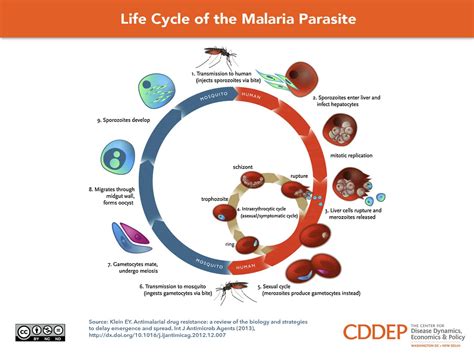
The malaria life cycle.
Symptoms of Malaria
The most common early symptoms of malaria are fever, headache and chills. Symptoms usually start within 10-15 days of getting bitten by an infected mosquito. Symptoms may be mild for some people, especially for those who have had a malaria infection before. Because some malaria symptoms are not specific, getting tested early is important. Some types of malaria can cause severe illness and death. Infants, children under 5 years, pregnant women, travellers and people with HIV or AIDS are at higher risk. Severe symptoms include:
- extreme tiredness and fatigue
- impaired consciousness
- multiple convulsions
- difficulty breathing
- dark or bloody urine
- jaundice (yellowing of the eyes and skin)
- abnormal bleeding.
People with severe symptoms should get emergency care right away. Getting treatment early for mild malaria can stop the infection from becoming severe. Malaria infection during pregnancy can also cause premature delivery or delivery of a baby with low birth weight.Classical symptoms are recurrent 6-10 hour attack cycles with three distinct stages, namely, a cold stage (rigors), a hot stage (fever up to 40 degrees Celsius (°C)), accompanied by headaches, vomiting, joint pain, and seizures in young children, and a perspiration stage (sweating, regaining thermal control, and fatigue).
Diagnosis of Malaria
Diagnosing malaria can be challenging due to an overlap in signs and symptoms that are also common to other diseases such as viral infections and enteric fever. A delay in the diagnosis and treatment of malaria is the leading cause of malaria deaths. Malaria must be diagnosed promptly to prevent complications from developing. A rapid and effective malaria diagnosis is essential to ease suffering and decrease community transmission. According to WHO guidelines, malaria must be diagnosed with a parasitological test, including light microscopy or immunochromatographic rapid diagnostic tests (RDTs), of which the results must be available. Despite microscopy being historically regarded as the gold standard...
Prevention and Control Strategies
While infection with P. falciparum continues to be the primary cause of malaria infections in South Africa, effective control measures have aided in successfully suppressing malaria infection rates until the early 1980s. As a result, South Africa established a monitoring system aimed at assessing the in vitro effectiveness of first-line treatments and gaining insights into the impact of drug resistance on the ever-changing malaria trends. In South Africa, efforts to control malaria focus on targeting these vectors with the use of measures like (i) indoor residual spraying (IRS), which involves applying an insecticide to the walls and surfaces of a house where the insecticide remains active for several months, effectively eliminating mosquitoes that come into contact with the treated areas, (ii) the distribution of insecticide-treated bed nets (ITNs) which creates a protective barrier against mosquitoes and aids in repelling and eliminating mosquitoes, and (iii) larviciding by destroying larval habitats. These measures aim to reduce vector populations, limit human-mosquito contact, and disrupt the cycle of transmission.
Vector control is a vital component of malaria control and elimination strategies as it is highly effective in preventing infection and reducing disease transmission. The 2 core interventions are insecticide-treated nets (ITNs) and indoor residual spraying (IRS). Progress in global malaria control is threatened by emerging resistance to insecticides among Anopheles mosquitoes. However, new generation nets, which provide better protection against malaria than pyrethroid-only nets, are becoming more widely available and represent an important tool in global efforts to combat malaria. Anopheles stephensi presents an added challenge for malaria control in Africa. Originally native to parts of south Asia and the Arabian Peninsula, the invasive mosquito species has been expanding its range over the last decade, with detections reported to date in eight African countries. An. stephensi thrives in urban settings, endures high temperatures and is resistant to many of the insecticides used in public health.
Preventive chemotherapy is the use of medicines, either alone or in combination, to prevent malaria infections and their consequences. It requires giving a full treatment course of an antimalarial medicine to vulnerable populations at designated time points during the period of greatest malarial risk, regardless of whether the recipients are infected with malaria. Preventive chemotherapy includes perennial malaria chemoprevention (PMC), seasonal malaria chemoprevention (SMC), intermittent preventive treatment of malaria in pregnancy (IPTp) and school-aged children (IPTsc), post-discharge malaria chemoprevention (PDMC) and mass drug administration (MDA). These safe and cost-effective strategies are intended to complement ongoing malaria control activities, including vector control measures, prompt diagnosis of suspected malaria, and treatment of confirmed cases with antimalarial medicines.
Malaria Treatment
Early diagnosis and treatment of malaria reduces disease, prevents deaths and contributes to reducing transmission. WHO recommends that all suspected cases of malaria be confirmed using parasite-based diagnostic testing (through either microscopy or a rapid diagnostic test). Malaria is a serious infection and always requires treatment with medicine. Multiple medicines are used to prevent and treat malaria. Doctors will choose one or more based on:
- the type of malaria
- whether a malaria parasite is resistant to a medicine
- the weight or age of the person infected with malaria
- whether the person is pregnant.
These are the most common medicines for malaria:
- Artemisinin-based combination therapy medicines are the most effective treatment for P. falciparum malaria.
- Chloroquine is recommended for treatment of infection with the P. vivax parasite only in places where it is still sensitive to this medicine.
- Primaquine should be added to the main treatment to prevent relapses of infection with the P. vivax and P. ovale parasites.
Most medicines used are in pill form. Some people may need to go to a health centre or hospital for injectable medicines.
Popular articles:
tags: #Africa
