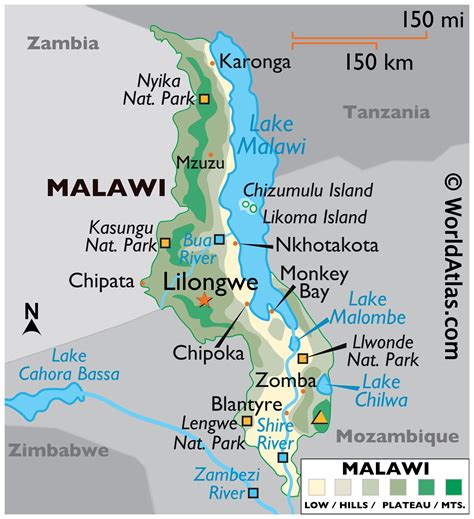
Malawi, officially the Republic of Malawi, is a landlocked country in Southeastern Africa. It is bordered by Zambia to the west, Tanzania to the north and northeast, and Mozambique to the east, south, and southwest.
Location of Malawi in Africa
Malawi is often referred to as the "Warm Heart of Africa." This nickname reflects the country’s reputation for the warmth and friendliness of its people, as well as its welcoming and hospitable nature. The nickname also underscores the country’s natural beauty and its inviting climate.
Malawi was named one of the top 10 countries to visit in the world in 2014 by Lonely Planet’s Best in Travel 2014.
Africa - A Journey Through Nature & Tradition | Documentary | Continents of the World Ep. 1
Geography and Climate
Malawi lies between latitudes 9° and 18°S, and longitudes 32° and 36°E. The Great Rift Valley runs through the country from north to south, and to the east of the valley lies Lake Malawi (also called Lake Nyasa), making up over three-quarters of Malawi's eastern boundary. The Shire River flows from the south end of the lake and joins the Zambezi River 400 kilometers (250 mi) farther south in Mozambique.
Read also: South-Central Africa Discovery
Lake Malawi is sometimes called the Calendar Lake as it is about 365 miles (587 km) long and 52 miles (84 km) wide.
In the mountainous sections of Malawi surrounding the Rift Valley, plateaus rise generally 914 to 1,219 meters (3,000 to 4,000 ft) above sea level, although some rise as high as 2,438 meters (8,000 ft) in the north. To the south of Lake Malawi lies the Shire Highlands, gently rolling land at approximately 914 meters (3,000 ft) above sea level.
Malawi's climate is hot in the low-lying areas in the south of the country and temperate in the northern highlands. The altitude moderates what would otherwise be an equatorial climate. Between November and April, the temperature is warm with equatorial rains and thunderstorms, with the storms reaching their peak severity in late March.
Flag of Malawi
History
The part of Africa now known as Malawi was settled around the 10th century by the Akafula, also known as the Abathwa. Later, the Bantu groups came and drove out the Akafula and formed various kingdoms such as the Maravi and Nkhamanga kingdoms, among others that flourished from the 16th century.
Read also: Interesting Ghana Facts
Soon after 1600, with the area mostly united under one native ruler, native tribesmen began encountering, trading with and making alliances with Portuguese traders and members of the military.
Missionary and explorer David Livingstone reached Lake Malawi (then Lake Nyasa) in 1859 and identified the Shire Highlands south of the lake as an area suitable for European settlement. As the result of Livingstone's visit, several Anglican and Presbyterian missions were established in the area in the 1860s and 1870s; the African Lakes Company Limited was established in 1878 to set up a trade and transport concern, a small mission and trading settlement were established at Blantyre in 1876, and a British Consul took up residence there in 1883.
In 1889, a British protectorate was proclaimed over the Shire Highlands, which was extended in 1891 to include the whole of present-day Malawi as the British Central Africa Protectorate. In 1907, the protectorate was renamed Nyasaland, a name it retained for the remainder of its time under British rule.
In 1944, the Nyasaland African Congress (NAC) was formed by the Africans of Nyasaland to promote local interests to the British government. In 1953, Britain linked Nyasaland with Northern and Southern Rhodesia in what was the Federation of Rhodesia and Nyasaland, often called the Central African Federation (CAF), for mainly political reasons.
An influential opponent of the CAF was Hastings Banda, a European-trained doctor working in Ghana who was persuaded to return to Nyasaland in 1958 to assist the nationalist cause. Banda was elected president of the NAC and worked to mobilize nationalist sentiment before being jailed by colonial authorities in 1959. In 1961, Banda's Malawi Congress Party (MCP) gained a majority in the Legislative Council elections, and Banda became Prime Minister in 1963.
Read also: About Kenya
The Federation was dissolved in 1963, and on 6 July 1964, Nyasaland became independent from British rule and renamed itself Malawi, and that is commemorated as the nation's Independence Day, a public holiday. Under a new constitution, Malawi became a republic with Banda as its first president. In 1971, Banda was declared president-for-life.
Under pressure for increased political freedom, Banda agreed to a referendum in 1993, where the populace voted for a multi-party democracy. In 1994 the first multi-party elections were held in Malawi, and Banda was defeated by Bakili Muluzi (a former Secretary General of the MCP and former Banda Cabinet Minister).
Government and Politics
Malawi gained independence on 6th July 1964 and was previously known as Nyasaland.
Malawi is a unitary presidential republic under the leadership of President Lazarus Chakwera. The current constitution was put into place on 18 May 1995. The branches of the government consist of executive, legislative, and judicial.
The executive includes a President who is both Head of State and Head of Government, first and second Vice Presidents, and the Cabinet of Malawi. The President and Vice President are elected together every five years.
The legislative branch consists of a unicameral National Assembly of 193 members who are elected every five years. The Malawi Congress Party is the ruling party together with several other parties in the Tonse Alliance led by Lazarus Chakwera while the Democratic Progressive Party is the main opposition party.
The independent judicial branch is based upon the English model and consists of a Supreme Court of Appeal, a High Court divided into three sections (general, constitutional, and commercial), an Industrial Relations Court and Magistrates Courts.
Malawi is composed of three regions (the Northern, Central, and Southern regions), which are divided into 28 districts, and further into approximately 250 traditional authorities and 110 administrative wards.
Economy and Infrastructure
Malawi is one of the world's least-developed countries. The economy is heavily based on agriculture, and it has a largely rural and growing population. Malawi has a low life expectancy and high infant mortality. HIV/AIDS is highly prevalent, which both reduces the labor force and requires increased government expenditures.
Malawi is predominantly an agricultural country. Agriculture plays a central role in the economy, accounting for around 30% of the country’s Gross Domestic Product (GDP) and employing about 80% of the population. Malawi’s main crops include maize, which is the staple food, as well as tobacco, tea, and sugarcane, which are key export commodities. Tobacco, in particular, is Malawi’s largest cash crop, contributing significantly to foreign exchange earnings.
Malawi has one of the lowest per capita incomes in the world. As of recent data, Malawi’s GDP per capita in nominal terms is approximately $600, placing it among the lowest globally.
Malawi’s main export is tobacco which accounts for 36.6 of total exports. Others include: gold (19%), tea (7.1%), ground nuts (6.85%), dried legumes (4.84%) and sugar (2.57%).
There are many investment barriers in Malawi, which the government has failed to address, including high service costs and poor infrastructure for power, water, and telecommunications.
Buses, lorries, and minibuses are the main modes of public transport in Malawi. Although there are some railway tracks, trains have not run in the country for many years - unlike many other African countries. Almost no rural Malawians own cars - most walk and use public transport, but some of the lucky ones have saved up to buy a bicycle.
Demographics and Culture
With a population of over 21 million, Malawi is largely an agricultural country and is making efforts to overcome decades of underdevelopment and the more recent impact of a growing HIV/AIDS problem. In 2023 almost 1,000,000 people were living with HIV/AIDS.
The official language in Malawi is English and Chewa.
Malawi has a diverse population that includes native peoples, Asians, and Europeans. Several languages are spoken, and there is an array of religious beliefs.
The people of Malawi have a rich history of traditional dance, mask carving and basketry.
Around 42% of girls in Malawi are married before the age of 18. Child marriage is driven by various factors, including poverty, traditional practices, and gender inequality. Many girls drop out of school when they marry, further limiting their future opportunities.
Tourism and Conservation
Malawi has not been a premier African tourist destination, but it is a real jewel for those who do visit. One of Malawi’s great attractions is its diversity of natural landscapes.
The country is about half the size of the United Kingdom or the size of Pennsylvania, and one fifth is covered by Lake Malawi which is home to more species of fish than any other lake in the world, including about 1,000 species of cichlids.
The vegetation along the lakeshore is lush and often supports local farming. The weather here is warm all year round. There are highland areas with cool fresh air and clear mountain streams and, as you climb, the deciduous forests give way to heaths, grassland, and evergreen forests.
For flower lovers, there is great diversity, including 400 orchid species. These are found at all altitudes around the country. There are also numerous everlasting flowers, proteas, aloes and gladioli with reedbeds and waterlilies in the Lower Shire lagoons.
Malawi is emerging as a developing safari destination, focusing on wildlife conservation and eco-tourism. In recent years, significant efforts have been made to restore wildlife populations and protect natural habitats. Malawi has worked with organizations like African Parks to relocate elephants from overpopulated areas to regions where their populations have dwindled.
UNESCO World Heritage Sites
Malawi has two sites listed on the UNESCO World Heritage List.
- Lake Malawi National Park: Located at the southern end of Lake Malawi, this site was designated a UNESCO World Heritage Site in 1984. The park is known for its exceptional biodiversity, particularly its rich variety of freshwater fish, including many endemic species of cichlids.
- Chongoni Rock-Art Area: This cultural site was inscribed as a UNESCO World Heritage Site in 2006. The Chongoni Rock-Art Area contains numerous rock shelters with ancient rock paintings created by the Batwa hunter-gatherers and later by agriculturalists. The art reflects the cultural traditions of these groups, spanning from the Stone Age to the present.
Key Facts About Malawi
| Category | Details |
|---|---|
| Government | Independent country since 6th July 1964 |
| Capital | Lilongwe |
| Major Languages | English and Chichewa (both official) |
| Major Religions | Christianity (80%) and Islam (20%) |
| Currency | Malawi kwacha (MWK) |
| Area | 118,480 km² (46,000 miles²) |
| Population (2023) | 21.1 million |
| Average Life Expectancy at Birth (2022) | 63 years |
| Average Annual Income (2024) | US$480 per year |
Popular articles:
tags: #Africa
