Ghana, the birthplace of the Pan-African movement, is a country celebrated for its rich cultural heritage, hospitable people, and stable democracy. Formerly known as ‘Gold Coast’, Ghana has interesting things to offer to the world. We're commemorating this Founders Day holiday with a list of fun and intriguing facts about our homeland Ghana.
While many are aware that Ghana was the first sub-Saharan African country to gain independence on 6th March 1957; that Ghana is renowned for its vibrant and intricately patterned native kente cloth; that Ghana is a leading global exporter of gold, shea butter, and cocoa, and that Ghana recognized as one of the safest countries in Africa, there are numerous lesser-known facts about Ghana that are equally fascinating.
Here are some mind-blowing facts about Ghana that are sure to intrigue and fascinate you.
Ghana is a multi-ethnic country with diverse linguistic and religious groups;[14] while the Akan are the largest ethnic group, they constitute a plurality. Most Ghanaians are Christians (71.3%); almost a fifth are Muslims; a tenth practice traditional faiths or report no religion.[3]
1. The Origin of "Ghana" and "Accra"
"GHANA" MEANS "WARRIOR KING"
Read also: South-Central Africa Discovery
Long before colonial times, West Africa was home to several powerful and prosperous kingdoms, including the Songhai Empire, the Kingdom of Mali (1226 - 1670), Ashanti Empire (1670 - 1901), the Fulani Kingdom (1808 - 1903) and more. The name “Ghana” was derived from the Soninke people of the ancient Ghana Empire that was located in West Africa from about 650 C.E to 1235 C.E (present-day Mali and Mauritania).
"Ghana" means “warrior king” in the Soninke language. This translation reflects the country’s historical and cultural heritage, emphasizing strength and resilience. The name was a powerful reminder of their shared heritage and the legacy of the ancient empire that once thrived in the wider region. The name “Ghana” was adopted when the country gained independence in 1957 to reflect the historical strength and resilience of the people since the Ghana Empire was known for its strong military and trade relations with North Africa and the Mediterranean world.
"ACCRA" MEANS "ANTS" IN AKAN
When the Portuguese first settled on the coast of present-day Ghana in 1482, the area now known as Accra was inhabited by several Ga villages, ruled from Ayaso (Ayawaso), located 24 km away. Between 1650 and 1680, Europeans constructed three fortified trading posts in the area: the English Fort James, the Dutch Fort Crevecoeur, and the Danish Christiansborg Castle.
During this time, Ayaso was destroyed in a tribal war, and its population, along with those from other major Ga towns on the Accra plains, moved to the coast to engage in profitable trade with Europeans. This migration led to the formation of three coastal villages-Osu (Christiansborg), Dutch Accra (later Ussher Town), and James Town-which became the foundation of modern Accra.
Read also: Discover Malawi
The name "Accra" is derived from the Akan word "nkran," referring to the anthills sprouted up in the abandoned outskirts of Ayaso and also the black ants common in the area. It eventually came to denote the inhabitants. Accra developed into a prosperous trading center and became the capital of the British Gold Coast colony in 1877.
2. The Ghanaian Cedi Has Been Modified 7 Times
HISTORY AND ORIGIN OF THE CEDI
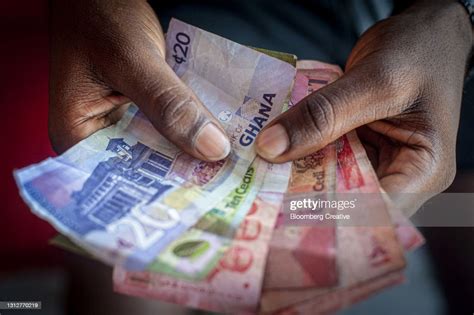
The name “cedi” was derived from the local word “sedie” meaning cowrie, a shell that was widely utilized as currency in the later part of the 19th Century. Before the Ghana Cedi was implemented as the local currency in 1965, Ghana and other ECOWAS nations used the West African Pound (which constituted of shillings and pence). After Independence, the Bank of Ghana took over from the West African Currency Board (WACB) and issued a new currency of Ghana pounds, shillings and pence in July 1958.
THE INTRODUCTION OF THE CEDI
In July 1965, Cedi notes with Nkrumah's portrait and Pesewa coins were introduced to replace the Ghana Pounds as Ghana left the British colonial monetary system, but that was only the beginning of the Cedi. After the overthrow of the CPP government in 1966, the military government replaced the existing currency notes which bore Nkrumah’s portrait, to notes without his portrait, and the New Cedi was introduced in February 1967.
Read also: About Kenya
This new Cedi design did not last long and was changed to reflect Ghanaian culture and colours only 5 years later after the military coup under Prime Minister Busua. Following another military coup under Hilla Limann just 7 years later, the new government replaced the Cedi notes again in March 1979.
THE FIRST CEDI OF THE 4TH REPUBLIC
The last military coup in Ghana's history took place 1981. This coup led by John Jerry Rawlings toppled the 3rd Republic and ushered in the 4th. Following the trend of the other coups, this new government also introduced new Cedi notes in 1983 to replace the old ones at a discount of 30% for amounts up to ¢5,000 and 50% for amounts in excess of ¢5,000.
With the instability and struggle for power, inflation set in and higher currency denominations were gradually added to this existing currency between 1986 and 2002.
THE RE-DENOMINATION OF THE CEDI
Till 1982, the highest denomination of the Cedi was the ¢50 note. With instability and inflation of the new currency, higher denominations of ¢500, ¢1000, ¢2000, ¢5000, ¢10,000 and ¢20,000 were introduced. The introduction of the denominations of ¢1000 and larger from 1991, gradually phased out all prior Cedi denominations from 1983.
By 2007, the lowest Cedi note in circulation was ¢1000 so in July 2007, the government re-denominated the cedi such that ¢10,000 = GH¢1, ¢20,000 = GH¢2 etc. So in 2007 the new GH¢1, GH¢2, GH¢5, GH¢10, GH¢20 and GH¢50 notes were introduced. With the rising national debt and soaring levels of inflation, GH¢100 and GH¢200 notes were introduced on 29th November 2019.
3. Ghana Has Not Had Political Unrest Since 1981
After independence in 1957, Prime Minister Kwame Nkrumah had The National Flag of Ghana designed by Mrs. Theodosia Salome Okoh to replace the flag of the United Kingdom, and declared the nation a Republic and a one party system. This caused tension and led to the military overthrow of Nkrumah and his Republic of Ghana in 1966.
A similar military coup will take place under Prime Minister Busia just 6 years later, and again in 1979 under Hilla Limann, and one more time in 1981 when the PNDC led by John Jerry Rawlings toppled the 3rd Republic in a military Coup, creating the 4th Republic of Ghana. However, Ghana is still considered one of Africa's safest and most stable nations because that was the last incidence of widespread civil unrest in Ghana till date.
In 1992, democratic elections with term limits were instituted in Ghana for the first time. After J. J. Rawlings served his 2 consecutive terms till 2000, the first peaceful political transition took place in 2001 with President John Agyekum Kuffour taking over as Ghana's newly elected president, guiding Ghana through immense economic growth until 2008.
4. World Heritage Sites: There Are Over 30 Slave Forts & Castles in Ghana
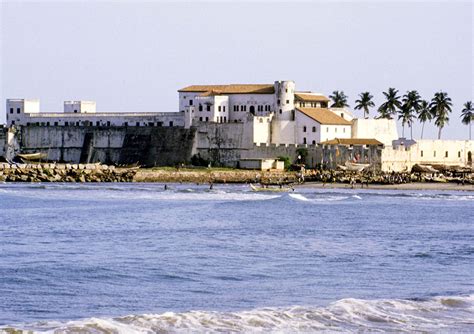
Throughout Ghana's history, several events have occurred that led to the creation and destruction of symbols and monuments representing those events. For example, over 40 forts and castles were built along the coast of Ghana during the slave trade. About 75% of them remain in some form or another, yet very few are well known and recognized. In fact, unlike how most European monuments are listed individually within their cities, UNESCO lists all these as 1 site.
Consequently, there are only 2 vaguely categorized heritage sites from Ghana:
- The Forts and Castles along the coast of Ghana from Beyin in the Western Region to Keta in the Volta Region (which spans over 537 kilometers / 334 mi),
- The ten remaining Asante Traditional Buildings in and around Kumasi, in the Ashanti Region (which is about 9,417 mi² in area).
THE FORTS AND CASTLES
Within the generalized collection and wide area covered by this category, there are over 30 individual monuments. In order of when they were built, these sites include:
| Name | Year Built |
|---|---|
| Elmina Castle | 1482 |
| Fort San Antonio in Axim | 1515 |
| Forte São Sebastião de Xama in Shama | 1523 |
| Fort Saint Jago in Elmina | 1555 |
| The ruins of Fort Nassau at Mouri | 1612 |
| Fort Amsterdam in Abandzi | 1638 |
| The ruins of the Little Fort at Anomabo | 1640 |
| Fort Orange in Sekondi | 1642 |
| Ussher Fort in Jamestown | 1649 |
| Cape Coast Castle | 1653 |
| Fort Batenstein at Butre | 1656 |
| Osu Castle | 1659 |
| English Komenda Fort | 1663 |
| James Fort in Jamestown | 1673 |
| The ruins of Fort Vredenburg at the Dutch Komenda | 1682 |
| Fort Metal Cross | 1683 |
| Fort Groß Fredericksborg in Princesstown | 1683 |
| The ruins of Fort Dorothea in Akwida | 1685 |
| Fort Patience in Apam | 1697 |
| The remains of Fort Royal in Amanful | 1699 |
| Fort Good Hope in Senya Beraku | 1715 |
| Vestiges of The English Fort at Tantumquery in Otuam | 1722 |
| The ruins of Fort Fredensborg at Old Ningo | 1734 |
| The Ruins of Fort Vernon at Prampram | 1742 |
| Fort William in Cape Coast | 1753 |
| Fort Apollonia in Beyin | 1768 |
| The ruins of Fort Kongenstein in Ada | 1783 |
| Fort Prinzensten at Keta | 1784 |
| Vestiges of the Danish Fort Augustaborg in Teshie | 1787 |
| Fort Victoria in Usshertown | 1821 |
| Fort McCarthy in Cape Coast | 1882 |
These fortified trading posts, founded between 1482 and 1882, were built and occupied at different times by merchants from Portugal, Spain, Denmark, Sweden, Holland, Germany (Prussia) and Great Britain. Many of the forts underwent various transformations during their successive use by the European colonizers. Though over 40 forts and castles were built and rebuilt, the above are all that remain.
THE REMAINS OF THE ASHANTI EMPIRE
The second cluster of monuments that are recognized collectively as a single heritage site are The remaining10 Traditional buildings of the Asante Empire. The buildings are located in the north-east of present-day Kumasi. The dwellings are made of earth, wood and straw.
These buildings served as fetish houses and shrines during the 18th and 19th centuries, during the golden age of the Ashanti Empire. During the British occupation of the area from 1806 to 1901, most Asante buildings of the period were destroyed. These are the last material remains of the great Asante Empire.
Ghana has 6 other tentative pending sites from 2000:
- Mole National Park -1958
- Tenzug - Tallensi shrine and settlements - 1600s
- Navrongo Catholic Cathedral -1906
- Nzulezu Stilt Settlement - 1400s
- Trade Pilgrimage Routes of North-Western Ghana - 1st Century AD
- Kakum National Park (Assin Attandanso Reserve) - 1992
5. There Are Over 80 Languages Spoken in Ghana
Ghana is a multicultural society with a rich diversity of more than 100 ethnic groups, over 80 languages, and a number religions. Christianity is the most prevalent religion, followed by Islam, traditional religions, and other faiths.
The major ethnic groups include the Akan, Mole-Dagbon, Ewe, and Ga-Dangme. This diversity contributes to the country's rich cultural tapestry and vibrant festivals. Though many languages are spoken within Ghana, Akan is the most widely spoken; however, English is the official language used in government and education.
There are other unspoken local modes of communication like Talking Drums and Ghanaian Sign Language. Traditional Ghanaians are also able to communicate over long distances with Talking Drums which involves drumming patterns that mimic the tone and rhythm of spoken language. This is how messages were passed from town to town between the 15th Century and the 19th Century.
Meanwhile Ghanaian Sign Language is a distinct and vibrant language that incorporates elements of American Sign Language, British Sign Language, and indigenous Ghanaian signs.
6. Ghana's National and Traditional Symbols
GHANA'S NATIONAL ANIMAL
The National animal of Ghana is Tawny Eagle also known as the Golden Eagle. This eagle symbolizes pride and strength, and is visible on our coat of arms. This feature in the national coat of arms means the Tawny Eagle is also featured our national currency, national passports and within all the logos of our governmental institutions and their official buildings.
GHANA'S COAT OF ARMS
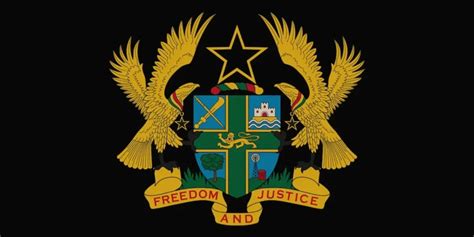
The upper left of the shield depicts the sword and staff used by chiefs and linguists at ceremonies. It is a symbol for the traditional authority of Ghana.
The upper right illustrates the Osu Castle (Built in 1660) which served as the Seat of Government till 2007 and symbolizes the national government.
The bottom left shows a cacao tree, producer of one of Ghana's premier exports and embodies the agricultural wealth of Ghana.
The bottom right shows a gold mine, which stands for the richness of industrial minerals and natural resources in Ghana.
A gold lion centered on a green St George’s Cross with gold fimbriation on the field of blue, represents the continuing link between Ghana and the Commonwealth of Nations.
The crest is a Black star of Africa with gold outline, upon a torse in the national colours. The black star also appears in Ghana's national flag and on Ghana's Black Star Monument represents African freedom and unity. It was adopted from the Black Star Line, a shipping line established by Marcus Garvey to promote trade and unity among people of African descent.
Supporting the shield are two golden Tawny eagles, with the Order of the Star of Ghana suspended from their necks. The compartment upon which the supporters stand is composed of a grassy field, under which a scroll bears the national motto of Ghana: Freedom and Justice.
GHANA'S NATIONAL FLOWER
The national flower of Ghana is the Impala Lily (also known as the Desert Rose or the Dry Season Bloom), which is also known by its scientific name, the Adenium obesum. This pink and white flower has thick, tuberous stems that help it survive long periods without water.
In nature, the plant reproduces through seeds, which have silky hairs that help disperse the seeds by wind. The Impala lily is a source of arrow poison and fish poison. It is a cultural symbol that inspires community, spirituality, art, and protection.
Popular articles:
tags: #Ghana
