In the realm of ancient monuments, stone circles hold a special place, evoking wonder and curiosity about the civilizations that erected them. While Stonehenge in England often dominates discussions about famous stone circles, Egypt boasts its own remarkable site: Nabta Playa. This ancient circle of stones, located in the desert of southern Egypt, is believed to be one of the oldest places where people studied the stars, dating back approximately 7,500 years.
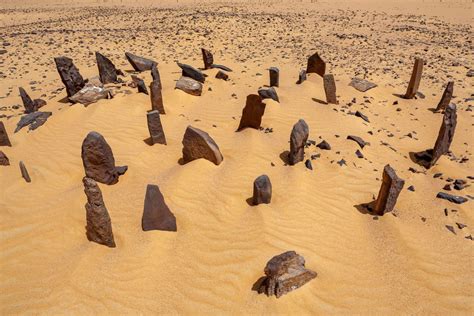
Nabta Playa stone circle. Source: Wikipedia
Nabta Playa is unique not only for its age but also for the ancient astronomy coded into its alignments. It could be evidence of the first Egyptian civilization to use astronomy.
Discovery and Early Interpretations
There are two versions of the story of how these megaliths were discovered. The first one comes from a Bedouin (nomadic Arab) named Eide Mariff who says he came across the stones while crossing the Sahara in 1973. He then took his colleague, prominent American archaeologist Fred Wendorf, out to the site. But Wendorf’s longtime friend and collaborator Romuald Schild remembers the story slightly differently.
Initially, Wendorf thought they were natural formations, but he soon realized that the site was once a large lakebed that would have destroyed any such rocks. He would return many times over the course of decades.
Read also: A Look at African Geography
The Structure and Purpose of Nabta Playa
The megalith monuments and stone slabs of Nabta Playa were constructed over years of habitation by the nomadic people who passed through the area over thousands of years. The most significant structure amongst them all is the calendar stone circle. The stones at Nabta Playa are carefully arranged. In the center, there are six important stones. Researchers believe this setup was used as an early calendar.
The circle is made up of four pairs of large stones and then an assortment of smaller stones. Wendorf, Schild, and the team of archeological excavators believed that the stones were aligned with the stars in some way. Those who built it could tell the time of year through the position of the stars and the Sun through their alignment. For instance, certain stones were placed to catch the first light of the sunrise on the longest day of the year, known as the summer solstice. The summer solstice would have coincided with the arrival of the annual monsoons. For the nomadic people who lived in the area, these summer rains were likely sacred. The solstice was a crucial time for ancient peoples, signaling when the rains would come.
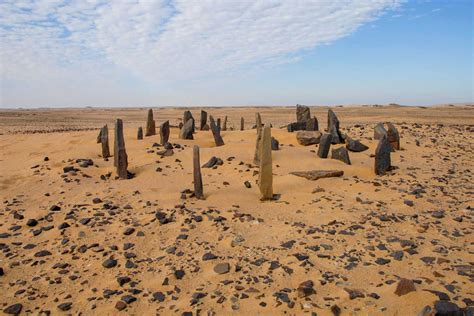
Stonehenge vs Nabta Playa. Source: humanoriginproject.com
Near the Calendar Circle, which is made of smaller stones, there are alignments of large megalithic stones. The southerly lines of these megaliths, Brophy argues, aligned to the same stars as represented in the Calendar Circle, all at the same epoch, circa 6270 BC.
Astronomical Alignments
Astrophysicist Thomas G. Brophy suggests the hypothesis that the southerly line of three stones inside the Calendar Circle represented the three stars of Orion’s Belt and the other three stones inside the calendar circle represented the shoulders and head stars of Orion as they appeared in the sky. These correspondences were for two dates - circa 4800 BC and at precessional opposition - representing how the sky "moves" long term.
Read also: Diverse Techniques of African Pottery
The Sirius alignment in question was originally proposed by Wendorf and Malville for one of the most prominent alignments of megaliths labelled the "C-line", which they said aligned to the rising of Sirius circa 4820 BC. Brophy and Rosen stated in 2005 that megalith orientations and star positions reported by Wendorf and Malville were in error, noting that "Given these corrected data, we see that Sirius actually aligned with the C-line circa 6000 BC. We estimate that 6088 BC Sirius had a declination of −36.51 degrees, for a rising azimuth exactly on the C-line average".
Using their original measurements, complemented by satellite imagery and GPS measurements by Brophy and Rosen, they confirmed possible alignments with Sirius, Arcturus, Alpha Centauri, and the Belt of Orion. They suggest that there are three pieces of evidence suggesting astronomical observations by the herdsmen using the site, which may have functioned as a necropolis.
Cultural and Religious Significance
By the 6th millennium BC, evidence of a prehistoric religion or cult appears. It has been suggested that the associated cattle cult indicated in Nabta Playa marks an early evolution of Ancient Egypt's Hathor cult. For example, Hathor was worshipped as a nighttime protector in desert regions (see Serabit el-Khadim).
Around 5500 BC a new, more organised group began to use the site, burying cattle in clay-lined chambers and building other tumuli. More complex structures followed during a megalith period the researchers dated to between about 4500 BC to 3600 BC.
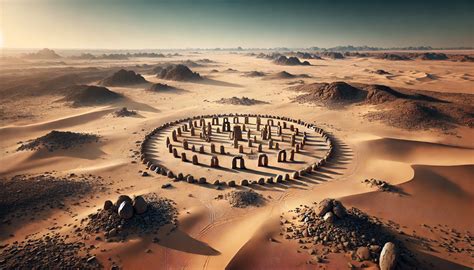
Early pottery from the Nabta Playa. Source: Pinterest
Read also: African Safari Lodges Review
In 2001, archaeologists dug up the central part of Nabta Playa, where they expected to find human remains. Instead, they found a cow’s skeleton. In the "Valley of Sacrifices,” there are ten mounds of broken sandstone blocks. The chambers beneath them contain remains of cattle, goats, and sheep. The largest and perhaps oldest contains an entire cow in an elaborate chamber covered by a tamarisk roof. The carcass is orientated roughly north-south, lying on its left side, with its head west.
At around 8000BC, the first signs of human occupation begin to appear in the region. It is this area where the oldest evidence of animal agriculture is found on the African continent.
Also, they argued that the pottery from the region had an important role in shaping the cultural development of the Eastern Sahara during the early Holocene period.
Environmental Context and Habitation
Although today the western Egyptian desert is totally dry, this was not always the case. There is good evidence that there were several humid periods in the past (when up to 500 mm of rain would fall per year), the most recent one during the last interglacial and early last glaciation periods which stretched between 130,000 and 70,000 years ago. During this time, the area was a savanna and supported numerous animals such as extinct buffalo and large giraffes, varieties of antelope and gazelle.
The first strong evidence for people at Nabta Playa appears around the year 9000 BC. At the time, the Sahara was a wetter, more pleasant place to live. Eventually, there was enough water that people could even dig wells and build homes around them. One site excavated at Nabta Playa revealed rows of huts with hearths, storage pits, and wells that were spread out over several thousand square feet.
But between 5000 B.C. and 3000 B.C., thousands of years after the stone circle was built at Nabta Playa, the region dried out again. Some researchers think this environmental stress could have forced the people of Nabta Playa to develop a complex society, which most scholars thought depended on the development of agriculture.
The nomadic people likely ate wild foods, but also planted some semi-domesticated crops along lakeshores at the beginning of each wet season. The African sorghum and millet seeds domesticated in this area would eventually spread along a trade route stretching through the Red Sea and into India - where they arrived some 4,000 years ago and went on to play an important role in the development of numerous civilizations.
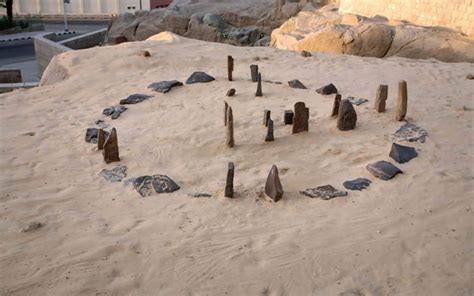
Nabta Playa Museum. Source: livescience.com
By that time, the people who first grew the seeds were gone. Some 1,500 years earlier, the region had dried out, becoming what is now Earth’s hottest desert, the Sahara. Here, many areas don’t see rain for years. That changing local climate forced the people of Nabta Playa to disperse. Some archaeologists think these people likely traveled south into Nubia, or modern day Sudan, as well as north into Egypt. This timing had led some scholars to suggest the event sparked a “black genesis” for the cultural development in Egypt.
Human remains at Nabta Playa seemed to be from people of both Central African and Mediterranean descent.
Preservation and Modern Understanding
After the first study of the site was published in 1998, tourists and visitors who were able to locate the stone circles began defacing the stones and moving some, eventually changing the alignment. Now, the stones (including a cow sculpture!) can be seen in their original formation at the Nubian Museum in Aswan, Egypt, where visitors can view the historic monument from a safe distance.
Malville agrees with Higginbottom. He says Nabta Playa might not get as much attention as Stonehenge because it is significantly smaller, and up until a few decades ago, it was buried in sand in a remote region of Africa.
The ancient society studied the constellations and understood the movements of the night sky. They made sacrifices and worshiped gods. They made jewelry out of cow bones. They ground up pigments for body painting. Researchers even discovered fish carvings at the site that suggest the nomads traded as far away as the Red Sea.
Located deep in the Nubian Desert, the area is one of the most inhospitable in Egypt. It is isolated by miles of dry, barren sand that endures extremely high temperatures.
If it is the origin of Ancient Egyptian Astronomy, it provides the earliest signs of the Egyptian civilization itself.
The "repetitive orientation of megaliths, stele, human burials and cattle burials reveals a very early symbolic connection to the north." Secondly, there is the orientation of the cromlech mentioned above.
Early pottery from the Nabta Playa-Bir Kiseiba area has characteristics unlike pottery from surrounding regions. This is followed by pottery with characteristics found only in the Western Desert. Later pottery from c.
Joel D. Irish (2001), reported in "Holocene Settlement of the Egyptian Sahara", based on osteological and dental data suggested a mainly sub-Saharan African affinity and origin at Nabta (with sub-Saharan tendencies most commonly detected), but also possible North African tendencies, concluding that, "Henneberg et al. suggest that the Nabta Playa people may have been most similar to Negroes from south of the Sahara.
The Nabta Playa site shows evidence of a society not previously recorded in ancient Egypt. Around 7500 years ago, the area was home to a population of people with cultural practice. The megalithic structures remain the most valuable remnants of a lost culture. Found within the area are stone circles, burial chambers, as well as megalithic and carved standing stones. So far, at least 30 of these structures have been uncovered.
Nabta Playa appears to be a center of cultural evolution of the Egyptian civilization. From the burial mounds to farming, and animal husbandry, the first sprouts emerge at Nabta Playa.
Studies reveal signs of occupation in the area for thousands of years. Geologists explain the climate was cycling from very arid and harsh to seasonally wet and habitable every few thousand years.
Weather could have been a factor for a cycle of cultures living in the area. Excavations show long spans of time passing without any artifacts found. Then, something happened at 3000BC (5000 years ago). It’s here the last signs of human occupation are recorded at Nabta Playa.
The circle is made up four gateways, two aligned North-South, and two pointing East-West. These alignments were likely used to track the summer and winter solstices, as well as vernal and autumnal equinoxes.
This would have been of extreme importance to the inhabitants of Nabta Playa at the time. The agricultural year would be based on when the wet season was approaching.
There was, however, more purpose for the site. In the middle of the stone circle is six anomalous stones that do not align to any of the four cardinal points.
Nabta Playa Stone Circle. Source: Youtube
Nabta playa could be one of the earliest astronomical observatories found in Egypt.
For lost ancient civilizations, the knowledge of the movements of the stars was held in utmost importance. Evidence shows that as it helped shape and develop cultures all over the world.
Most curiously, Nabta Playa shows knowledge of precession of the equinox. It’s the much larger cycle of the star constellations in the sky comparative to the sunrise on the spring solstice.
Just before the sun rose on the summer solstice around 5000BC, three of the stones in the center of the stone circle would have lined up perfectly with the belt stars of the constellation of Orion. This time marks when the precession cycle is at one extreme.
12,000 years earlier, the opposite extreme of the precession cycle occurs. Again, the other three stones line up precisely with the shoulder stars of Orion. The stone circle is an accurate astronomical map tracking time back to around 16,500BC.
Ancient Egyptians at Nabta Playa were recording the movements of the constellation of Orion’s Belt as a way to mark the precession of the equinox.
Not far from the stone circle at Nabta Playa are further signs of ancient astronomy. Several clusters of standing stones have been found in groups in a runway formation from a central viewing stone. It is thought that this viewing stone was used to track and site different stars.
From the viewing stone, each visible stone is not only marking a specific star of the sky. It also marks the correct distance that star is situated from earth. As a scaled-down model, when applied to the modern astronomical measurements, it is an astonishing match.
Today, researchers can estimate the night sky as it would have looked at the time Nabta Playa was inhabited. Using this data, at the time of sunrise on the Spring equinox, they found a correct match for the heliacal rising of the stars indicated by their corresponding stone.
For the ancients, just before the sun appeared on the horizon, the star relative to its stone would have risen perfectly overhead.
Popular articles:
tags: #Egypt
