The African Grey Parrot is Africa‘s largest parrot and is known for being one of the world’s most proficient talking and mimicking birds, earning it a reputation among bird enthusiasts.
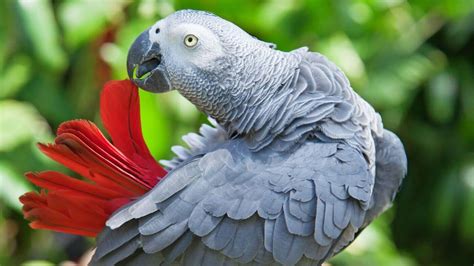
If you've ever seen an African Grey parrot, then you know that they are beautiful birds, but did you also know that they are capable of amassing vocabularies of up to 1,000 words or more, and using the words that they learn to speak in context? To say that these birds are intelligent would be an understatement, and the best part is, that's not the only thing that makes the African Grey parrot so special. Read on to discover a few of the most interesting and exciting facts about African Grey parrots, including their origin, information on the various subspecies of African Grey, and more.
Physical Appearance
The African Grey parrot has a distinct appearance with feathers that are predominantly gray with a bright red tail. Some of the feathers have a white border, which adds to the elegance of the bird’s plumage. The hues of adults and juveniles differ slightly.
As the term implies, the body color is pastel or slate gray; the feathers for the head and chest have white borders, creating a fluted effect. The coverts of the wing feathers are quite darker, with vivid crimson color for the tail. Their upper and lower mandibles, similar to their beaks, are all black.
Greys have a masked appearance due to a wide face area that extends beyond the back of the eye. On a young bird (under one-year-old), the iris is black or gray, while on a mature bird, the iris is yellow.
Read also: Animals in the Democratic Republic of Congo
A Congo Grey’s overall body length is 14 to 16 inches, with a wingspan of 18 to 20 inches. Depending on the place of origin, the weight might range from 350 to 650 grams.
Specific Species
While all types of African grey parrots look similar, there are two distinct types and a couple of lesser-known subspecies of this beloved bird. The most popular and common is the Congo African grey. The Congo African grey is the largest of the African grey parrots, sporting a lighter gray color in its plumage, and a solid black beak.
The second most common type is the Timneh African grey, which was recognized as a species in and of itself in 2012. The Timneh African grey is slightly smaller than the Congo, and its feathers are darker in color. Another defining characteristic of the Timneh grey is that it has a horn-colored upper mandible instead of a black one.
Despite their differences, both of these types of African grey parrots make excellent pets, and both are equally intelligent.
Timneh African Grey Parrot
The Timneh African Grey (Psittacus erithacus timneh) is the lesser of two African grey parrot subspecies. The popularity of the Congo’s smaller relative has surged in recent years.
Read also: DR Congo - Zambia: Key Insights
Timneh Greys are a darker shade of grey than Congo Greys. Darker gray feathers cover its head, back, and upper chest, and a unique “V” shape of dark feathers covers a lighter grey hue on the belly. The Timneh white scalloping of head feathers is likewise more noticeable. Its dark grey feathers give a bluish hue under certain lights.
Compared to the Congo African Grey, the Timneh has a shorter body length, ranging from 9 to 11 inches from beak to tail, and a wingspan of 13 to 15 inches.
Congo African Grey vs. The Congo African Grey dwarfs the Timneh in size.
The Timneh African Grey is more adaptive and quieter than the Congo. The Timneh is darker grey in tone and features a v-shaped design on the upper chest.
Congo and Timneh African Greys have the mental capacity of a five-year-old youngster and the emotional maturity of a perpetual two-year-old. Because of their faster maturation rate, Timneh African Greys are thought to have a more stable personality than their larger counterparts. With the proper support, devotion, and care, Congos can be just as steady.
Read also: Ghana U23 Face Congo U23
Birds vary in their sociability. Both subspecies are, on the whole, wary birds. African Greys prefer to take a step back and examine their surroundings before becoming involved. Congo African Greys and Timneh African Greys appear to communicate in the same way, and gender seems to have no bearing on whether they learn to speak or not. Timneh African Greys may create rudimentary words around six months, although Congo African Greys typically start talking after a year.
Habitat
Congo African Greys can be found from Angola to the Ivory Coast, as well as inland from Kenya to Tanzania. They are often kept as pets (they are among the top three most regularly traded birds) and can be found in captivity all over the world.
African greys are found throughout the lowland rainforests in western and central Africa. While they prefer to inhabit the rainforest, they have also been seen on forest edges, within gallery forests (which are forests located alongside streams or rivers), and in gardens.
They migrate away from feeding sites at night and roost in flocks. To avoid predators, they sleep on coastal or river islands or near clearings wherever possible; it’s not uncommon to see over 100 birds sitting in a single tree.
Behavior and Communication
African Grey parrots in the wild live in big flocks of up to several hundred birds, which can be seen flying between foraging and roosting places. They communicate by making high-pitched sounds and blowing whistles.
They are very sociable and use a range of noisy vocalizations to coordinate flocking, warn of danger, and vent rage toward rivals. The birds have been observed imitating the sounds of other birds and even bats.
They communicate with each other through high-pitched screams and clear whistles.
6 WAYS TO TEACH YOUR PARROT TO TALK! | PARROT TALK (Merlin Subtitles) | MARLENE MC'COHEN
Diet
Climbing up a tree from branch to branch, instead of flying, the African grey collects seeds, nuts, fruit, and berries.
The following vegetables are suitable for feeding: celery, spinach, asparagus, tomatoes, cauliflower, corn, pumpkin, potatoes, peas, carrots, cabbage, mustard greens, chilies, yams, and plantains.
Breeding and Lifespan
African Grey parrots are monogamous and have lifelong pair bonds. The birds breed during the dry season in most areas; some populations breed twice a year.
African grey parrots mate for life and build their nests high above the ground in tree holes. In a clutch, they usually lay three to five eggs, one every two to four days. The eggs are incubated for about 30 days by the female grey while the male guards the nest cavity and gathers food to feed her.
African grey parrots have been known to live for up to 80 years in captivity, so it's imperative that those who adopt them can commit to a lifetime of living with a bird.
Intelligence and Cognitive Abilities
Besides being one of the most popular pet bird species, African grey parrots are also one of the most intelligent. In recent years, much research has been done on the mental capacity of African grey parrots by scientists around the world.
The most famous instance of this is the work that Dr. Irene Pepperberg conducted with her famous African grey, Alex. Using Alex and other African greys in research trials focusing on communication, she was able to show that not only can African grey parrots learn an incredible amount of human words, they can learn to use them in context to communicate with their owners.
Alex was a well-known Congo African Grey. Alex recognized many objects by name, form, and color. He also knew how to count to six and comprehended the concepts of “same,” “different,” “larger,” and “smaller.”
N’kisi is a well-known Congo African Grey with an extensive vocabulary, a sense of humor, and potentially telepathic skills!
Right-footed African Grey parrots have a greater vocabulary than left-footed African Grey parrots.
Because African greys have the same level of cognitive ability as four to six-year-old children, they can identify objects by color, material, shape, and number.
Most people can relate to the difficulties of keeping a young child occupied, so it's not a stretch to say that keeping a highly intelligent bird from getting bored can be similar. African grey parrots need plenty of mental stimulation to stay happy and healthy, so they must be provided with a variety of toys and other ways to exercise their minds.
Threats and Conservation Status
Due to its popularity in the pet business, the African grey parrot was designated as “near endangered” in 2007. Its extraordinary ability to replicate the human voice and its extended longevity make it the most popular avian pet in Europe, the United States, and the Middle East.
More than 359,000 grey parrots were traded on the international market between 1994 and 2003. Every year, it is estimated that up to 21% of the world’s population is harvested.
The African grey parrot became listed as ‘near threatened’ in 2007 due to its popularity in the pet industry. It is the most popular avian pet in Europe, the US, and the Middle East due to its incredible ability to mimic the human voice as well as its long lifespan. It is thought that up to 21% of the global population is harvested every year.
African Grey parrots were once targeted for hunting for food and their stunning red tail feathers. It was believed that feathers had magical qualities, so headdresses were made from them.
The Ogoni people of Nigeria safeguard the population of African Greys. The people exchange the naturally molted red feathers for children’s school supplies, clothing, and books.
The African Grey Parrot as a Pet
The species is engaging and intelligent, and it builds strong ties to its human caregivers due to its social, swarming behavior. It can, however, become destructive and aggressive if not properly educated. Responsible breeders will not sell young birds until they can feed themselves.
Because they are so intelligent, African grey parrots form very strong bonds with their owners and can be quite emotionally needy. Due to this trait, they do best with owners who can devote ample time to handling and socializing with them daily. Also, African grey parrots need a lot of exercise to keep their strong muscles toned and maintain an adequate physical condition.
African grey parrots are too emotionally sensitive to be able to handle being bounced from owner to owner, but sadly many of them do have several homes throughout their lifetimes because people rush into adopting them without fully thinking it through.
Pros and Cons of Owning an African Grey Parrot
Pros
- Intelligence: African grey parrots have the cognitive capacity of a 5-year-old child and are known for their problem-solving skills.
- Affectionate nature: These birds are known to form strong bonds with their owners and love to cuddle and snuggle.
- Long lifespan: Some African grey parrots can live up to 50 years in captivity.
Cons
- High maintenance: These birds require a lot of attention, affection, and mental stimulation to stay happy and healthy.
- Loud vocalizations: African grey parrots have a loud, piercing scream that can be disruptive and annoying.
- Destructive nature: These birds love to chew and can quickly destroy furniture, woodwork, and other household items.
- Specialized diet: African grey parrots require a specialized diet that includes fresh fruits, vegetables, and nuts, which can be expensive and time-consuming to prepare.
Fun Facts
- The color gray is significant to the Yoruba people of Nigeria. Its tail feathers and image are utilized to make masks during their Gelede social and religious holidays.
- The red coloring of the tail feathers is thought to signify both menstrual blood and the brilliant red oil on which they feed.
- They puff up their feathers to appear more significant when they sense danger.
- The ancient Romans, Greeks, and Egyptians placed a high value on African Grey parrots.
Scientific Classification
Here is the scientific classification of the African Grey Parrot:
| Category | Classification |
|---|---|
| Common Name | African grey parrot |
| Kingdom | Animalia |
| Phylum | Chordata |
| Class | Aves |
| Order | Psittaciformes |
| Family | Psittacidae (true parrots) |
| Genus | Psittacus (parrot) |
| Species | erithacus (a solitary bird which can be taught to speak) |
