A central business district (CBD) is the commercial and business center of a city. It contains commercial space and offices, and in larger cities will often be described as a financial district. Geographically, it often coincides with the "city centre" or "downtown". However, these concepts are not necessarily synonymous: many cities have a central business district located away from its traditional city center, and there may be multiple CBDs within a single urban area. The CBD will often be highly accessible and have a large variety and concentration of specialised goods and services compared to other parts of the city.
The Johannesburg Central Business District, commonly called Johannesburg CBD, is one of the main business centres of Johannesburg, South Africa. It is the densest collection of skyscrapers in Africa.
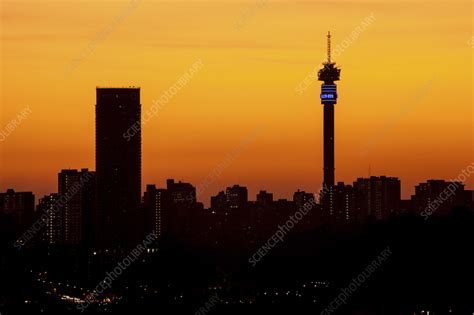
Johannesburg CBD Skyline
Historical Context
The area that is currently the Central Business District has been the central area of Johannesburg nearly since its inception. Its central location in the city as well as careful planning led to it being chosen as the best location for residential and commercial development, especially during the economically prosperous 1960s and 1970s.
However, it wasn’t always like this. Johannesburg was built on the riches of a gold-mining empire and in its heyday rivalled New York in wealth, power, and grandeur.
Read also: A Look at Central African Republicball
Under apartheid, the Central Business District was classified as a whites-only area, meaning that black people were allowed to work and shop there but could not live there.
The Abolition of Racially Based Land Measures Act, 1991 repealed many of the apartheid laws that imposed race-based restrictions on landownership and land use, including keeping the blacks out of the CBD. Application of the Group Areas Act became very lax in the 1980s, among other things because courts were not able to handle all the cases, and when the Act was abolished even more disadvantaged black people moved into the City Centre, often taking over whole buildings by overfilling them with people that the previous middle-class white tenants found unacceptable neighbours.
This is not only true of previously established residential areas such as Hillbrow on the periphery of the CBD but also of former office blocks in the heart of the CBD, that were converted to residential accommodation as businesses fled the centre in the late-1980s and 1990s.
Decline and Challenges
The subsequent influx of blacks in search of economic opportunity and rising crime rates led to an equally rapid exodus of white business and home owners to the suburbs of Sandton and Midrand. Many white investors simply abandoned their properties, leaving them to be “hijacked” by black squatters and gangs. A crime wave swept through the city as businesses left the CBD, which made walking around the area dangerous. Many businesses and people fled the Central Business District and surrounding areas such as Braamfontein, Hillbrow, and Yeoville for more secured houses or offices in the Northern Suburbs. By the late 1990s, the Central Business District was a no-go zone and a virtual ghost town.
The newly elected African National Congress (ANC) government, overwhelmed by enormous transitional problems, did little to prevent the decline of the city, a precipitous fall marked by weak administration, ineffective management, and lack of political will.
Read also: Resilience of Women in CAR
As we return to the safety of the white suburbs, I reflect that so much of this is also about overcoming the demonization of inner-city Johannesburg in the minds of suburban white residents.
Revitalization Efforts
The situation has improved since. There have been significant movements to redevelop the city centre. The Johannesburg city government installed CCTV cameras all over the Central Business District, which decreased crime dramatically. Several historical buildings have also been developed and turned into condominiums, which developers hope will draw new residents to the area.
Maboneng (a Sotho word meaning “place of light”) is home to an ambitious project spearheaded by a developer, Jonathan Liebmann, which has successfully converted several derelict warehouses and disused factories into unique retail, housing, and office buildings. It is anchored by Arts on Main, one of the two main building complexes in Maboneng Precinct, and home to many artists’ workshops, galleries, and other creative spaces.
Urban regeneration is taking hold, and even flourishing in some places, and the dreams of true believers who moved back home like Ted are being realized. This once great city may never recapture its former glory, but a brighter future beckons.
There is hope for Jo’anna after all.
Read also: Kenya Shilling Historical Rates
The Colosseum in Johannesburg CBD is a prime example of urban regeneration
The African City Model
The African City Model is applicable to cities in sub-Saharan Africa founded during or before the European colonial period.
The African City Model is a simplified and abstracted diagram that focuses on three distinct and adjoining types of central business districts (CBDs) and the ethnic and segregated nature of residential zones in cities within former European colonies in Africa.
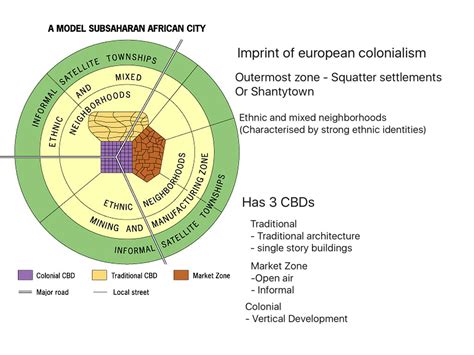
African City Model
Key Components of the African City Model:
- Traditional CBD: Centrally located but its streets rarely follow a grid pattern, because it is based on a pre-European, pre-colonial model.
- Colonial CBD: Has a rectangular street grid and was built primarily as the European business and government district during the colonial era (1500s to 1900s AD), next to the Traditional CBD.
- Market Zone: A transitional area and a CBD of its own, abutting the other CBDs. It is a crowded and chaotic jumble of shops, stalls, and open-air vendors.
Popular articles:
tags: #Africa
