Welcome to the enchanting world of the baobab tree, the ancient and iconic giants that have stood tall for centuries in the vast African savannah. These fascinating trees have captivated the imaginations of travelers, scientists, and nature enthusiasts alike, with their unique features and cultural significance.
Our planet is a busy, crazy place. And amidst all the noise, voices get lost and some stories are never heard. For our growing team of writers and contributors, those are the stories that matter most: we dedicate our time to them all day and every day. You, our viewers, are passionate about these stories we tell.
In this article, we'll explore the remarkable trees that dominate the African landscape, from the towering Entandrophragma excelsum on Mount Kilimanjaro to the iconic baobabs scattered across the continent. Let's delve into the world of Africa's giants.
The Majestic Baobabs (Adansonia)
Baobabs (Adansonia) are distinctive trees with incredibly large trunks. Baobabs have among the lightest wood for any tree. They can store tremendous amounts of water, as their trunks noticeably swell during the rainy season.
The African baobab (A. digitata) has a vast range throughout the arid parts of Africa; six additional species are native to the Indian Ocean island of Madagascar, off south-east Africa; and an eighth species is native to north-west Australia.
Read also: World's largest football stadium in Morocco
African baobabs are trees that often grow as solitary individuals, and are large and distinctive elements of savanna or scrubland vegetation. They grow to a height of 5-25 metres (16-82 feet).
They are typically found in dry, hot savannas of sub-Saharan Africa, where they dominate the landscape and reveal the presence of a watercourse from afar. They have traditionally been valued as sources of food, water, health remedies or places of shelter and are a key food source for many animals. They are steeped in legend and superstition.
The scientific name Adansonia refers to the French explorer and botanist, Michel Adanson (1727-1806), who wrote the first botanical description for the full species. "Digitata" refers to the digits of the hand, as the baobab has compound leaves with normally five (but up to seven) leaflets, akin to a hand.
The earliest written reports of African baobab are from a 14th-century travelogue by the Arab traveler Ibn Batuta. The first botanical description was by Alpino (1592) looking at fruits that he observed in Egypt from an unknown source. They were called Bahobab, possibly from the Arabic "bu hibab", meaning "many-seeded fruit".
Characteristics of the African Baobab
The trunk is typically very broad and fluted or cylindrical, often with a buttressed, spreading base. Trunks may reach a diameter of 10-14 m (33-46 ft), and may be made up of multiple stems fused around a hollow core. The hollow core found in many tree species is the result of wood removal, such as decay of the oldest, internal part of the trunk. In baobabs, however, many of the largest and oldest of the trees have a hollow core that is the result of a fused circle of three to eight stems sprouting from roots.
Read also: Premier Shopping Guide: Africa
All baobabs are deciduous, losing their leaves in the dry season, and remaining leafless for about eight months of the year. The leaves are palmately compound with five to seven (sometimes up to nine) leaflets in mature trees, but seedlings and regenerating shoots may have simple leaves. The transition to compound leaves comes with age and may be gradual. African baobabs produce simple leaves much longer than most other Adansonia species.
Flowers are large, white and hanging. Flowering occurs in both the dry and the wet season. Buds are rounded with a cone-shaped tip. Flowers are showy and sometimes paired, but usually produced singly at the end of a hanging stalk about 15-90 centimetres (6-35+1⁄2 inches) in length. The calyx is typically made up of five (sometimes three) green triangular bent-back lobes (sepals) with a cream-coloured, hairy interior. The petals are white, roughly the same width and length - up to 8 cm (3 in), and are crumpled in bud. Flowers open during the late afternoon, staying open and fertile for only one night.
The androecium is white and made up of a 3-6 cm (1+1⁄4-2+1⁄4 in) long tube of fused stamens (a staminal tube) surrounded by unfused (free) filaments 3-5 cm long. Styles are white, growing through the staminal tube and projecting beyond it. They are usually bent at right-angles and topped with an irregular stigma. Pollen grains are spherical with spikes over the surface, typical of the Malvaceae family.
All Adansonia develop large rounded indehiscent fruits which can be up to 25 cm (10 in) long with a woody outer shell. Inside is a fleshy, light beige coloured pulp. African baobab fruits are quite variable in shape, from nearly round to cylindrical. The shell is 6-10 millimetres (1⁄4-3⁄8 in) thick.
Baobab trees store water in their trunks and branches on a seasonal basis as they live in areas of sustained drought and water inaccessibility. During the dry season, the trees will flush out all of their leaves. During this period, the circumference of the trunk will shrink about 2-3 cm and the water content of the stem will drop by about 10%.
Read also: Ghanaian political lies: An in-depth look
Baobab trees have much higher water and parenchyma content than most trees, which allows them to grow very large with less energy expenditure. Parenchyma are soft plant tissue cells that are commonly used for water storage in other drought tolerant species like cactus and succulents. The water fluxes from the vascular tissue into the parenchyma cells at the center of the tree with the help of actively transported ions.
A. digitata is the type species for the genus Adansonia and is the only species in the section Adansonia. All species of Adansonia except A. digitata are diploid; A. digitata is tetraploid.
On the Atlantic coast, this may be due to spreading after cultivation. Its occurrence is very limited in Central Africa, and it is found only in the very north of South Africa. In East Africa, the trees grow also in shrublands and on the coast.
The African baobab is largely found in savannah habitats, which tend to be fire-prone. Adaptations to survive frequent fires include a thick and fire-resistant bark and thick-shelled fruit.
Pollination in the African baobab is achieved primarily by fruit bats, in West Africa mainly the straw-coloured fruit bat, Gambian epauletted fruit bat, and the Egyptian fruit bat.
With their hard coat, baobab seeds can withstand drying and remain viable over long periods. The fruits are eaten by many species and the germination potential is improved when seeds have passed through the digestive tract of an animal or have been subjected to fire.
Some aspects of the baobab's reproductive biology are not yet understood but it is thought that pollen from another tree may be required to develop fertile seed. Isolated trees without a pollen source from another tree do form fruit, only to abort them at a later stage.
The baobab is a protected tree in South Africa, and yet is threatened by various mining and development activities. In the Sahel, the effects of drought, desertification and over-use of the fruit have been cited as causes for concern. As of February 2025, the African baobab is not yet classified by the IUCN Red List, although there is evidence that populations may be declining.
People have traditionally valued the trees as sources of food, water, health remedies or places of shelter. Baobab leaves can be eaten as a relish. Young fresh leaves are cooked in a sauce and sometimes are dried and powdered. The powder is called lalo in Mali and sold in many village markets in Western Africa. Baobab leaves are sometimes used as forage for ruminants in dry season.
In 2008, the European Union approved the use and consumption of baobab fruit.
Around Gweta, Botswana, some have been declared national monuments.
The African baobab in Mahajanga, Madagascar, had a circumference of 21 metres by 2013. The Ombalantu baobab in Namibia has a hollow trunk that can accommodate some 35 people. At times it has served as a chapel, post office, house, and hiding site. The Holboom baobab (Holboom, Nyae Nyae Conservancy, Namibia) is one of the trees with a hollow core.
The first botanical description of A. digitata was done by Adanson based on a tree on the island of Sor, Senegal. On the nearby Îles des Madeleines Adanson found a baobab that was 3.8 metres (12 ft) in diameter, which bore the carvings of passing mariners on its trunk, including those of Prince Henry the Navigator in 1444 and André Thevet in 1555.
The Grove Place Baobab, listed as a Champion Tree, is believed to be the oldest (250-300 years) of some 100 baobabs on Saint Croix in the US Virgin Islands. It is seen as a living testament to centuries of African presence, as the seeds were likely introduced by an African slave who arrived at the former estate during the 18th century.
Zimbabwe's Big Tree, near Victoria Falls, stands 25 meters tall and is visited by hundreds of thousands of tourists yearly.
European explorers claimed the trees could live for up to 5,000 years, but carbon dating indicates they may live up to 3,000 years. Known to reach up to 100 feet tall with a circumference to match, these trees are enormous, providing shelter, food, and water for various life forms. Indigenous African savanna peoples have long centered their communities around these monumental trees.
As a succulent, the tree absorbs and stores water from the rainy season in its massive trunk, producing a nutrient-dense fruit in the dry season, which can grow up to a foot long. The fruit contains tartaric acid and Vitamin C, serving as a vital nutrient and food source for many species. They are also an essential source of water and shelter for hundreds of animals, including birds, lizards, monkeys, and even elephants - which can eat their bark for moisture when there is no water nearby. Bats pollinate the flowers, feeding on their nectar.
For humans, the baobab’s fruit pulp can be eaten, soaked in water to make a refreshing drink, preserved into a jam, or roasted and ground to make a coffee-like substance. The bark can be pounded to make everything from rope, mats, and baskets to paper and cloth. Leaves are also used, they can be boiled and eaten, or glue can be made from their flower’s pollen.
Throughout the Zambezi, Indigenous communities note the baobab for its branches that seem to span out in all directions like roots. Local legend says the baobabs were too proud, so the gods became angry and uprooted them and threw them back into the ground upside-down.
The African baobab is the most widespread tree species of the genus Adansonia, the baobabs, and is native to the African continent and the southern Arabian Peninsula (Yemen, Oman). These are long-lived pachycauls; radiocarbon dating has shown some individuals to be over 2,000 years old.
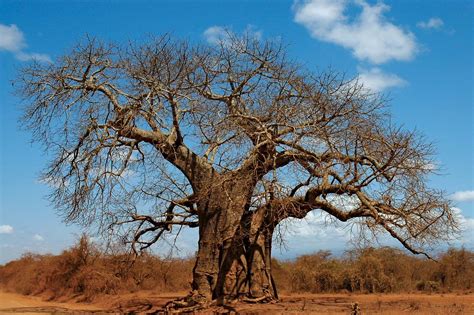
Sagole Big Tree
The largest known living baobab is the Sagole Big Tree, a specimen of A. digitata located in Masisi, Vhembe, South Africa, near the border with Zimbabwe. Based on its most recent measurements, Sagole has an extremely large base that covers 60.6 m² (652.3 sq ft), a height of 19.8 m (64 ft 11.5 in) and a total wood and bark volume of 414 m³ (14,620 cu ft).
Tsitakakoike Baobab
Until 2018, the largest living baobab was the sacred Tsitakakoike Baobab, a specimen of the endangered species Adansonia grandidieri, which grew near Andombiro in the Ambiky Forest of south-west Madagascar. The incredibly stout and compact tree had a cylindrical trunk with a base that covered 59.6 m² (641.5 sq ft), a height of 14.6 m (47 ft 10.8 in) and a total volume of 455 m³ (16,068 cu ft) - 380 m³ (13,420 cu ft) of which was trunk and 75 m³ (2,648 cu ft) of which was canopy. It partially broke and collapsed in February 2018 leaving about 40% of the tree still standing, but this was expected to also collapse soon after.
Platland/Sunland Tree
An even larger African baobab tree (A. digitata) alive during the 21st century was the Platland/Sunland Tree of Modjadjiskloof, South Africa, with a base of 67.9 m² (730.9 sq ft), height of 18.9 m (62 ft) and a total wood and bark volume of 448 m³ (15,821 cu ft). Unfortunately, a large portion of the Platland Tree collapsed and died in 2016, leaving the Sagole Big Tree to claim the top spot.
Balsa wood is well known to model aeroplane makers as one of the lightest and softest woods, with a wood density that averages around 0.15 g/cm³, yet baobab wood is even lighter, averaging 0.13 g/cm³. As a result, the aboveground dry mass of the Platland baobab was estimated at only 58 tonnes (64 US tons) and about 59 tonnes (65 US tons) for Tsitakakoike.
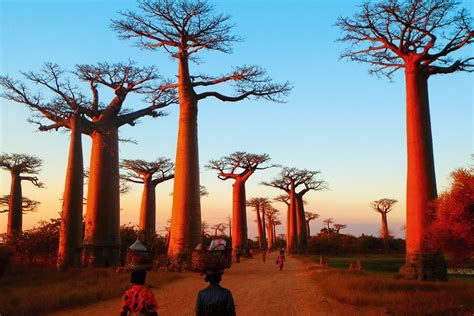
Africa's Tallest Indigenous Tree: Entandrophragma excelsum
Entandrophragma excelsum, is Africa's tallest indigenous tree native to tropical East Africa and occurs in eastern D.R.of the Congo, Rwanda, Burundi, Uganda, Tanzania, Malawi and Zambia. This species is scattered in areas of upland semi-deciduous forest, in mid-elevation and montane rainforest, at (925 -) 1280 - 2150 metres elevation.
In 2016, a team of researchers led by Andreas Hemp from the University of Bayreuth in Germany announced the discovery of the tallest known tree in Africa. This giant stands at 81.5 meters (268 feet) tall, with a diameter of 2.55 meters (8.5 feet), and is estimated to be between 500 and 600 years old.
The tree was discovered on its southern slope in Tanzania. This side of Kilimanjaro is encircled by a belt of tropical rainforest, where the record-breaking tree thrives in one of the river valleys.
Trees of this species lack common names outside Africa, so it is primarily recognized by its scientific name, Entandrophragma excelsum, which in Latin translates to "tall Entandrophragma."
Characteristics of Entandrophragma excelsum
Entandrophragma excelsum dioecious, deciduous large tree, commonly up to 45 (-60) m tall.
Leaves pinnate on stalks to 60 cm or more with 8-16 large leaflets, almost opposite, each one oblong, 8 - 18 (-30) cm long and 4.5 - 8 (-14) cm wide.
Inflorescence, 25 - 30 cm long and 10 - 15 cm wide.
This is a large deciduous tree with short leaves but massive branches and a wide-spreading canopy. It has moderately light wood, with an average density of 460 kg/m³ (28.8 lb/ft³) at 12°C (53.6°F) humidity, comparable to spruce wood.
The wood of Entandrophragma excelsum is not in much demand for local applications because it often warps and twists considerably upon drying. Moreover, it is not durable and not very attractively figured.
Uses of the Wood
The wood is suitable for the production of sliced and rotary veneer, and can be made into plywood of satisfactory quality. The wood is suitable for construction, flooring, joinery, interior trim, furniture, cabinet work, musical instruments, vehicle bodies, toys, novelties, boxes, crates, carvings, turnery, veneer and plywood.
Discovery and Significance
Before the recent discovery, it was believed that trees of this species didn't grow taller than 55 meters (180 feet). However, in this extraordinary location on the southern slopes of Mount Kilimanjaro, the height of the ten tallest Entandrophragma excelsum trees begins at 59 meters (194 feet).
The impressive size of E. excelsum, which earned it a place among the world’s tallest tree species, has been attributed by scientists to the favorable climate and mineral-rich volcanic soil of Mount Kilimanjaro.
Popular articles:
tags: #Africa
