The art of the ancient city of Ife has, since its "discovery" in the 19th century, occupied a special position in the corpus of African and global artworks. The sculptures of Ife are one of the legacies of the kingdom of Ife, whose capital city, Ile-Ife, is the center of a tradition in which its primacy and reverence is nearly unparalleled among the old world's cultures and religions.
Ile-Ife, as the tradition goes, is the genesis of all humanity, deities, and the world itself; it was the site of creation of civilization and social institutions, and it is from Ife that kingship, religion, and the arts spread to other places. When English traders visited Ile-Ife, they were informed that their kings originated from Ife; when missionaries went to convert the city's inhabitants, the latter said Christianity was one of several religions from Ife. In all contexts and in all iterations of this tradition, the city of Ife was where all roads of humanity led and from where they originated.
Despite its location deep in the heart of the “forest region” of West Africa and at the periphery of the medieval world's trading theater, Ife was the innermost West African kingdom known to external sources of the medieval era. From the 14th-century accounts of Ibn Battuta and of al-Umari (based on correspondence received from Mansa Musa), to the 15th-century Portuguese accounts of an interior kingdom of great importance whose ruler was revered by many of the West African coastal kingdoms, Ife's position in West Africa's political landscape was lofty and unequalled, much like its art.
This article provides an overview of the history of the Ife kingdom and the copper-alloy and terracotta sculptures made by its artists, covering the political and religious circumstances in which they were produced and the visual and ritual power they were intended to convey.
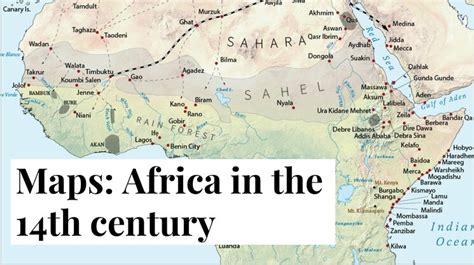
Map of the Ife kingdom at its height in the 14th century and some of the cities mentioned in this article.
Read also: Explore African Warrior Traditions
Origins of Ife and the Emergence of Social Complexity in Yorubaland
The emergence of the Ife kingdom is related in a Yoruba epic that tells a story of confrontation between two personalities, Obàtálá and Odùduwà, who were a representation of several personalities and factions in classical Ife that stood for the dominant opposing camps identified with the Old order (Obàtálá) against the New order (Odùduwà). This tradition spans the period of consolidation of several small polities in the Ife heartland around the capital city Ile-Ife from the early 2nd millennium to the end of the classical Ife in the 15th century and includes the appearance of several real personalities such as King Obalufun II who reigned in the early 14th century.
Archaeological evidence indicates that the early small polities in the Yorubaland during the mid-1st millennium were an advanced form of the "house society." These were forms of social organizations comprised of multiple households that clustered for the purposes of reciprocity, security, and self-preservation, and from which emerged rulers who managed conflicts and priestly functions. These rulers later leveraged the prosperity of their "houses" to expand their influence over other "houses" and through this process, created the earliest centralized polities.
The most notable among the early Yoruba states was the Oba Kingdom that arose in the last quarter of the 1st millennium. Another early Yoruba state was the Idoko kingdom southwest of Ife, which was likely in place at the turn of the 2nd millennium and was later part of the Ijebu kingdom by the 15th century, whose capital Ijebu-Ode was enclosed within a defensive system of ramparts and walls called Sùngbo’s Erédò, which enclosed an area of 1400 sq km.
These early states developed a new form of political institution where a leader took on more executive roles on top of being the ceremonial role of being the mediator of conflict and the ritual head. Such rulers adopted forms of regalia such as the headgear and jasper-stone beads and undertook public works that required a high level of organization of labor to build monuments such as the city walls and ramparts as well as palace complexes.
Ife was therefore not the earliest Yoruba state but rather adopted and innovated traditions developed by its older peers to greatly enhance its political and ritual primacy relative to them to create the Ife-centered orientation of Yoruba world views.
Read also: African Rituals Explored
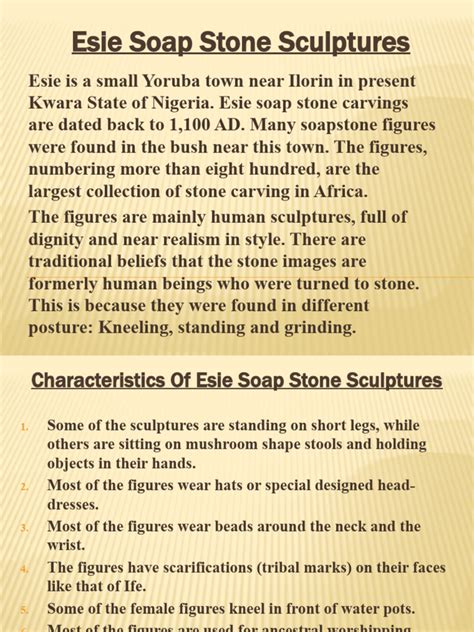
Soapstone sculptures from Esie, depicting men and women with crowns and jasper beads (Esie Museum, Nigeria).
The rampart and ditch system of Ijebu-Ode measures around 10 meters from the floor in its best-preserved sections, the height totaling over 20 meters when the wall at its crest is included, the width of the ditches is around 5 meters, and the walls were originally perfectly vertical made of hardened laterite. This “walls” system extends over 170 km and would have been one of many similar fortification systems in the Yorubaland, including at Ile-Ife and the more famous Benin “walls”.
The formal period of consolidation and emergence of the centralized kingdom of Ife is dated to the 11th century when the first city wall was constructed and the earliest potsherd pavements were laid. These constructions are the most visible remnants of the earliest processes of political re-alignments that occurred in Ife's classical era that were associated with the upheavals brought about by the confrontation between the Obàtálá and Odùduwà groups in which the former were deposed by the latter by employing the services of O̩ranmıyan, a mounted warrior associated with the Odùduwà group, after a civil war had weakened the rule of the Obàtálá.
The deeply allegorical nature of the tradition has spawned several interpretations, most of which agree with the identification of at least three figures in the epic as real personalities: Obalufon I (a ruler from the Obàtálá group that reigned before the civil war), Obalufon II (also called Alaiyemore; he was the successor of Obalufon I and is associated with both groups), Moremi (queen consort of Obalufon II, she is also associated with both groups), and at times the figure O̩ranmıyan who may represent Ife's military expansionism or was a real figure who ruled just before Obalufon II, the latter of whom is credited as the patron of Ife's arts, especially the copper-alloy masks, and remembered as the pacifier and peace-maker of the warring parties along with his consort Moremi, heralding a period of peace and wealth in the kingdom.
Other groups that feature prominently include autochthonous Igbo groups as well as the Edo of Benin kingdom. The former were allied with the Obàtálá group and had their influence diminished by queen Moremi. This group is postulated to be related to the ancient Igbo-Ukwu bronze casters of the Nri kingdom in southeastern Nigeria that also had a similar but older concept of divine kingship as Ife as well as an equally older naturalist bronze-casting art tradition from which Ife derived some of its motifs for displaying royal regalia.
Read also: African Warrior Costume Guide
On the other hand, the Edo of Benin came under the orbit of Ife during the late phase of Ife's classical era and continued to regard Ife’s ruler as their spiritual senior by the time the Portuguese accounts of the kingdom were being written. Added to this melting pot of ethnicities are the Songhai-speakers (Djerma) who linked Ife to the West African emporiums of Gao and Timbuktu, the latter had since fallen under the Mali empire’s orbit during the reign of its famed emperor Mansa Musa (r. 1280 -1337AD); the presence of all these non-Yoruba speaking groups in Ife is a testament to its cosmopolitanism and augments the claim in its traditions as the origin of mankind.
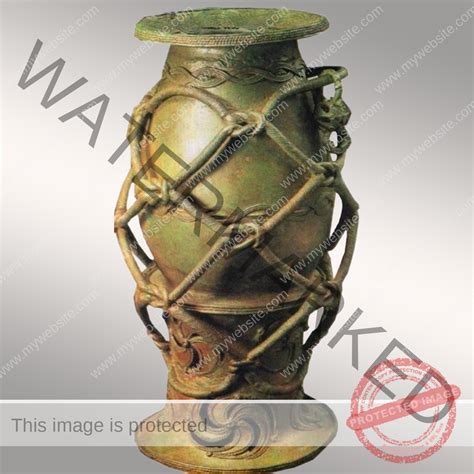
Bronze roped pot, wine bowl, and vessel shaped in form of a triton snail-shell; from Igbo Ukwu, dated to the 9th century AD, (Nigeria National Museum).
Classical Ife: Art, Religion, Conquest, and Wealth
Archaeologically, the tumultuous nature of the Ife epic isn't immediately apparent. Ile-Ife was consistently flourishing from the 12th to the early 15th century, as indicated by the extensive potsherd pavements laid virtually everywhere within its inner walls as well as many parts of the settlements between the inner and outer walls, which had a circumference of over 15km. These potsherd pavements consisted of broken pottery that was laid in neat herringbone patterns inside a fairly deep surface-section of the street that had been prepared with residual palm oil. The street was then partially backed by lighting dry wood above it. The end result was a fairly smooth street whose surface integrity could last centuries without the need for extensive repair. The potsherd pavements were also used in house floors and temples floors as well as compounds surrounding them with more elaborate patterns reserved for temples and other prestigious buildings.
The tradition of potsherd pavements seems to have been widely adopted in the West African cities of the early 2nd millennium in both the “sudanic” regions controlled by Mali such as the ancient city of Jenne-Jenno as well as the “forest regions” under Ife’s orbit although its unclear whether Ife was the origin of this technology.
Added to this was the material culture of Ife, specifically its pottery and terracotta sculptures, which span a fairly wide range of production from the 10th to 16th century. The peak in production of these artworks was in the 13th and 14th century when most of the copper alloy and similar terracotta sculptures were made, the majority of which have been found in Ife itself, such as in the Wunmonije compound and the Ita Yemoo site, as well as the sites of Tada and Jebba, which are considerably distant from Ife, attesting to the level of political control of Ife, whose densely settled city had an estimated population of 75-100,000 at its peak in the 14th century, making it one of Africa's largest cities at the time.
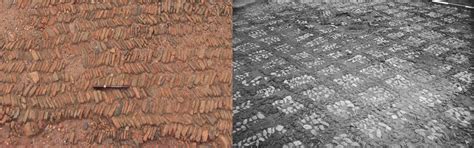
Potsherd pavements near Igbo-Olokun grove in Ile-Ife, potsherd and quartz pavements in a section of Ile-Ife.
Ife's prosperity was derived from its monopoly on the production of glass beads that were sold across the Yoruba land and in much of “sudanic” West Africa as far as Gao, Timbuktu, Kumbi-Saleh, and Takedda (the old commercial capitals of the region’s empires). Ife's glass has a unique signature of high lime and high alumina content (HLHA) derived from the local materials which were used in its manufacture, a process that began during the 11th century. The beads were made by drawing a long tube of glass and cutting it into smaller pieces, the controlled heating colored them with blue and red pigments derived from the cobalt, manganese, and iron in the materials used in the glass-making process such as pegmatitic rock, limestone, and snail shells.
Initially, the Yorubaland used jasper-stone beads such as those depicted.
The sublime beauty, remarkable expressiveness, elegant portraiture, life-size proportions, sheer volume, and sophistication of the Ife collection, which included many naturalist (realistic) works, was especially appealing to Western observers who immediately drew parallels to some of their best art traditions, particularly the ancient Greek sculptures, and ascribed mythical origins to Ife’s artists, claiming their works as accomplishments beyond the capacity of an African artist, and clouding our understanding of Ife's history and its art tradition.
The distinctive sculptures of Ife, which include both naturalist and stylized works, were mostly part of ancestral shrines and mortuary assemblages and were a product of ancestral veneration in Ife's religion. These copper-alloy and terracotta sculptures represent real personalities; both royal and non-royal, who were active in the “classical period” of Ife, especially between the late 13th and early 14th century; many of whom played an important role in the growth of the kingdom, as well as heads of important "houses" in the kingdom who were venerated by their descendants.
Ife's artworks were commissioned by Ife’s patrons; they were sculpted by Ife artists who employed styles and motifs common in Yoruba art using materials derived from Ife's immediate surroundings and from their inventive glass and metallurgical crafts-industries; its these artists of Ife that invented glass manufacture, making this African kingdom one of the few places in the world where glass was independently invented.
Ife's artists conveyed the visual forms and power of their patrons into sculpture in a process that was independent of the rest of the world’s art traditions which Ife's art is often compared to. The aesthetics and visual systems of Ife’s art that produced the naturalist sculptures which awed Western observers (and by extension modern art observers), wasn't a natural consequence of Ife's "exceptionalism" relative to the rest of the African art traditions (which would be incorrect since naturalist sculptures are present in Nubian, Asante, Benin and Kuba art among others) nor was it a “natural progression” of artistic sophistication from the abstract/stylized figures to the naturalist figures (this theory in Art history is Eurocentric and pervades art criticism, but even in Europe its validity is debated among classical art historians who question the presumption that the naturalist Greco-roman sculpture and the medieval renaissance art it influenced, corresponded to peaks in cultural accomplishments).
Ife's naturalism, as well as its stylized art, was instead a product of the political and religious concepts of expressing power and ritual that were prevalent in the kingdom at the time these sculptures were made. These highly sophisticated artworks are best interpreted within the political and religious context of the kingdom of Ife in which they were produced and not through the myopic lens of “naturalist progression” which invites superficial comparisons and misconstrues the intent behind the visual messages that Ife’s artists communicated and the rest of African artists with whom they are often unfairly juxtaposed against.
Here is a table summarizing key aspects of the Kingdom of Ife:
| Aspect | Description |
|---|---|
| Origins | Yoruba epic of Obàtálá and Odùduwà; consolidation of small polities |
| Early States | Oba Kingdom, Idoko Kingdom |
| Classical Era | 11th-15th century; construction of city walls and potsherd pavements |
| Key Figures | Obalufon I, Obalufon II, Moremi, O̩ranmıyan |
| Artistic Production | Copper-alloy and terracotta sculptures; peak in 13th-14th century |
| Economic Base | Monopoly on glass bead production |
| Cosmopolitanism | Presence of Igbo, Edo, and Songhai-speaking groups |
