African table lamps, particularly those designed in the Blackamoor style, have a rich and complex history within European decorative art. Originating in the Early Modern period, the Blackamoor figure is a visual trope depicting a man of sub-Saharan African descent, typically adorned in clothing suggesting high status.
These figures have been incorporated into various decorative items, including sculpture, jewelry, and furniture. In modern times, the Blackamoor is considered to have racist connotations, with its association to colonialism and slavery.
Art historian Adrienne L. Childs explains that when applied to people, the terms "black" and "blackamoor" are inherently connotative. "Black" as a social class, was introduced to create an inferior status or class of people that lack humanity. The term is ultimately derived from the name of the Moors, a historic people in the western Mediterranean.
Blackamoors have a long history in decorative art, stretching back to 17th century Italy and the famous sculptor Andrea Brustolon (1662-1732).
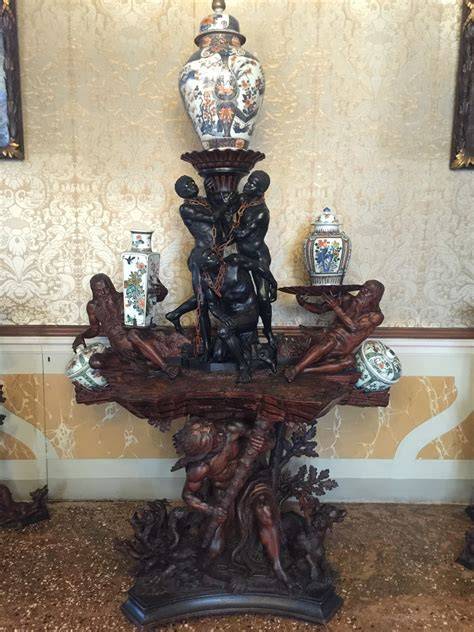
Console with Moor by Andrea Brustolon
Read also: Experience Fad's Fine African Cuisine
Common Examples in Decorative Art
Common examples of items and objects decorated in the blackamoor style include sculpture, jewellery, and furniture. Typically the sculpted figures carried something, such as candles or a tray. In jewelry, blackamoor figures usually appear in antique Venetian earrings, bracelets, cuff links, and brooches (Moretto Veneziano).
Blackamoor figures are typically male, sometimes depicted with a head covering such as a turban. Sculptures are typically carved from ebony, or painted black to contrast with the bright colors of the embellishments.
In decorative sculpture, the full body is depicted, either to hold trays as a servant figure, or bronze sconces to hold candles or light fixtures. They may be incorporated into small stands, tables, or andirons, and are often portrayed in pairs.
Often, blackamoor figures are depicted in acrobatic positions that would be physically impossible to hold for any extended length of time.
Historical Context and Symbolism
From the period of the Atlantic slave trade, it has also been categorised as a 'kneeling slave'. The statue was set up as one monument to honour the 1st Earl of Warrington by his son, the second Earl in c. 1735. Aleksandr Pushkin had a blackamoor figurine on his desk to remind him of Abram Petrovich Gannibal, his great-grandfather.
Read also: The Story Behind Cachapas
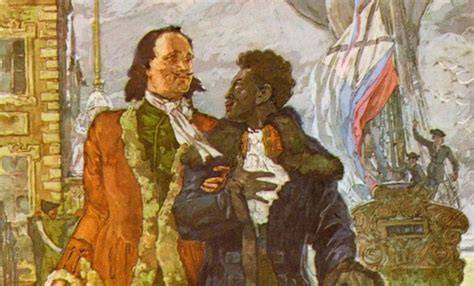
Абрам Петрович Ганнибал
Vogue editor Diana Vreeland had a famous collection of blackamoor figurines and blackamoor jewelry and famously said: “Have I ever showed you my little blackamoor heads from Cartier with their enameled turbans? I'm told it's not in good taste to wear blackamoors anymore, but I think I'll revive them." Civil rights activist and pop star Anita Pointer of the Pointer Sisters has some blackamoor pieces in her extensive collection of black memorabilia that she started in the 1970s. As a child, she witnessed extreme racial oppression in her mother's hometown, Prescott.
In heraldry, a blackamoor may be a charge in the blazon, or description of a coat of arms. The reasons for the inclusion of a blackamoor head vary.
Fred Wilson, an African-American sculptor, displayed an installation at the 2003 Venice Biennale that incorporated blackamoors. Wilson placed wooden blackamoors carrying acetylene torches and fire extinguishers. Wilson noted that such figures are so common in Venice, few people notice them. He said, "They are in hotels everywhere in Venice ... which is great, because all of a sudden you see them everywhere.
Controversy and Modern Perspectives
In modern times, the blackamoor is considered to have racist connotations, with its association to colonialism and slavery.
Read also: Techniques of African Jewellery
Here's a table summarizing key aspects of Blackamoor figures:
| Aspect | Description |
|---|---|
| Origin | Early Modern period in Europe, particularly Italy |
| Depiction | Man of sub-Saharan African descent in high-status clothing |
| Materials | Ebony, painted wood, bronze, and precious metals |
| Common Uses | Sculptures, jewelry (earrings, brooches), furniture (table legs, candle holders) |
| Modern View | Considered racially insensitive due to associations with colonialism and slavery |
