Morocco, a land of culture, civilization, and authenticity, attracts not only tourists but also numerous production companies. The diversity of landscapes and the ambient lighting make it an ideal location for filming series, films, and blockbusters.
Morocco is home to a wide range of landscapes that can double for numerous settings around the globe. From the vibrant markets of Marrakech and the ancient medinas of Fez to the rolling dunes of the Sahara Desert and the snow-capped peaks of the Atlas Mountains, Morocco offers filmmakers a unique palette of locations.
Whether you're looking for urban scenes, exotic deserts, lush oases, or stunning coastlines, Morocco has it all.
Filmmakers worldwide have been drawn to Morocco because of its proximity to the West and the abundance of stunning settings to realize their visions. Morocco boasts breathtaking landscapes, distinct architecture, and lively culture, making it an exceptional choice for filming.
Here are some of the reasons why Morocco is an ideal location for film production:
Read also: Hunting in Africa
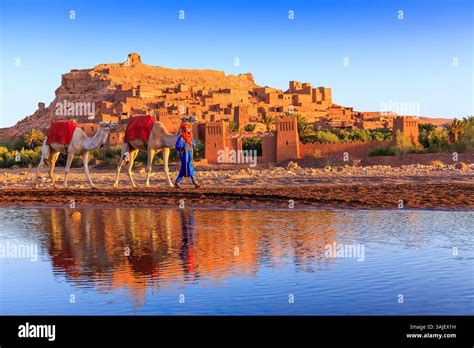
Ait Benhaddou in Ouarzazate, Morocco
Diverse and Stunning Locations
Morocco’s rich history and cultural diversity are reflected in its architecture, ranging from ancient Roman ruins to stunning Islamic art, Berber fortresses, and French colonial buildings. This variety offers a wealth of settings to bring any story to life.
Ideal Climate
Morocco enjoys a pleasant climate throughout the year, with over 300 days of sunshine annually. This consistent weather makes it ideal for shooting any time of the year, minimizing delays due to weather conditions.
Cost-Effective Filming
Compared to many Western countries, Morocco offers highly competitive production costs. Filming in Morocco is considerably more cost-effective due to the lower expenses for permits, location fees, crew, and equipment rentals.
Government Incentives and Support
Morocco has a long history of welcoming international film productions and offers a range of incentives to encourage filmmakers. The Moroccan Cinematographic Centre (CCM) offers financial rebates and support for foreign productions, simplifying the process of obtaining permits and providing logistical assistance.
Read also: Force Recon Marine's Transformation
Skilled Local Talent
Morocco boasts a pool of skilled local talent and multilingual crews who are experienced in working with international productions. From actors to technicians, local professionals bring a wealth of experience, cultural insight, and creativity to any project.
Historical Context of Moroccan Cinema
The history of film in Morocco, like that of modern technology in most of the world, begins with colonialism. Spain invaded Morocco in 1860, and England and France’s involvement in Morocco subsequently grew until the three powers agreed in 1907 to Franco-Spanish control.
During this period, The French Lumière brothers shot a few very short films in Morocco in 1896. They were the first to show a film in Morocco, presenting some footage to a limited audience in the royal palace in Fez. In these circumstances of political upheaval, the sultan signed an agreement accepting the French Protectorate in 1912.
French occupation and administration of Morocco, despite indigenous resistance, involved a radical shift in social organization. The French built villes nouvelles, new cities equipped with modern conveniences and colonial institutions. Approximately fifty features were filmed under colonial rule (1912-1956), consisting entirely of European or American film crews.
French administrators and colons (settlers) built movie theaters in the villes nouvelles; of course, they did not show films in Moroccan Arabic. However, Egyptian films became popular by the 1950s. Moroccans’ preference for Egyptian films, due to shared linguistic and cultural components, contributed to a Pan-Arab consciousness that threatened any vestige of legitimacy for colonial governments.
Read also: Chad Reid shooting incidents: An in-depth look
The first film laboratory, Cinéphane, opened in Casablanca in 1939. In 1944, the Service du Cinéma was created in the Ministry of Information, and the Centre Cinématographique Marocain (CCM) was set up to make documentary films, especially of a tourist nature. Some of these short documentaries were shown by film buses (ciné-bus) that traveled throughout rural areas to educate the masses.
In 1945, the privately owned Souissi studio and laboratory opened in Rabat, forming the second highest quality studios in Africa, after Egypt. After independence, they fell into financial crisis and closed.
Films played a large part in the lives of urban young people in twentieth-century Morocco. One enthusiast, Omar Akalay, wrote about his memories of 1950s Morocco and the relief that cinema provided amid political unrest. Early Moroccan films retain allusions to this unrest.
After Morocco became independent in 1956, Moroccans created short films for the CCM. Complying with state interests in popular education, they showed weekly in theaters throughout Morocco. The Cinema Support Fund was instituted one year before independence; it oversaw the price of tickets. A fee was added to the normal ticket price to offset costs of film production and the building of new theaters.
The Moroccan government took steps in the 1980s to support a national film industry, instituting a cinema tax and forming a commission for film production and promotion. This support enabled an increase in Moroccan film production. In the twenty-two years from 1958 to 1980, only twenty films had been completed. In contrast, thirty-one films were created in five years from 1980 to 1984.
Challenges in Film Distribution
A very select group of people control most film distribution, favoring an import-based monopoly of Moroccan cinemas. Most imported films come from only four countries: USA, France, India, and Italy. Egyptian films tend to come in video forms, as opposed to films for theaters. The profits gained by foreign films, and the low incentive to invest in Moroccan films, kill local market potential.
Distributors and exhibitors claim that Moroccan films will not fill theaters. The number of theaters is symbolic of their sense that their business has shrunk and is endangered. The debate revolves around opposing priorities and the definition of a national cinema: cultural patrimony vs. commercial product.
Foreign productions sell cheaply because by the time they arrive in Morocco, they have already more than earned their costs from previous distribution. In addition, foreign productions come replete with a range of publicity materials, the cost of which Moroccan distributors could not afford.
Due to foreign domination of domestic markets, festivals provide the most publicity and viewing of Moroccan films available. They also promote Morocco’s image as a modern, advanced member of the international community.
The CCM created the National Film Festival (Festival National du Film Marocain) in 1982 to showcase new Moroccan films, at least for a domestic audience.
Contemporary Moroccan Cinema
In what has been described as a "vibrant new era" of Arab cinema, the 2020s has seen some stability in the Moroccan film industry. In 2022, the first Moroccan animated films and animated series were produced. In 2023, Moroccan cinema saw record-breaking production numbers, box office hits, and new infrastructure, partly due to the CCM's support and investments in upgrading and digitizing theaters.
Cinema in Morocco has a long history, stretching back over a century to the filming of Le chèvrier Marocain ("The Moroccan Goatherd") by Louis Lumière in 1897. In 1944, the Moroccan Cinematographic Center (CCM), the nation's film regulatory body, was established.
Six years later, Mohammed Ousfour made the first Moroccan movie, Le fils maudit ("The Damned Son"). Love in Casablanca (1991), starring Abdelkrim Derkaoui and Muna Fettou, was one of the first Moroccan films to deal with Morocco's complex realities and depict life in Casablanca with verisimilitude.
A first generation of directors made film in Morocco in the 1970s-1990s and developed the film industry in Morocco. Since roughly the year 2000, a younger generation of Moroccan filmmakers has been taking over.
Internationally Renowned Films Shot in Morocco
Many production companies flock to the country being attracted by the diversity of the landscapes and the ambient lighting ideal for the filming. Series, films and blockbusters are regularly shot in Morocco.
Internationally renowned films shot in Morocco include: Inception (2010), Gladiator (2000), Babel (2006), The Last Temptation of Christ (1988) and The Man Who Knew Too Much (1995). Martin Scorcese used the biblical settings of Morocco for his film The Last Temptation of Christ (1988).
Morocco's landscapes were also a great asset to replicate ancient Rome in Ridley Scott's Gladiator (2000) and Egypt in Alain Chabat's Mission Cléopatre (2002). Kasbahs and desert landscapes were used to reproduce the imaginary kingdom of Westeros in the Game of Thrones series and will also be used for the new House of Dragon series, whose events take place 300 years before those of Game of Thrones.
| Film Title | Year | Director |
|---|---|---|
| Inception | 2010 | Christopher Nolan |
| Gladiator | 2000 | Ridley Scott |
| Babel | 2006 | Alejandro G. Iñárritu |
| The Last Temptation of Christ | 1988 | Martin Scorsese |
| The Man Who Knew Too Much | 1956 | Alfred Hitchcock |
| Mission Cléopatre | 2002 | Alain Chabat |
Film Studios in Morocco
As you enter the Studio CLA in Ouarzazate, you’ll instantly dive into the sets that have been used in the making of many films. Outside the site, you’ll witness a geuine reconstruction of Jerusalem in the Middle Ages. If you're staying in Ouarzazate, the Studio is a place you can’t afford to miss.
As you leave Ouarzazate heading to Marrakech, the Atlas Studio offers a view that covers several sets from several films: Gladiator, Kundun, Asterix mission Cleopatra, Kingdom of Heaven, Ben-Hur...
Ouarzazate is known for its film studios.
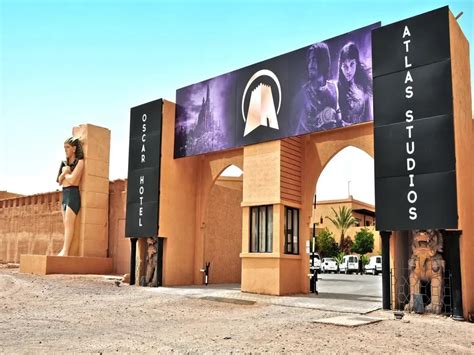
Atlas Studios in Ouarzazate
Marrakech International Film Festival
It is one of the most beautiful cinematographic and cultural events. It welcomes and pays tribute to personalities and actors who have succeeded in promoting cinema all over the world.
Created in 2001 by His Majesty King Mohammed VI, the Marrakech International Film Festival is a real gathering as it offers uncensored films, masterclasses, tributes, but also the best of Moroccan cinema. Special attention is given to young talents, through the "Cinécoles" competition which rewards the best short films made by students.
Like most industries worldwide, the film industry in Morocco is in a period of transition. For instance, focusing on public theater spaces no longer holds up as it did prior to the COVID-19 pandemic. Film distribution has also moved online. The implications of these changes in viewing (moving from public viewings to private viewings and from brick-and-mortar to virtual) are still to be realized.
Popular articles:
tags: #Morocco
