Africa, a continent of diverse ethnicities, languages, and cultures, has a rich philatelic history shaped by both colonial influences and the emergence of independent nations. From the early European contacts to the post-colonial era, postage stamps have served not only as proof of prepayment for mail but also as miniature works of art reflecting the continent's evolving identity.
The European nations that colonized Africa during the nineteenth and twentieth centuries shaped African postal systems and, hence, African philately. Even the postal systems of Liberia and Ethiopia, the two countries that were not colonies, had postal systems that were designed and supplied from outside the continent.
Images of British kings and queens appear on the stamps of British colonies prior to the 1930s, after which local scenes appeared. French symbols graced the stamps of French colonies until, as with British stamps, printers included local scenes. German colonies, which ceased to exist after WWI, showed the Kaiser’s yacht.
Few places in Africa had adequate facilities to print postage stamps. When supplies of a particular value ran out, local presses created 'provisional' issues-overprints and surcharges, for instance-pending the arrival of new supplies. Such circumstances produced many of the rarities of African philately.
The African stamp market, in general, is one of the hottest areas of the market just now.
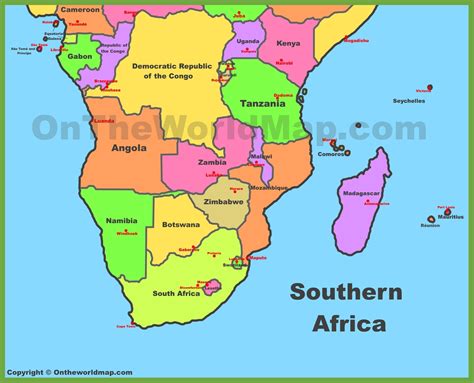
Political map of Southern Africa
Read also: African Postage Stamp Collection
Colonial Influences on African Stamps
By 1850, the period of extensive capture of new slaves in Africa was largely over and the European scramble for political influence and control in Africa began to reach its height. Seven of the nine major European powers of the nineteenth century competed for political influence in Africa.
Great Britain, France, Portugal, Spain, Italy, Belgium and to a lesser extent Germany all attempted military and political occupations of Africa. The largest and most significant of the colonial African powers was Great Britain. Britain issued stamps for scores of its colonies through its postal agents-the Crown Agents.
There are two types of British influenced stamp issues -those that were produced in Britain by the Crown Agents and those that were produced indigenously in Africa. The Crown Agent stamps are very popular with collectors but unfortunately tell us little besides the political entities for which they were issued. Throughout the period 1850-1950 these British Crown Agent issues changed little.
Usually, they had the picture of the reigning British monarch (Queen Victoria through George VI) along with the name of the country from which the stamp was issued. Some ten or more of the stamps in the British African areas of influence were not issued or administered by the Crown Agents. These stamps were issued by the Afrikaans who occupied Southern Africa.
Read also: Exploring Ghana's Culture via Stamps
French Colonies
The French created scores of African colonies, mainly centered in sub-Sahara Africa. The colonial stamps that France issued for its African colonies are very different than any of the other European colonial administrators. After the first few issues (which are largely just French stamps overprinted for use in the colony to which they were sent), the French African colonial issues began to be long colorful pictorial sets, illustrating native African life.
None of the other European stamp issuers for Africa did this, and we are indebted to the French colonial post office for many of the earliest and most indigenous illustrations of African flora, fauna and people. Early stamp collectors enjoyed these French issues. Inexpensive, full color illustrations of African life did not exist outside of these French colonial postage stamps. Collectors bought them eagerly and, as the price of the earlier issues rose with demand, created a large market for later pictorial issues.
Portuguese Colonies
The Portuguese maintained two large colonies in Southern Africa-Angola and Mozambique, as well as several other stamp issuing entities that were more post offices than administrative states such as Horta and Kionga. The two main colonies of Portugal followed a issuing policy that seems to have been a hybrid of Britain and France. The earliest issues were boring and bland denomination only issues. But, noticing the French success with collectors, the later nineteenth and earlier twentieth century issues are colorful and interesting depictions of African life.
South Africa: A Detailed Look
The Republic of South Africa, previously The Union of South Africa, is a country located at the southern tip of Africa, with a coastline on the Atlantic and Indian Oceans. Before South Africa was united in 1910, each part of what would later become South Africa issued their own stamps. During the Second Boer War, some cities issued their own stamps.
The first stamp of the Union of South Africa was a 21⁄2d stamp issued on 4 November 1910. It portrayed the Monarch King George V and the arms of the four British colonies which formed the Union: Cape Colony, Natal, Orange River Colony and Transvaal.
Read also: A Chronicle of Nigerian Postage Stamps
Most South African stamps issued between 1926 and 1951 were in pairs. The Second World War was the impetus for another well-known South African stamp format, the so-called “bantams”. In 1941 a set of stamps was issued to publicise the War Effort. Between 1942 and 1944 these stamps were reprinted in a much smaller format, between half and one third the size of the previously issued stamps, hence the nickname “bantam”.
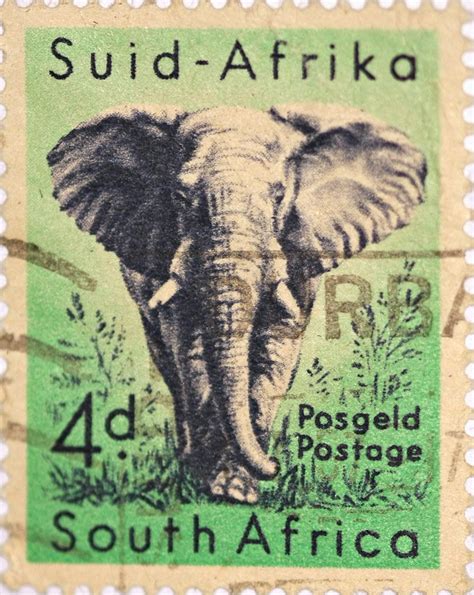
South African Bantam Stamps
After the end of the Second World War, the push for full independence from Great Britain intensified. This was achieved in 1961 when the Union of South Africa became the Republic of South Africa. The change of currency took place in February, which resulted in a stop-gap measure of several previously issued stamps being reprinted in the new currency.
Stamps inscribed with the new name and currency were ready to be issued on the first day of independence, 31 May 1961, although the bilingual pairs format was no longer in use, with each stamp being inscribed in both English and Afrikaans. The first set of the Republic was issued on 31 May 1961.
From 1961 to 1966, stamps were inscribed "REPUBLIC OF SOUTH AFRICA - REPUBLIEK VAN SUID-AFRIKA". However, from 1967 stamps were simply inscribed "RSA". South Africa issued many attractive and interesting stamps throughout the 1970s and 1980s, including what is arguably the country's most (in)famous stamp, the withdrawn “Word of God” 40c stamp from 1987.
The stamp was to have been released as part of a set of four commemorating the Bible Society of South Africa, but was withdrawn after objections to the use of the Hebrew word for “God”.
Post-Independence Stamp Issuance
Between 1950 and 1965 nearly all the African colonies gained their independence. The African colonies had done well being on their own and they were little interested in reestablishing the status quo of older colonial rule. But most colonizers won’t give up their colonies without a fight (see-the American Revolution). When the African countries demanded their independence, there was nothing the Europeans could do but accede.
One of the problems encountered by some African countries is that their borders were not drawn rationally based on the interests and political allegiance of the indigenous inhabitants. Rather, one of the legacies of the colonialism is borders that were drawn on maps in European conference rooms with little attention paid to who lived where.
African postage stamps have evolved in two basic directions over the last fifty years - some countries subcontract out their postal issues and some have maintained internal control of their stamp issuance. It is not well known that several large corporations exist which essentially contract with smaller poorer nations to gain control of their postal emissions.
Many of the larger and more economically significant African nations have retained control of their post offices and issue stamps from which we can learn about that country’s history and culture.
But, increasingly, and importantly, African stamps are related to African interests. African statesmen are honored and commemorated. African culture is depicted and exhibited. African artists are designing their own stamps and African values and sensibilities are making these stamps appealing to the people who live in these countries.
Now, African nations are proudly designing and producing postage stamps to honor their own heritage.
Understanding French West African Stamps: A Collector's Guide to Philatelic History and Origins
The Growth of African Philately
Traditionally, the stamps of modern African nations were rarely collected because of lower education levels and comparative poverty. Over the last decade many African nations have enjoyed the fastest growing economies in the world.
Wealthier, well educated people often collect stamps and this is as true of the emerging African middle class as it was with the Chinese, Indian, and American middle classes before them.
Finally, the way any country’s stamps become popular and valued as a scarce collectible commodity is for the stamps to have a wide philatelic audience in the three main areas where most of the world’s collectors live-the United States, Europe and China.
In this regard, modern African stamps increasing emphasis on indigenous values and culture has ensured an increasing market for their stamps.
Popular articles:
tags: #Africa
