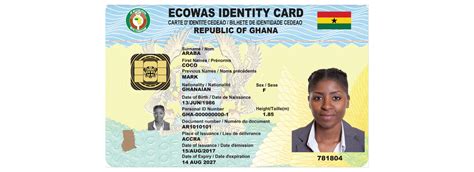
The Ghana Card is the official National Identity Card issued to Ghanaian citizens and non-citizen residents living in the country. It serves as proof of identity, citizenship, and residence of the holder.
What is the Ghana Card used for?
The card has many established uses, including SIM card registration, bank account establishment, residence permit registration or renewal, travel documentation, business registration, and more. As of July 1, 2022, it has become the only form of identification accepted to set up and manage various types of accounts in Ghana.
Who Should Apply?
Individuals who intend to live in Ghana, or spend a reasonable amount of time in the country, and need access to financial services or immigrations services are encouraged to register for their GhanaCard at the earliest possible time.
The Non-Citizen Ghana Card
The Non-Citizen Ghana Card is a national identification card issued by the National Identification Authority (NIA) together with the Ghana Immigration Service for non-Ghanaians who reside in Ghana. It is a requirement for foreigners living or doing business in Ghana to have this card for various activities like banking, healthcare, acquiring a SIM card, etc.
Obtaining a non-citizen Ghana card is easy. You can start the process by filling out the application registration form. After your details have been verified and biometric information processed, you will wait a few minutes for your card to be printed. In a case of system challenges you may be given a date to collect your Non-Citizen Ghana Card (usually within a week).
Read also: Kenyan Media Landscape
The Non-Citizen Ghana Card is initially valid for 1 year. To renew your Non-Citizen Ghana Card, the process closely mirrors the initial application. You will be required to provide the same information as during the first registration. It’s important to renew your card before it expires.
Requirements and Information Needed
Other Information that you will be required to provide:
- Contact details.
- Hight.
- Residential address.
- Hair colour.
- Eye colour.
- Languages spoken.
- Applicants parent information.
The Non-Citizen Ghana Card comes with a processing fee of $120 or the Ghana cedi equivalent for first issuance. The renewal fee is $60.
What to do if your card is lost, stolen, or damaged
If your Non-Citizen Ghana Card is lost, stolen, or damaged, report it immediately to the nearest NIA office. You first need to go to a police station and fill a form. You will be given a document to submit to the National Identification Authority (NIA) for the replacement. At the NIA office, you will have to take a form for card replacement.
For Ghanaians, you Pay a current amount of Ghc 30.15 via mobile money. Non-Ghanaians Replacing loss Non-Ghanaian Identity Card, You pay U$60 or its equivalent.
Read also: Baskets from Ghana
Important Notice
Kindly note effective from 1st July 2024, the Visa Application Centre will be relocated to our upgraded modern facility at the below address. Mandatory booking of Appointment for enrollment of the Non Citizen IDcard at VFS.
Please be informed of New Working Days for enrollment of the Non Citizen IDcard at VFS. The Premium Centre for Foreigner Identification Management System (FIMS) Registration will be opened on the following days Tuesday and Thursday from 08:00 to 14:00. Appointment slots will be opened accordingly on the said days.
Uses of the Ghana Card
The NIA facilitates the integration of all public sector/ civil operation, law enforcement, corporate and business applications/systems to the NIS, and the provision of general identification services.
Here are some of the specific uses of the Ghana Card:
- Credit Information: The use of the Ghana Card can enable the banks in Ghana to easily establish a person's credit-worthiness from the Credit Referencing Agencies any time they apply for a loan.
- Registration of Business: Business registration is linked to a Ghana Card holder's PIN to help identify them as the true owner of their business.
- Education: The PIN of a Ghana Card holder's child is captured during enrollment into primary school and the number is used for admission into every school level until the child completes tertiary education. This helps in tracking the progress of a Ghana Card holder's child in the educational sector for necessary policy interventions.
- Job Search: The Ghana Card is used to establish a persons identity during job search.
- Access to Social Services: The Ghana Card authenticates a persons entitlement to government services.
- Protecting the Rights of Children: Child trafficking especially for forced labour is on the increase in Ghana and children get lost daily.
- E-Commerce & Payment Industry: The Ghana Card is used in a multiplicity of situations - to register for offline services such as a loan or an insurance plan, while buying a car.
- Pension Claims: The Ghana Card identifies a Ghana Card holder as the rightful and only person authorized to receive their pension benefits.
- Insurance Claims: A person needs to prove their identity in the event of any disaster for which they have to make insurance claims.
The Ghana Card (ID Card) is plastic and has the size of a credit card.
Read also: Ghanaian Business Profile: Franko Trading
THIS CARD IS THE PROPERTY OF THE GOVERNMENT OF THE REPUBLIC OF GHANA.
On the photo a micro-holographic reflecting stamp is placed. The back contains the machine readable zone. The microchip, inside the card contains biometric data such as fingerprints of the holder, the image, signature, etc. The data can be extracted from the chip with wireless RFID technology.
The ID card serves as a travel document for national travel. The identity card is requested at the districts (and is issued for free to all Ghanaians) where a digital picture of the bearer's face and fingerprints are taken. The National Identification Authority has started an online process to issue Ghana Cards. This involves submitting the printed document at the NIA office.
How to register for a non-citizen Ghana card ( foreign nationals )
Brief History of the Ghana Card Project
In July 2023, through the initiative of the Vice President, Dr. The project was discontinued three years later due to problems with logistics and lack of financial support. This was the first time the idea of national identification systems arose.
Again, in 1987, the Government of the Provisional National Defence Council (PNDC) through the National Commission for Democracy (NCD), revisited the national identity card concept by establishing committees including a Technical Implementation Committee. Due to economic difficulties, the issue was not pursued.
Once again, in 2001, when the National Economic Dialogue was convened, the National Identification System (NIS) was seen as a major policy concern. By 2003, the National Identification Secretariat was set up to implement and manage the National Identification System (NIS). The Act establishing the National Identification Authority was passed in 2006, with Prof.
Pick-up trucks, vans and civilian buses were procured for the mass registration exercise. Drivers were recruited, interviewed and selected. The National Identification Authority's Head Office was built and 97% of the building completed.
A pilot mass registration exercise was held to test the forms and equipment deployed for the exercise as well as the registration process as outlined by the Authority. This pilot registration exercise took place in two communities - Abokobi and Sege - in the Greater Accra Region, for 10 days from July 27 to August 4, 2007.
The testing selection and training of staff for the Central and Western regions were executed successfully, with mass registration taking off in the Central Region on July 1, 2008.
By the end of July 2008, Prof. On July 22, 2009, Dr.
| Service | Fee (Ghc) |
|---|---|
| Replacing lost Ghana Card (Ghanaians) | 30.15 |
| Replacing lost Ghana Card (Non-Ghanaians) | US$60 or equivalent |
| First Issuance (Non-Citizen Ghana Card) | US$120 or equivalent |
| Renewal Fee (Non-Citizen Ghana Card) | US$60 |
Firmus Advisory Limited is a business consulting firm operating in three areas in Ghana:
- Regulatory Compliance: Company Formation, Tax Advisory, Immigration Support Services, Regulatory licensing and permits, Product certification.
- Market Research: Customer Experience, Market Insights, Industry Research, Employee Engagement, Business Plan.
- Trade Development: Business to Business match-making, Market Development, Market Entry Services, In-market seminars for visiting business delegations.
Popular articles:
tags: #Ghana
