Nigeria, officially the Federal Republic of Nigeria, is a country in West Africa. It is situated between the Sahel to the north and the Gulf of Guinea in the Atlantic Ocean to the south. Nigeria borders Niger in the north, Chad in the northeast, Cameroon in the east, and Benin in the west. With a population of more than 230 million, it is the most populous country in Africa, and the world's sixth-most populous country.
Nigeria is a regional power in Africa and a middle power in international affairs. Nigeria's economy is the fourth-largest in Africa, the 53rd-largest in the world by nominal GDP, and 27th-largest by PPP. Nigeria is often referred to as the Giant of Africa by its citizens due to its large population and economy, and is considered to be an emerging market by the World Bank.
The name Nigeria derives from the Niger River running through the country. This name was coined on 8 January 1897, by the British journalist Flora Shaw. The neighboring Republic of Niger takes its name from the same river.
The federal government of Nigeria is composed of three distinct branches: the executive, the legislative, and the judicial, whose powers are vested and bestowed upon by the Constitution of the Federal Republic of Nigeria. One of the primary functions of the constitution is that it provides for separation and balance of powers among the three branches and aims to prevent the repetition of past mistakes made by the government.
Nigerian politics take place within a framework of a federal and presidential republic and a representative democracy, in which the president holds executive power. Legislative power is held by the federal government and the two chambers of the legislature: the House of Representatives and the Senate.
Read also: The Rise of Nigerian Basketball
The most populous country in Africa, Nigeria accounts for approximately 20% of West Africa's people. Although less than 25% of Nigerians are urban dwellers, at least 24 cities have populations of more than 100,000. The variety of customs, languages, and traditions among Nigeria's 250 ethnic groups gives the country a rich diversity.
Before the colonial period, the area which comprises modern Nigeria had an eventful history. More than 2,000 years ago, the Nok culture in the present Plateau state worked iron and produced sophisticated terra cotta sculpture. In the northern cities of Kano and Katsina, recorded history dates back to about 1000 AD.
Historical Context
The present day territory of Nigeria was home to a vast array of city-states. In the early 19th century the Fula jihads culminated in the Sokoto Caliphate. The modern state originated with British colonialization in the 19th century, taking its present territorial shape with the merging of the Southern Nigeria Protectorate and the Northern Nigeria Protectorate in 1914.
Nigeria became a formally independent federation on 1 October 1960. Nigeria is a founding member of the African Union and a member of many international organizations, including the United Nations, the Commonwealth of Nations, NAM, the Economic Community of West African States, Organisation of Islamic Cooperation and OPEC.
Following World War II, in response to the growth of Nigerian nationalism and demands for independence, successive constitutions legislated by the British Government moved Nigeria toward self-government on a representative, increasingly federal, basis. Nigeria was granted full independence in October 1960, as a federation of three regions (northern, western, and eastern) under a constitution that provided for a parliamentary form of government.
Read also: Requirements for Nigeria Police Clearance
From the outset, Nigeria's ethnic, regional, and religious tensions were magnified by the significant disparities in economic and educational development between the south and the north. On January 15, 1966, a small group of army officers, mostly southeastern Igbos, overthrew the government and assassinated the federal prime minister and the premiers of the northern and western regions.
In a move that gave greater autonomy to minority ethnic groups, the military divided the four regions into 12 states. The Igbo rejected attempts at constitutional revisions and insisted on full autonomy for the east. Finally, in May 1967, Lt. Col. Emeka Ojukwu, the military governor of the eastern region, who emerged as the leader of increasing Igbo secessionist sentiment, declared the independence of the eastern region as the "Republic of Biafra." The ensuing civil war was bitter and bloody, ending in the defeat of Biafra in 1970.
Following the civil war, reconciliation was rapid and effective, and the country turned to the task of economic development. Foreign exchange earnings and government revenues increased spectacularly with the oil price rises of 1973-74. On July 29, 1975, Gen. Murtala Muhammed and a group of fellow officers staged a bloodless coup, accusing Gen. Yakubu Gowon's military government of delaying the promised return to civilian rule and becoming corrupt and ineffective.
The process of creating additional states continued until, in 1996, there were 36. A constituent assembly was elected in 1977 to draft a new constitution, which was published on September 21, 1978, when the ban on political activity--in effect since the advent of military rule--was lifted.
On December 31, 1983, the military overthrew the Second Republic. Maj. Gen. Muhammadu Buhari emerged as the leader of the Supreme Military Council (SMC), the country's new ruling body. He charged the civilian government with economic mismanagement, widespread corruption, election fraud, and a general lack of concern for the problems of Nigerians.
Read also: Nigeria's Thriving Music
In early 1989, a constituent assembly completed work on a constitution for the Third Republic. In the spring of 1989, political activity was again permitted. In October 1989 the government established two "grassroots" parties: the National Republican Convention (NRC), which was to be "a little to the right," and the Social Democratic (SDP), "a little to the left."
In the historic June 12, 1993 presidential elections, which most observers deemed to be Nigeria's fairest, early returns indicated that wealthy Yoruba businessman M.K.O. Abiola had won a decisive victory. However, on June 23, Babangida, using several pending lawsuits as a pretense, annulled the election, throwing Nigeria into turmoil.
Abacha dissolved all democratic political institutions and replaced elected governors with military officers. Abacha promised to return the government to civilian rule but refused to announce a timetable until his October 1, 1995 Independence Day address. Following the annulment of the June 12, 1993 election, the United States and other nations imposed various sanctions on Nigeria, including restrictions on travel by government officials and their families and suspension of arms sales and military assistance.
After achieving its independence and republican status, in 1960, (becoming the fourth largest democratic country in the world) and 1963 respectively, Nigeria experienced its first military coup, in 1966, followed by a civil war, which lasted until 1970. It was made possible to bring back the democratic ideal for a few of years in the year 1978. Nevertheless, only General Abdulsalami Abubakar took the control of the nation after the death of Sani Abacha and stuck to his word. The country's modern Constitution became official in 1999. The elections in 1999 were more successful, compared to that of the previous military ruler.
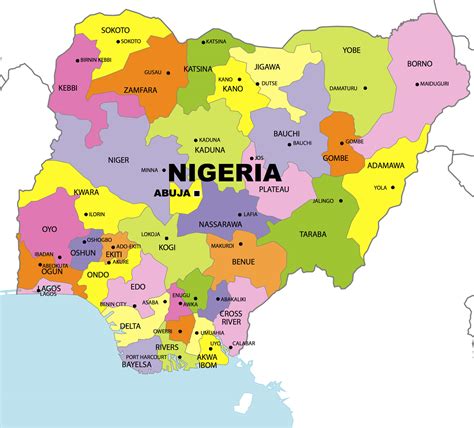
Map of Nigeria's states
Constitutional Framework
Under the 1999 constitution, executive power is vested in a president who serves as both the head of state and the chief executive, is directly elected to a four-year term, and nominates the vice president and members of the cabinet. The constitution provides for a bicameral National Assembly, which consists of the House of Representatives and the Senate.
The legislative branch of Nigeria is responsible for and possesses powers to legislate laws. Together, the two chambers form the law-making body in Nigeria, called the National Assembly, which serves as a check on the executive arm of government. The legislative powers are summarized in chapter one, section four of the 1999 Nigerian Constitution.
The National Assembly of Nigeria has two chambers: the House of Representatives and the Senate. The House of Representatives is the lower chamber of Nigeria's bicameral National Assembly and is presided over by the speaker of the House of Representatives. It has 360 members each of the federal constituencies of the country, who are elected for four-year terms in single-seat constituencies.
Each state elects 10 members to the House of Representatives for four-year terms; members of the Senate—three from each state and one from the Federal Capital Territory—also are elected to four-year terms.
The Senate, which has 109 members, is presided over by the president of the Senate. A total of 108 members are elected for four-year terms in 36 three-seat constituencies, which correspond to the country's 36 states.
The president is elected through universal suffrage which is regarded as more than a privilege extended by the state to its citizenry, and it is rather thought of as an inalienable right that inheres to every adult citizen by virtue of citizenship. In democracies it is the primary means of ensuring that governments are responsible to the governed. The president is head of both the state and government, and heads the cabinet of Nigeria, the Federal Executive Council.
The constitution also sanctions the president's status as commander-in-chief of the armed forces in Section 130. The constitution of 1999 vests all the executive powers of the federation in the person of the president which can be exercised directly by him or his vice president or members of his cabinet. The executive branch is divided into Federal Ministries, each headed by a minister appointed by the president, Federal Ministries are those civil service departments which were made responsible for delivering various types of government service and each ministry is headed by a permanent secretary who reports to a minister in the Federal Cabinet.
Nigeria has 24 Federal Ministries. The president must include at least one member from each of the 36 states in his cabinet. The president's appointments are confirmed by the Senate of Nigeria. The ministries are responsible for various parastatals (government-owned corporations), such as universities, the National Broadcasting Commission, and the Nigerian National Petroleum Corporation.
The legislature is said to be the first among the three arms of government – the legislature, executive, and the judiciary. These arms are characterized by the principle of separation of power as each is supposed to be independent of the other. The legislature derives its powers from the 1999 Constitution (as amended) in Sections 4(1) and 4(2). It is also vested with investigatory powers, financial powers, confirmation and impeachment powers. The Legislature is the symbol of democracy all over the world.
The federal government of Nigeria is composed of three distinct branches: the executive, the legislative, and the judicial. The common law in the legal system is similar to common-law systems used in England and Wales and other Commonwealth countries.
The judicial branch is made up of the Supreme Court of Nigeria, the Court of Appeals, the high courts, and other trial courts such as the magistrates', customary, Sharia and other specialized courts. According to the 1999 constitution, the Supreme Court has both original and appellate jurisdictions (the power to reverse, modify and change a decision or ruling made by a lower court). Appellate jurisdiction exists for both the civil law and criminal law, the supreme court has the sole authority and jurisdiction to entertain appeals from Court of Appeal, having appellate jurisdiction over all lower federal courts and highest state courts.
Decisions and rulings by the court are binding and absolute on all courts in Nigeria except the Supreme Court itself. The National Judicial Council serves as an independent executive body, insulating the judiciary from the executive arm of government.
The law of Nigeria is based on the rule of law, the independence of the judiciary, and British common law (due to the long history of British colonial influence). The common law in the legal system is similar to common-law systems used in England and Wales and other Commonwealth countries. English law, derived from its colonial past with Britain: Nigeria belongs to the common law family. This is because English law makes up a substantial part of the Nigerian law. Nigeria, though now a sovereign nation, was once under British rule. Upon gaining independence in 1960, numerous English laws were copied, and most of the laws have since been repealed in England.
Common law, case law has developed since colonial independence; common law can be defined as that unwritten body of laws based on judicial precedents. Customary law, which is derived from Indigenous traditional norms and practices. In Nigeria, customary law can be divided, in terms of nature, into two different classes, which are the ethnic or non-Muslim customary law and the Muslim law (Sharia). The ethnic customary law in Nigeria is Indigenous, and this system of customary law applies and is valid to members of a specific ethnic group.
Muslim law is a religious law that is solely based on the Muslim faith and applies to the members of such faith. Sharia law, law used in some states in the northern region. In two principal respects the sharia law greatly differs from Western systems of law. Sharia law possesses a much wider scope, since it regulates the individual's relationship, not only with his or her neighbors and the state, which is perceived as the limit of most other legal systems, but also with God and with the individual's own conscience.
The grant of independence to Nigeria was a milestone in the political history of the country. This period witnessed the consolidation of political gains made during the colonial era. Politicians genuinely focused their lapses on the polity. The Armed Forces of Nigeria assumed the rulership of Nigeria from 1966–1979 and 1983–1999. The breakdown of law and order which occurred in the period under review would not be attributed to any defect in the Nigerian legal system. Corrupt practices both in the body politics and all aspects of Nigerian life eroded efficiency and progress.
FACT FILES: (African Politics) Nigerian Government Explained in 3 Minutes
Local Government
There are two tiers of government—state and local—below the federal level. The functions of the government at the local level were usurped by the state government until 1988, when the federal government decided to fund local government organizations directly and allowed them for the first time to function effectively. Nigeria is divided into 36 states and the Federal Capital Territory, where the country’s capital, Abuja, is located; the constitution also includes a provision that more states can be created as needed.
Each state is further divided into local government areas (LGAs). These states and their local governments are essential to the function of a federal government because they have a pulse on the local population and can therefore assess the needs of constituents and enact policy or infrastructure that is helpful. They are also important because the federal government has the time and resources to take on national projects and international affairs while local governments can take care of the Nigerians native to their respective states. The devolution of power between the states and the federal government helps the functionality of Nigeria.
774 local governments oversee the collection of local taxes, education, health care, roads, waste, and planning. The local government look after the affairs of the common men and women in the Nigeria society.
Evolution of States
At independence the country was divided into three regions: Northern, Eastern, and Western. The Mid-West region was created out of the Western region in 1963. In 1967 Col. Yakubu Gowon, then the military leader, turned the regions into 12 states: 6 in the north, 3 in the east, and 3 in the west. Gen. Murtala Mohammed created an additional 7 states in 1976. Gen. Ibrahim Babangida created 11 more states—2 in 1987 and 9 in 1991—for a total of 30. In 1996 Gen. Sani Abacha added 6 more states.
Justice System
The Nigerian legal and judicial system contains three codes of law: customary law, Nigerian statute law (following English law), and Sharīʿah (Islamic law). Customary laws, administered by native, or customary, courts, are usually presided over by traditional rulers, who generally hear cases about family problems such as divorce. Kadis (judges) apply Sharīʿah based on the Maliki Islamic code. Since 1999, several states have instituted Sharīʿah law.
Nigerian statute law includes much of the British colonial legislation, most of which has been revised. State legislatures may pass laws on matters that are not part of the Exclusive Legislative List, which includes such areas as defense, foreign policy, and mining—all of which are the province of the federal government. Federal law prevails whenever federal legislation conflicts with state legislation.
In addition to Nigerian statutes, English law is used in the magistrates’ and all higher courts. Each state has a High Court, which is presided over by a chief judge. The Supreme Court, headed by the chief justice of Nigeria, is the highest court.
Political Process
The constitution grants all citizens at least 18 years of age the right to vote. The Action Group (AG) and the Northern People’s Congress (NPC) were the major Nigerian parties when the country became independent in 1960. However, their regional rather than national focus—the AG represented the west, the NPC the north, and the National Council for Nigeria and the Cameroons the east—ultimately contributed to the outbreak of civil war by the mid-1960s and more than 20 years of military rule.
Political parties were allowed briefly in 1993 and again starting from 1998, but only parties with national rather than regional representation were legal, such as the newly created People’s Democratic Party (PDP), the Alliance for Democracy, and the All Nigeria People’s Party. Since then, many other parties have been created, most notably the All Progressives Congress (APC), the All Progressives Grand Alliance (APGA), and the Labour Party.
Nigeria is a multi-ethnic and culturally diverse federation of 36 autonomous states and the Federal Capital Territory. The political landscape is partly dominated by the ruling All Progressives Congress party (APC) which controls the executive arm of government and holds majority seats at both the Senate and House of Representatives in parliament, and majority of the States. President Bola Ahmed Tinubu was sworn into office on May 29, 2023, having won the February 2023 Presidential election.
Challenges and Reforms
Nigeria continues to face many social and economic challenges that include insecurity such as banditry and kidnappings especially in the northwest region, continued insurgency by terrorist groups in the north-east, and separatist agitations in the south-east. President Tinubu has continuously pledged to turn around the economy and ensure security across the country.
During 2015-2022, growth rates declined, and real GDP per capita fell, driven by policy missteps and shocks. Monetary and exchange rate policies became increasingly distortive, eroding confidence. Fiscal deficits increased due to lower oil production and costly subsidies, notably to sustain an overvalued exchange rate. The economy was also buffeted by external shocks such as the COVID-19 pandemic, higher global food and fertilizer prices following Russia’s invasion of Ukraine, and domestic shocks such as a destructive demonetization policy in early 2023, and devastating floods in October 2022 and September 2024.
Following a change in administration in May 2023, Nigeria has been pursuing bold reforms to re-establish macroeconomic conditions for stability and growth. The gasoline subsidy has been completely eliminated, and the exchange rate has been unified and allowed to be market-reflective, eliminating the parallel market premium and generating large fiscal and broader economic benefits. The Central Bank of Nigeria has appropriately tightened monetary policy and refocused on its price stability mandate, and ended deficit monetization.
The macroeconomic reforms, if sustained, create a new platform to ignite inclusive growth and poverty reduction, while also calling for deep structural reforms. Nigeria’s new policy direction boosts international competitiveness, increases the attractiveness of Nigeria for domestic and foreign investments, and has started to reduce debt-related fiscal risks and reopen fiscal space. Yet, addressing deep-rooted constraints is key to sustaining stronger growth in Nigeria. This requires reducing trade barriers, facilitating trade, increasing access to reliable power supply, and improving the business environment.
Development Challenges
Despite having the largest economy and population in Africa, Nigeria offers limited opportunities to most of its citizens. Nigerians born in 2020 are expected to be future workers 36% as productive as they could be if they had full access to education and health, the 7th lowest human capital index in the world. Weak job creation and entrepreneurial prospects stifle the absorption of the 3.5 million Nigerians entering the labor force every year, and many workers choose to emigrate in search of better opportunities.
Popular articles:
tags: #Nigeria
