The New Africa House, formerly known as Mills House, is an academic building and a former dormitory at the University of Massachusetts Amherst. The building, constructed in the Georgian Revival style with Art Deco accents, is located in the Central Residential Area of the UMass campus.
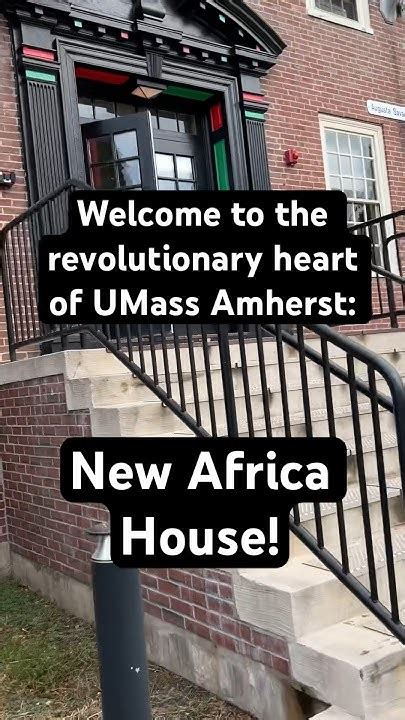
New Africa House at UMass Amherst
Early History as Mills House
Designed by Louis Ross, who also designed many other dormitories and the Student Union on campus, Mills House was built in 1948 along the eastern side of Infirmary Way, becoming the fourth dormitory in Central (then known as Clark Hill). A year later, Brook House, a mirror structure to Mills, was completed, followed by Baker and Van Meter in the subsequent decade, rounding out Central in its current form.
Mills House was named after George Franklin Mills, an early dean of the Massachusetts Agricultural College (which later became the University of Massachusetts). Mills had been a teacher of literature and Latin for many years, and also served as the college treasurer.
Notably, Mills House was among the first dormitories to house Black students. Although Black students were never explicitly denied admission to the university, they were heavily discouraged from applying, effectively barring them from entry en masse until the 1960s.
Read also: Accommodation in Franschhoek: A Detailed Look
The Committee for the Collegiate Education of Black Students (CCEBS)
In the latter half of the 1960s, faculty members at UMass formed the Committee for the Collegiate Education of Black Students (CCEBS) in 1967 to address the under-representation of Black students on campus. The mission of the CCEBS was to recruit Black students from both out-of-state and within the Commonwealth, bringing upwards of 150 Black students onto campus over the next few years.
As these new Black students arrived on campus under the CCEBS program, their housing options were limited. The majority were assigned to live in Mills House, which quickly became the heart of the Black student community on campus.
During this time, the African Students Association (ASA) emerged on campus, holding regular meetings on the first floor of Mills House. The ASA played a pivotal role in the building's history before its transition into the New Africa House.
Racial Incidents and Activism
Two major racially charged incidents occurred at Mills House between the formation of the CCEBS and its renaming as New Africa House.
The 1968 Incident
The first incident occurred on November 5, 1968, the day after the presidential election. A Black student named James R. Hall was allegedly attacked with a white friend on Orchard Hill by a group of white students who reportedly told Hall and his friend that since Nixon had won the election, “niggers don’t belong at UMass anymore.”
Read also: Elegance and Comfort in Pretoria
While some sources claim the incident was fabricated, it served as a rallying cry for members of the African Students Association, headquartered in Mills House. The next day, an organized march of up to 100 Black students departed from Mills House and headed for the Whitmore Administration Building. There, they staged a sit-in protest against the beatings and read a list of 20 demands to the university administration.
UMASS | Isenberg South Africa 2025 - Day 8
- A public apology from the administration.
- A minimum of 15 Black police officers and the disarming of all police.
- Black doctors on campus.
- Sensitivity training for all faculty and staff.
- Tougher consequences for racist behavior by students and faculty.
- Funds for the refurbishing of Mills House.
After negotiations with then-president Lederle, the crowd dispersed. The only demand the university fully met was the allocation of additional funds for the refurbishing of Mills House. They refused to disarm the police and, due to all positions being filled, could not hire any new Black officers. However, they agreed to hire more Black security guards and provide mandatory sensitivity training to all police and security personnel.
The 1970 Occupation
On February 26, 1970, another incident occurred when a Black student, Dan Brown, rear-ended the car of a white student athlete on Infirmary Way. The ensuing argument escalated into a fistfight, and soon students from both sides joined in, initiating what one source called a “race riot.” Outnumbered, the Black students retreated into Mills House.
Once inside, they expelled all the white students living in the building, moved furniture to create a barricade, and began a multi-day occupation of Mills House. The Black students, again as in ’68, set forth a list of demands, including the creation of an Afro-American Studies Department and the establishment of a Black Cultural Center on campus.
After intense negotiations, Dean Fields agreed to have the building vacated and shut down as a dormitory by the end of the month, to be reopened as a Black Cultural Center. The university approved the creation of the Afro-American Studies Department and bequeathed responsibility for this new cultural space onto the fledgling department. This “Black Cultural Center” would become the New Africa House.
Read also: Guest Houses: Boksburg, South Africa
The New Africa House
In 1970, Mills House was shut down as a dormitory and shortly after reopened as the New Africa House, an academic space and home of the W.E.B. DuBois African American Studies Department. The then newly formed African-American studies department, the W.E.B. Du Bois Department for Afro-American Studies, relocated its offices there, where it remains to this day.
The New Africa House is also home to the Augusta Savage Gallery, a multicultural and multi-arts facility named in honor of renowned sculptor Augusta Savage. Founded in 1970 by the Afro-American Studies Department, the Gallery’s mission is to promote artistic works from a broad spectrum of cultures, selected for their aesthetic integrity and ability to enlighten viewers on issues such as race, ethnicity, class, and cultural identity.
According to UMass emeritus professor Ernest Allen, the New Africa House offered “a sense of protection on the campus, because there were incidents, and some very nasty incidents that occurred in the early years of New Africa House.
Judyie Al-Bilali, an associate professor of Performance and Theater for Social Change, said, “The 70s was a radical time. So, the fact that there was also a pioneering Black Studies Department, it gave a feeling to the campus. There was political unrest. We were in the streets all the time.
Today, New Africa House stands as a testament to the activism and resilience of Black students at UMass Amherst, serving as a vital center for academic study, cultural expression, and community building.
The New Africa House was not always known as such. It was called “Mills House” and served as a dorm and office building in Central Residential Area.
“We didn’t want the community divided up, we needed a center on campus where they could come together, we needed a Black culture center,” Thelwell said in the documentary.
The New Africa House was also a place for community. Allen said that faculty, staff and students all enjoyed the restaurant. “Not just African American students or faculty either.
One night, Parker-Fairbain said she was “fed up” and sent Dr. Stephanie Shonekan, former head of the W.E.B. The event would be funded by the African American Studies Department and coordinated among the Afro-Am Undergraduate Council.
When students walked into the basement of the New Africa House that night, they saw easels, provided by the studio arts department, covered in art.
“One was the need to revitalize the New Africa House and bring students back into that space. Another was the desire to unify Black students across [Registered Student Organizations] and departmental arts. And a third was creating a space that didn’t exist.
“The New Africa House’s possibility is ever changing. It is a building. It’s just a building. But it’s what’s inside. It’s who’s there.
“My roots go deep at UMass Amherst and they extend from New Africa House.
Popular articles:
tags: #Africa
