Design trends constantly change, but how do you keep up with current styles and create a timeless look? Zellige tile is a popular classic décor choice. Each unique finished product adds a rich, eclectic mix of color, texture, and glaze to any space. Zellige's imperfections accentuate its indelible character. Follow these Zellige installation tips when you use this stunning tile in your next home interior project.
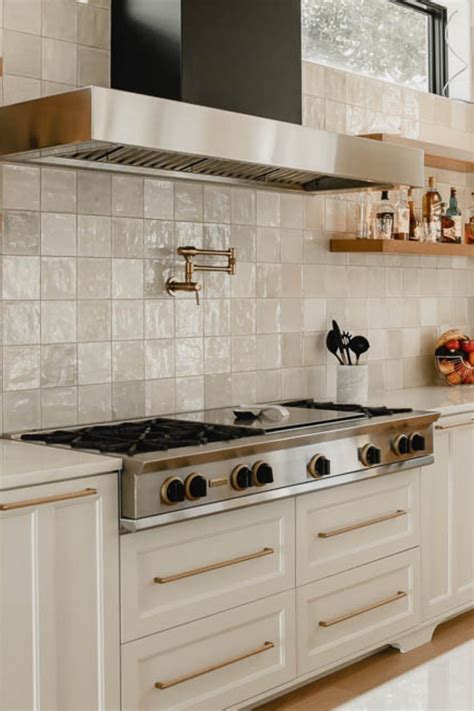
Multiple Application and Design Possibilities
The art of Zellige originated over 1,300 years ago in modern-day Spain. Craftspeople mix natural clay with water, shape each tile by hand and dry them. Then, they kiln-fire Zellige tiles over olive branches, giving each tile its extraordinary color palette and pattern. This centuries-old tile's classic appeal works well in various design schemes, from farmhouse/cottage to Old World charm and Mid-century modern. As for layout, you can vertically stack them on an entire wall-like in a shower-or stagger them subway-style for a kitchen or bathroom backsplash.
You can also use Zellige tiles on the floor or arrange them to create an attractive border.
Installation Inspiration Spotlight
DIYer Chelsea McLemore passes on some lessons she learned while installing Riad Tile's Natural White Thin Zellige in her recent kitchen renovation. We love the weathered charm Zellige adds to Chelsea's kitchen renovation. Notice how the backsplash tiles look raised and uneven.
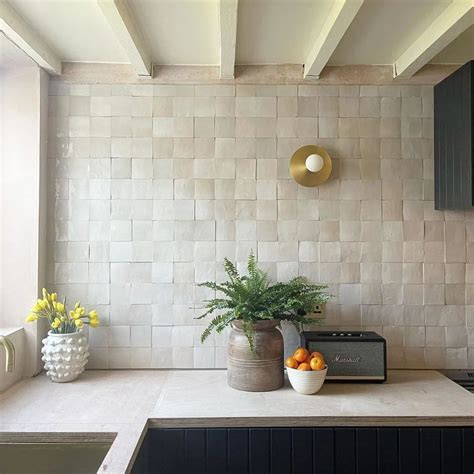
More Zellige Installation Tips
Whether you're a seasoned home improvement DIYer or starting your first renovations, these helpful tips are specifically geared toward installing Zellige tile. Zellige is glazed terracotta tile, so it does not require sealing.
Read also: The Allure of Blue and White Tile
- You'll need to use wedge spacers-usually very small, like 1/16"-to align Zellige's signature uneven edges.
- The traditional Zellige installation method doesn't use grout joints.
- Zellige tiles cut easily.
- Use Mapei Ultracolor Plus FA to grout glazed tiles and Mapei Flexcolor CQ for Unglazed Natural Tile.
Zellige Flooring
Zellige flooring applications work best in light-traffic areas with minimal heavy impacts. To ensure perfect bonding between Zellige tiles and the subfloor, pay close attention when applying adhesive on the floor and back of the tiles.
Zellige in Wet Areas
In wet areas like swimming pools, shower floors and walls, and fountains, ensure the surface you will lay Zellige tiles on is waterproof, stable and rigid before installing. Also, use adhesive cement and grout that are suitable for wet spaces.
How to Install Zellige Tiles
Zellige tiles are handcrafted in Morocco using natural clay. Although they have become a trend in recent years, it’s a process that’s hundreds of years old. Due to their handmade nature, they have a different installation process than your average tile. Each shape is slightly irregular and there is color variation between them. These are a great choice for someone who does NOT want a manufactured, perfect looking, tile as these will give you more of a rustic, old world look.
Materials needed:
- Riad Zellige Tile
- Mapei Type 1 Tile adhesive
- Tile trowel
- Grout Float
- Sponge
- Laser level
- Spacers for sockets
- Silicone caulk
- Wet tile saw
Steps:
Read also: Morocco's Blue Pearl
- The first thing you will want to do upon receiving your tiles, is to inspect them for any unusable pieces that may have broken during shipping. Always make sure to order about 10-15% more than you actually need, because if there aren’t casualties in shipping, there will be in the cutting process! If you have more than one box, you will mix the tiles between the boxes so the color variation is evenly dispersed.
- Soak your tiles for 4 minutes. This releases air from the clay.
- Work from the center of your wall, and move out from there. This will ensure any cuts made will be symmetrical. You want to create pyramid sections with your tiles, rather than working in long rows. Use a laser level to provide you with an even and clear vertical and horizontal line. We did not do this the first time, and it resulted in tiles that were going slightly diagonal! Do not skip this step. Countertops are usually not perfectly level so this will make sure you get it right. Even if your countertops are level, the tiles are not, so you will be allowing cracks to form more so in areas to accommodate for the uneven edges. Align your laser level on the horizontal and vertical orientation and move it up each row. You may need to trim the bottom of some of the tiles on the first row to get things lined up. Try rotating each tile to see which side is the best fit. I’d say this feels more like masonry than tiling. There is a learning curve, but you will get the hang of it!
- Use the serrated trowel to apply adhesive. You don’t want to put too much on, just a thin layer. Because each tile is not a perfect square, and some corners may be chipped (not really a defect, but part of the nature of handmade tiles), there will naturally be some gaps between each tile once they’re on the wall. And you are done! Make sure to use a sponge to wipe away any adhesive that collected on the surface.
- Use receptacle spacers to make your electrical sockets flush with your tile.
- As I mentioned, I did NOT grout my tiles, but you do want to add silicone to the bottom of your tile where it meets your countertop.
Even though the tiles have a Morrocan vibe, they have been used in various home styles including European kitchens, bathrooms and beyond! Each tile has a distinctive appearance with subtle imperfections that add to its beauty (in my opinion).
The first step was to prepare the section of wall behind the stove where the backsplash would go. The first thing we had to deal with was cutting out a section of the beadboard so we could install the tiles directly to the wall. We used a multi-purpose saw like this one to cut into the beadboard and were able to get an amazingly straight line all the way down (this tool is AWESOME). After ripping the beadboard out we scraped and sanded the wall to get any major sections of adhesive off. The wall must be level and clean but we didn’t hyperfixate on a perfectly smooth surface too much.
4×4 zellige tiles are traditionally laid in a stacked pattern. This makes it really simple and gives a vintage vibe. The most important thing is to make sure your tiles are lining up and not gradually “drifting” as you lay. The easiest way to do this is with a laser level. We set our level up with a perpendicular line to follow as we went. NOTE: The first row across and the first row down are most important!
Next, we applied a layer of adhesive to the wall using a notched trowel. For best results, use a circular motion to spread the adhesive evenly. After applying adhesive to the wall, I applied more adhesive to each tile with a smaller notched trowel. This part was kind of fun.
Next, we pressed each tile into the adhesive on the wall, making sure it was well-adhered and in a straight line. There were a few places where I used tile spacers to maintain even lines if a tile was gradually sliding.
Read also: Men's Moroccan Fashion
For a small project like this, we could have probably got away with a manual tile cutter. However, since we have so many tile projects coming up at the house, we decided to purchase a wet saw.
I have always loved the look of dry stacking zellige tiles instead of grouting. If you are working in light traffic areas or a place that won’t come in contact with lots of water, a no-grout look is totally fine.
If using an unglazed natural zellige tile it is important to apply a sealer. My tile was glazed and the manufacturer specifically said not to use a sealer.
The final step of the installation process was to use a kitchen and bath caulk to caulk in all the side cracks and spaces.
Regular cleaning with a damp cloth and mild soap will keep them looking their best. Avoid harsh chemicals and excessive moisture, especially in wet areas, to preserve the tile’s finish.
We love having this little unique accent in our kitchen to frame out our lovely stove.
Before beginning, it is recommended to unpack all the tiles from the box, especially if you have several boxes. Riad Tile recommends soaking the tiles in water for half an hour before installation.
| Area | Recommendation |
|---|---|
| Interior Floor | Yes |
| Interior Wall | Yes |
| Shower Floor | Yes |
| Shower Wall | Yes |
| Steam Shower | Yes |
| Residential (Low/High Traffic) | Yes |
| Commercial (Low Traffic) | Yes |
| Kitchen | Yes |
| Sink Backsplash | Yes |
| Stove Backsplash | Yes |
| Fireplace Surround | Yes |
| Exterior (Non-Freeze Thaw) | Limited Use |
| Exterior Floor (Bejmat Only) | Yes (2x6 size) |
| Exterior Wall | Yes |
| Pool & Fountain Waterlines | Yes (Glazed Zellige Only) |
A few key points to note for specific areas:
- Floor Installations: Since each zellige tile is hand chiseled there may be a few sharp edges. A good installer should be able to get the tiles flush with minimal lippage. if you find some tiles that stick up slightly or are a bit rough on the edges after grouting, a tile rubbing stone can be used to soften the edges.
- Kitchen Countertops: We typically don’t recommend any glazed tiles for countertop usage nor natural unglazed tiles dut to the porous nature of the clay, (stone is our countertop material of choice)
- Stove Backsplash: Zellige works well as a stove backsplash, except in the case with a stove that has an oven vent that vents heat directly onto the tiled backsplash. in such a case, we recommend the standard 4″ metal splash that comes with most ranges.
- Salt Water Pools: While we can recommend glazed zellige for pool & fountain water lines in non-freeze locations, we do not have thorough testing yet on salt water pools so for now, we are unable to recommend zellige for usage in saltwater pools.
Please note, the specifications section of the zellige material guidelines gives detailed information on where a tile can be used.
We always like to say an installation is only as good as your tile installer. please make sure you hire a professional experienced with zellige.
Zellige does not come with any trim as moroccans use traditional methods such as mitering to finish edges. we subscribe to the european model where tile looks best when cladding surfaces meet seamlessly and in a monolithic fashion. think of a tiled wall from floor to ceiling as opposed to half way up a wall and as a way to offer a more custom finish. if you are looking for an alternatives for surface bullnose and corner trim, we recommend one of the following:
- Run a grout joint bead of caulk or grout along the exposed tile edge - just as they do in europe.
- Build out sheetrock surface to meet the tile inset for one flush, continuous surface.
- If your project turns a corner, neatly miter the edge to give it the cleanest, crafted finish.
We always (and we mean always) recommend relying on your (experienced) installer for decisions about grout. please refer them to our material guidelines for the most up to date advice on what sort of grout to use. we adhere to the industry recommendations of a minimum grout-joint size of 1/16″.
As a general guideline for grout colors we suggest matching grout to the color of the tile. Contrasting grout will emphasize all the chips and imperfections (even bringing out ones you don’t initially see). If you’re still tempted by the idea of contrasting grout, read our material guidelines for the caveats on that front.
Be sure that your installer creates multiple grout boards (if considering different options) before you make a final choice, and that you experience them during every time of the day and under all lighting options.
A few other tips are in order:
- Make sure you and your installer take every tile out of every box and lay them out on the floor before you install them, and blend, blend, blend.
- Be present for the installation: think about installing zellige as an art project that will become a permanent part of your home. careful planning and attention to detail is imperative!
Handmade Zellige tile is making waves in the design world, and for good reason! Its organic imperfections, glossy finish, and artisanal charm create a truly unique look that stands apart from mass-produced tiles.
Both tiles begin as a mixture of clay and water, then are hand-shaped, sun-dried, and kiln-fired. Moroccan artisans stack tiles in simple kilns for firing, much like the process used in Mexico. However, the key difference lies in glazing. While traditional Moroccan Zellige uses lead-based glazes to achieve its signature shine, this comes with health risks for tile makers. At Clay Imports, we are committed to safety and sustainability, so our Zellige tiles use only lead-free glazes.
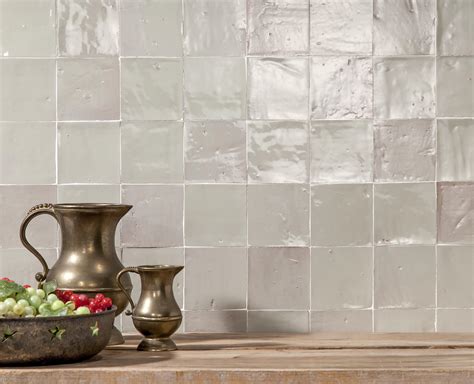
What Makes Zellige Different from Other Clay Tiles?
The biggest visual difference? Beveled edges. Unlike conventional clay tiles, Zellige tiles have slightly slanted edges, allowing for ultra-tight grout joints. Since Zellige is handcrafted, variations in size, thickness, and texture are expected: these organic imperfections add to its charm.
To let the beauty of Zellige shine, opt for neutral grout colors like light or medium gray.
While Moroccan Zellige has been used in water features for centuries, it requires careful installation and maintenance. Due to its unglazed edges and back, prolonged water exposure may lead to damage.
High variation is an undeniable characteristic of zellige tile. Due to its unique characteristics, Zellige requires more time and skill to install. We highly recommend hiring a professional tile installer experienced in handmade tile.
Since Zellige tiles are known for their beautiful irregularities, we strongly recommend ordering samples first to ensure you love the look in your space.
Zellige tile is more than just a design trend-it’s a centuries-old craft that brings warmth, history, and authenticity to your space.
More and more homeowners are settling back from standardized contemporary interiors and rather seeking to create distinctive and unique homes altogether. And believe it, zellige tiles are the definite way to achieve an out-of-the-box look. These types of tiles are truly state-of-the-art, exceptional in practicality and aesthetics, and wholesome in every way possible.
Zellige tiles are quite strong and durable! No wonder these tiles can be used in the entryway foyer, bathroom, kitchen, and other high-traffic areas of your home.
Zellige tiles are hand-glazed on special clay and fired in a particular way to make them extremely heat resistant. Well, yes! These tiles can be used in spaces that are exposed to high and extreme temperatures.
Zellige tiles are quite easy to clean and easy to maintain. All you need is to simply wipe off the surface using a damp cloth regularly to maintain the original shine and the utmost unique look.
Zellige tiles are handmade and hand-glazed - hence, every tile is unique from one another. They’re individually fired to purposely give a bespoke and distinctive look!
Zellige tiles are usually glazed - hence, making them reflect the incoming natural or artificial light.
Since each tile piece is handmade and requires special attention from skilled labor and craftsmen - they can be slightly more expensive as compared to other ceramic or porcelain tiles.
Installing zellige tiles can be quite tricky and complex. No two tiles are alike!
So, if you like the ‘perfections’ in ‘imperfections’ - zellige tiles are truly for you!
How to install a kitchen backsplash using zellige tile
Popular articles:
tags: #Moroccan
