The Old-World charm of Morocco tile and Mediterranean tile remains timeless. There's something special about the enduring art form of Zellige tile in a fast-paced, technology-driven world. You don't have to travel across continents to enjoy a timeless Mediterranean tile aesthetic. And thankfully, the rustic charm of Moroccan tile is a design trend that's likely here to stay.
If you’ve ever tiled a floor then you know the painstaking, backbreaking effort it takes to properly cut, mortar, assemble and grout a tiled surface - even with power tools, let alone manually as in past centuries. So it’s pretty easy to conclude that in the heyday of azulejos and zellige, beauty and craftsmanship must have been valued tremendously in spite of the time and pain involved in creating these works of art.
Let's delve into the rich history and cultural significance of blue and white Moroccan tiles, exploring their origins, evolution, and enduring appeal.
Origins and Early Development
Zellige tile's origin dates to around 711 A.D. Muslim inhabitants of North Africa and the Mediterranean created Zellige as handmade Moorish art with non-refined clay from Morocco's Fez region. The word "zellij" comes from the root Arabic word زَلَجَ, meaning "to slide," according to Muslim lifestyle brand lasouk. Zellij (Arabic: زليج, romanized: zillīj), also spelled zillij or zellige, is a style of mosaic tilework made from individually hand-chiseled tile pieces.
The origins of Zellige tiles can be traced back to the Roman era, where the use of mosaic art was widespread across the Roman Empire. The Romans were known for their intricate mosaic floors and walls, composed of small, colored stones and glass pieces of different sizes arranged in elaborate patterns. These early mosaics set a precedent for the use of geometric designs in decorative art.
Read also: Comprehensive Guide to African Blue Basil
Roman mosaic techniques and artistry significantly influenced the early development of Zellige tiles. The meticulous craftsmanship and geometric precision seen in Roman mosaics were adopted and refined by later cultures. In particular, the use of small, tessellated pieces to create intricate designs became a foundational aspect of Zellige tile work.
The Islamic Golden Age, spanning from the 8th to the 14th centuries, was a period of significant cultural and scientific advancements across the Islamic world. During this time, Islamic artistic traditions, including those of mosaic and tile work, flourished.
The principles of Islamic art, which emphasized abstract and geometric designs due to religious prohibitions against depicting living beings, profoundly influenced the development of Zellige tiles. This era saw the rise of elaborate architectural decorations, with Zellige tiles being used extensively in mosques, palaces, and public buildings to create visually stunning and spiritually symbolic spaces.
The migration of Moorish artisans from Andalusia to Morocco in the 8th century played a crucial role in the evolution of Zellige tiles. These skilled craftsmen brought with them their knowledge of Islamic art and architecture, including the intricate tile-making techniques that had developed in Spain. Their influence led to the integration of Andalusian styles with local Moroccan traditions, resulting in a unique and sophisticated form of tile work.
The introduction of Zellige tiles to Morocco occurred during the 8th century, coinciding with the spread of Islam and the migration of the Moors from Andalusia to North Africa. The Moors brought with them a rich heritage of Islamic art and architecture, including the intricate tile-making techniques that had flourished in Spain. These techniques found a new home in Morocco, where they were embraced and further developed by local artisans. The fusion of Andalusian and Moroccan styles created a unique and vibrant form of glazed Zellige tilework that became a defining feature of Moroccan art and architecture.
Read also: Morocco's Blue Pearl
The initial use and adaptation of Zellige tiles in Moroccan architecture marked a significant evolution in the country’s artistic landscape. Moroccan artisans quickly adopted the new techniques and began incorporating Zellige tiles into various architectural elements. Early examples of Zellige tilework can be seen in the walls, floors, and fountains of mosques, palaces, and private residences.
One of the earliest examples of Zellige tilework in Morocco can be found in the Al-Qarawiyyin Mosque in Fes, which was founded in 859 AD and significantly expanded in the 12th century. This mosque is renowned for its intricate Zellige mosaics that adorn the walls, columns, and floors. The geometric patterns and vibrant colors of the tiles reflect the sophisticated craftsmanship and the influence of Islamic art during the early adoption of Zellige in Moroccan architecture.
Constructed in 1156, the Tinmal Mosque is a significant Almohad architectural site that features early examples of Zellige tilework. Although much of the mosque is in ruins today, the remaining Zellige decorations provide insight into the early use of these tiles in Moroccan religious architecture.
The Kasbah of the Udayas, built in the 12th century during the reign of the Almohad dynasty, is another early example of Zellige tilework. This fortress complex in Rabat showcases Zellige tiles in various parts of its structure, including its walls and gates.
Because Islam prohibits portraying living things, artists created geometric patterns for artistic expression and to add color and significance to the mesmerizing mosaics. First, artisans hand cut, fire, and glaze each zellij tile. Next, they set them in a plaster base to form an endless number of geometric patterns, including squares, diamonds, polygons, stars, and crosses.
Read also: Transform Your Kitchen with Blue Tile
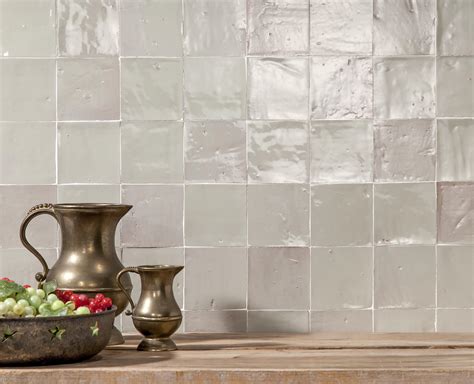
Zellige Tiles in Fez (Source: Wikipedia)
Evolution and Refinement
The 12th century was a pivotal period for the development of Zellige tiles, marked by the influential patronage of the Almoravid and Almohad dynasties. These dynasties were known for their strong support of the arts and architecture, which significantly contributed to the flourishing of Zellige craftsmanship. The Almoravid rulers, who were the first to establish Marrakech as a capital, initiated major architectural projects that prominently featured Zellige tiles. The Almohads, who succeeded the Almoravids, continued this tradition and further enhanced the use of Zellige in their grand constructions.
During the 12th century, there were significant advancements in the techniques used to create and assemble Zellige tiles, leading to a refinement of the craft. Artisans perfected the process of shaping and firing the clay tiles, improving the durability and finish of the final product. They also developed more precise methods for cutting the tiles into intricate geometric shapes, allowing for more complex and detailed mosaic patterns.
This period saw the evolution of distinctive geometric designs that are emblematic of Zellige tilework, such as stars, polygons, and interlaced forms. The enhanced precision in tile assembly techniques enabled the creation of expansive, seamless mosaics that covered large architectural surfaces, transforming walls, floors, and fountains into vibrant works of art. These advancements solidified Zellige’s role as a key element of Islamic and Moroccan architectural identity.
During the Nasrid Dynasty and Marinid Dynasty in the 14th century, more vibrant colors of green, blue, and yellow joined the Zellige tile palette. By this period, more colours were employed such as yellow (using iron oxides or chrome yellow), blues, and a dark brown manganese colour.
This style of tile mosaic, formed by assembling a large number of small hand-cut pieces to form a pattern, is evident in famous buildings of the period such as the Alhambra palaces of the Nasrids, the mosques of Tlemcen, and the Marinid madrasas of Fez, Meknes, and Salé. It is also found in some Christian Spanish palaces of the same period who employed Muslim or Mudéjar craftsmen, most notably the Alcazar of Seville, whose 14th-century sections are contemporary with the Alhambra and contain zellij tilework in the same style, although of slightly lesser sophistication.
Among the most exceptional surviving examples of Nasrid zellij art are the dadoes of the Mirador de Lindaraja and the Torre de la Cautiva in the Alhambra, both from the 14th century. In addition to zellij work further west, a somewhat distinctive style of zellij with brightly coloured pieces, often in floral patterns of palmettes and scrollwork, developed among the craftsmen of Tlemcen.
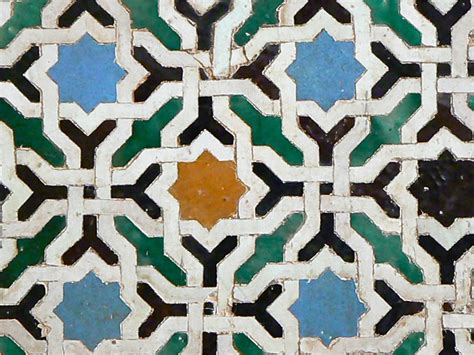
Zellige Tiles in the Alhambra (Source: Pinterest)
Craftsmanship and Techniques
The creation of Zellige tiles involves a meticulous and labor-intensive process that has remained largely unchanged for centuries. The first step is the molding and shaping of clay, which is done by hand to form the basic tile shapes. This clay is sourced from specific regions known for its high quality.
Once shaped, the tiles are left to dry naturally before being fired in kilns at high temperatures. This firing process hardens the tiles and prepares them for the next stage, which involves glazing them with vibrant colors derived from natural pigments.
After glazing, the tiles are fired again to set the colors. The next step is hand-cutting the glazed tiles into small, precise pieces using specialized tools. These pieces are then painstakingly assembled into intricate mosaic patterns, a process that requires significant skill and patience. Each mosaic is carefully crafted to ensure the pieces fit together seamlessly, creating the distinctive geometric designs characteristic of Zellige tiles.
Making Moroccan tiles is an enduring art form. Many artisans learn the craft from family members at a very early age, so these skills, expertise, and art transcend multiple generations. Zellij making is considered an art in itself. The art is transmitted from generation to generation by ma'alems (master craftsmen). A long training is required to implant the required skills and training usually starts at childhood.
In Fez, craftsmen begin training between the ages of 6 and 14 and the average apprenticeship lasts approximately ten years, with many more years required to achieve the status of ma'alem. Now young people learn zellīj making at one of the 58 artisan schools in Morocco. However, the interest in learning the craft is dropping.
The artisans who create Zellige tiles, known as Maallems, use a variety of traditional tools to achieve their intricate designs. Key tools include the “manqach,” a small hammer used for precise cutting, and the “ferqa,” a special chisel designed for shaping tiles. These tools allow artisans to cut the tiles into the precise shapes needed for complex geometric patterns.
The color palette used in Zellige tilework is traditionally limited to a few vibrant hues: cobalt blue, green, white, black, and red, each made from natural pigments. These colors are applied as glazes before the second firing. The choice of colors and patterns is deeply symbolic, often reflecting elements of nature and Islamic artistic traditions. The use of natural materials and traditional techniques ensures that each Zellige piece is unique, maintaining the authenticity and cultural heritage of this ancient craft.
Traditional zellige manufacture is considered an art and requires great experience, precision, and patience. The traditional manufacturing process begins with predrying the clay in a rectangular or square form. The clay is then adjusted and trimmed to the desired shape, dried, hand-glazed, and fired. This process has remained largely unchanged over centuries, but modern manufacturing does incorporate some newer practices and technologies. For example, modern manufacturers cut the distinct shapes out of the predried clay rather than the finished tiles, and fire the tiles a second time after glazing for added strength.
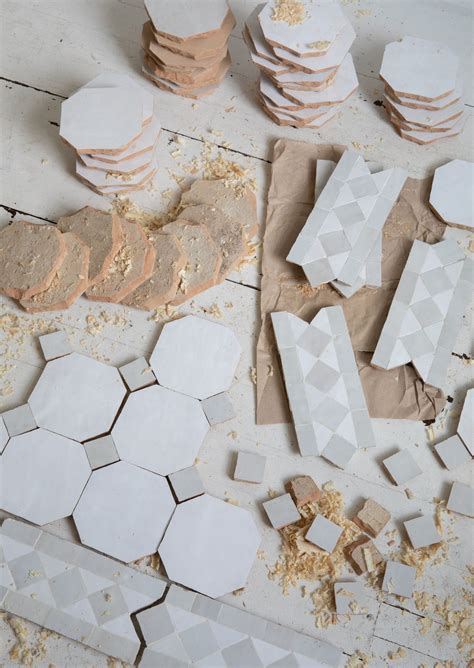
Zellige Tile Making Process (Source: Granada Design)
Cultural and Artistic Significance
Zellige tiles are deeply rooted in the principles of Islamic art, which heavily influenced their design and usage. One of the core tenets of Islamic art is aniconism, the avoidance of depicting living beings, which led to the prominence of geometric patterns in Zellige tilework. These geometric designs not only adhere to religious guidelines but also symbolize the infinite nature of Allah, representing unity and order within the cosmos.
The intricate patterns are created through the precise arrangement of small, hand-cut tiles, reflecting both mathematical precision and artistic creativity. Additionally, the colors and shapes used in Zellige tiles carry significant symbolism. For instance, blue often represents the sky and spirituality, green signifies nature and life, white symbolizes purity, and black denotes depth and eternity. These symbolic elements combined with geometric patterns create a visually and spiritually resonant form of art that aligns with Islamic aesthetic and religious values.
In traditional zellij decoration, geometric patterns of varying complexity were the most prominent and widespread motif. Vegetal arabesque motifs were also used, though less frequently. Geometric patterns were created on the basis of tessellation: the method of covering a surface with the use of forms that can be repeated and fitted together without overlapping or leaving empty spaces between them.
How to install a zellige tile backsplash - DIY no grout?!
Architectural Significance
Zellige tiles have been a crucial element in Moroccan architecture, used extensively in mosques, palaces, fountains, and homes. In religious structures, such as mosques, Zellige tiles are used to create intricate mihrabs (prayer niches) and minbars (pulpits), enhancing the spiritual ambiance through their detailed and symbolic designs. Palaces and royal residences feature expansive Zellige mosaics on walls, floors, and courtyards, symbolizing the wealth and power of the patrons.
Moroccan tiles adorned ceilings, floors, columns, courtyards, pools, and fountains in buildings, mosques, universities, and other public places throughout Morocco for centuries. The 20th-century Hassan II Mosque in Casablanca, Morocco, features a breathtaking display of Zellige tile inside and outside the building.
Public fountains adorned with Zellige tiles not only serve practical purposes but also act as decorative elements that enhance the aesthetic appeal of communal spaces. In private homes, Zellige tiles are often found in courtyards, kitchens, and bathrooms, adding a touch of elegance and cultural heritage. The use of Zellige in various architectural contexts showcases its versatility and enduring appeal as a key component of Moroccan design.
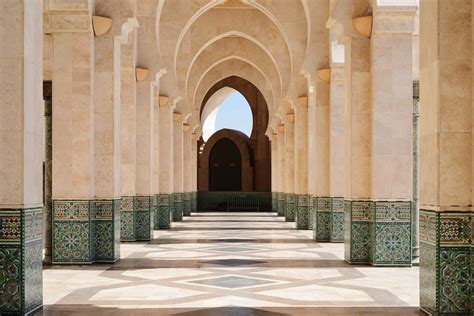
Moroccan Architecture (Source: Discover Walks)
Notable Examples
One of the most famous examples of Zellige tilework is found in the Alhambra in Granada, Spain. This historic palace and fortress complex, built during the Nasrid dynasty, features extensive use of Zellige tiles in its intricate geometric patterns and vibrant colors, showcasing the artistic excellence of Moorish craftsmen.
Another significant example is the Hassan II Mosque in Casablanca, Morocco, one of the largest mosques in the world. This modern marvel, completed in 1993, features extensive Zellige mosaics that adorn its interior and exterior surfaces, blending traditional craftsmanship with contemporary design.
These historic monuments highlight the enduring legacy and artistic significance of Zellige tiles in both historical and modern architectural contexts.
Regional Variations
While Zellige tilework is found throughout Morocco, there are notable regional variations in style and design. For example, the city of Fez is renowned for its traditional Zellige patterns, characterized by intricate, multi-colored geometric designs that reflect the city’s rich artistic heritage. In contrast, Marrakech often features more simplified and larger geometric patterns, with a distinctive color palette that includes bold reds and earthy tones, reflecting the city’s vibrant cultural atmosphere.
Coastal regions like Rabat and Casablanca may incorporate nautical motifs and colors, such as blue and white, inspired by their proximity to the sea. These regional differences in Zellige styles demonstrate the adaptability and diverse expressions of this art form across Morocco.
| Region | Characteristics | Color Palette |
|---|---|---|
| Fez | Intricate, multi-colored geometric designs | Traditional colors, varied hues |
| Marrakech | Simplified, larger geometric patterns | Bold reds, earthy tones |
| Rabat & Casablanca | Nautical motifs, coastal influences | Blue and white |
Blue and White: A Timeless Combination
Was there ever a more perfect - or long-lived match - as blue and white? It’s not just timeless, it’s beyond time, universal in geographic reach - and in spirit. By the 20th century, from Europe to the Americas, blue and white had become firmly ingrained in interior design as a signal of classic taste to be employed any time a nod to tradition (with a touch of nostalgia) was called for.
In France, toile de Jouy translated the blue and white motif (along with other colors) to fabric. Cheaper and more broadly available thanks to strong domestic textile manufacturing, toile de jouy began moving beyond classic Chinese motifs, depicting romantic, pastoral and rural scenes. It soon became a hallmark of classic French provincial design… and in time, toile de Jouy spread from more simple country French design back up to the aristocratic classes.
Cheap and accessible, indigo dye was commonly used throughout the world to create resist-dyed textiles like shibori. Inexpensive, these blue and white fabrics were often associated with the working class. In Japan, for example, mending techniques like aizome, sashiko and boro traditionally used indigo-dyed textiles and white cotton thread, which were both inexpensive and readily available.
Thanks to denim, that winning combination of blue and white is synonymous with comfort and casual ease - which is why it’s used so extensively in homes that are anything but classical and traditional. Blue and white: from renaissance palaces to laid back interiors, high brow or low brow, it’s a chromatic classic that will never go out of style.
Popular articles:
tags: #Moroccan
