Biblical Egypt (Hebrew: מִצְרַיִם; Mīṣrāyīm), or Mizraim, is a theological term used by historians and scholars to differentiate between Ancient Egypt as it is portrayed in Judeo-Christian texts and what is known about the region based on archaeological evidence. Along with Canaan, Egypt is one of the most commonly mentioned locations in the Bible, and its people, the Egyptians (or Mitsri), play important roles in the story of the Israelites.
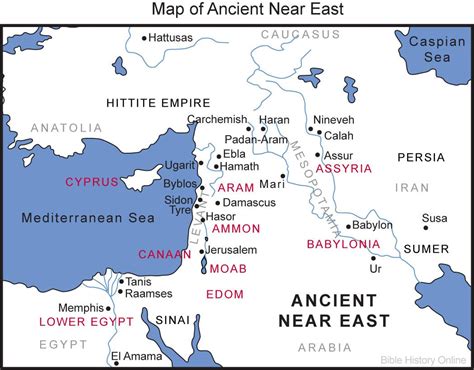
Map of the Biblical Near East
Key Biblical Narratives Involving Egypt
In the Bible, a number of Jews took refuge in Egypt after the destruction of the Kingdom of Judah in 597 BC, and the subsequent assassination of the Jewish governor, Gedaliah (2 Kings 25:22-24, Book of Jeremiah 40:6-8). On hearing of the appointment, the Jewish population fled to Moab, Ammon, Edom and in other countries returned to Judah (Jeremiah 40:11-12).
Abraham's Sojourn in Egypt
In the Book of Genesis, Abraham and Sarah, along with their nephew Lot, were living in Canaan when a famine struck the area and so, the group travels to Egypt, where the Pharaoh, betaken by Sarah's beauty, made her his concubine, unaware that she is married because Abraham introduces himself as her brother, not her husband. Pharaoh gives number of gifts to Abraham in exchange for Sarah, in the form of livestock and slaves, one of whom is Hagar, who would later become Abraham's concubine and the mother of his firstborn son, Ishmael.
For how long Sarah lives in Pharaoh's palace is not clear, though it is known that the LORD strikes Pharaoh and members of his household, save for Sarah, with plague, and Pharaoh deduces that Sarah is somehow the cause. "And there was a famine in the land: and Abram went down into Egypt to sojourn there; for the famine was grievous in the land."
Read also: Egyptian Adventure
Joseph in Egypt
Later in the Book of Genesis is the story of Abraham and Sarah's great-grandson, Joseph, the eleventh son of Jacob and his first son with his second wife, Rachel. It is said that Jacob prefers Joseph over all of his other sons, causing tension between Joseph and his brothers, and so, they sell him into slavery, to a group of traveling Midianites headed for Egypt, where he's purchased by Potiphar, the captain of the guard.
Joseph does well as a member of Potiphar's household, highly respected by his master, until Potipher's wife, scorned by Joseph, falsely accuses him of attempting to rape her and Joseph is imprisoned as a result. During his imprisonment, Joseph successfully interprets the dreams of two fellow prisoners, both servants of Pharaoh, one of whom is sentenced to death and the other who returns to Pharaoh's graces.
Joseph reveals to Pharaoh that his dreams are signs of a great famine to come, and for his service, Pharaoh makes Joseph the vizier of Egypt and gives to him an Egyptian wife, Asenath. When famine strikes much of the region, not only Egypt, the Egyptians are so well prepared for it that they have a surplus of grain, which foreigners come to buy, among them, Joseph's brothers, who do not recognize him.
The Exodus
In the Book of Exodus, the Israelites, descendants of Joseph and his brothers, are still living in the land of Goshen, and are now slaves, beaten, raped, and overworked by the Egyptian overlords under the reign of a new, tyrannical pharaoh. A great-great-grandson of Joseph's brother Levi, Moses, is born in a time when Pharaoh has decreed all newborn Hebrew males be slain and he is saved from Pharaoh's orders by Pharaoh's daughter, who rescues him from the Nile River and raises him as her own son.
For a time, Moses leaves Egypt, to escape punishment in the death of an Egyptian man who had beaten an Israelite man, and goes into Midian, and makes a new life there, but returns to Egypt to free his brethren, chosen by the LORD to do so. There, with his brother, Aaron, and sister, Miriam, Moses demands the release of his people but Pharaoh refuses and for his stubbornness, he and his people suffer the Plagues of Egypt, famine, insect swarms, and notably, the deaths of all the firstborn Egyptians.
Read also: Learn Arabic in Egypt: Guide
Solomon and Pharaoh's Daughter
In the Books of Kings, Solomon, the king of Israel and the son of David, is said to have married Pharaoh's daughter, whose name is not provided, and received the city of Gezer as part of her dowry. Nothing else is written as to the personal nature of Pharaoh's daughter or about her relationship with Solomon. However, their relationship, and Solomon's willingness to take wives from other nations, in violation of laws against intermarriage in the Book of Deuteronomy, is thought to have contributed to his downfall.
And Solomon made affinity with Pharaoh king of Egypt, and took Pharaoh's daughter, and brought her into the city of David, until he had made an end of building his own house, and the house of the Lord, and the wall of Jerusalem round about.- KJV, 1 Kings 3:1
Jeroboam's Refuge in Egypt
Also in the Books of Kings is the story of Jeroboam, a former servant of Solomon who later conspired against him and, when his plotting was revealed, fled to Egypt, where Pharaoh Shishak protected him until Solomon's death. Solomon sought therefore to kill Jeroboam.
Shishak's Invasion of Judah
In the Books of Chronicles, Rehoboam, son of Solomon and the first king of Judah, is attacked in the fifth year of his reign by an Egyptian pharaoh, whose personal name is given as Shishak, whom some historians have identified with Shoshenq I. It written that Rehoboam may have expected an attack, as he fortified fifteen major cities, among them Bethlehem and Hebron, but his efforts were not enough, as Shishak came with 1,200 chariots and 60,000 soldiers, not only Egyptians but also Lubims, Sukkites, and Kushites.
As a result of his defeat, Judah became a vassal state, subordinate to Egypt. Shishak's invasion of Judah is portrayed as the wrath of the LORD, for the Israelites had forsaken the LORD and so, the LORD left them to the hands of Shishak.
Read also: Clothing in Ancient Egypt
The Flight into Egypt
In the Gospel of Matthew, part of the New Testament, it is said in Matthew 2:13-23 that Joseph, the earthly father of Jesus of Nazareth, is visited by an angel in a dream, who tells him to take Mary and Jesus and go to Egypt, to avoid Jesus being slain by King Herod I, called the Flight into Egypt.
Key Locations in Biblical Egypt
This map highlights many of the important locations in Egypt during biblical times. Memphis (located south of modern-day Cairo) was the capital of the Egyptian Old Kingdom and was succeeded by Thebes in later times. Alexander the Great founded Alexandria in 331 B.C.E., and the city quickly became an important center for culture and education in the Hellenistic world.
A very large Jewish population developed here, and Alexandria is known as the birthplace of the Greek version of the Bible called the Septuagint (LXX). In addition, Amarna, Nag Hammadi, and Elephantine are all significant Egyptian archaeological sites that have yielded texts relevant to the study of ancient Judaism and Christianity.
Synchronizing Biblical and Egyptian Timelines
In this paper we will show that the biblical and Egyptian chronologies produce timelines that diverge greatly back before about 600 B.C. This has important implications for interpreting archaeological findings, which are usually published with Egyptian dates, and no indication is given that the biblical dates might be different. The result is claims that the Bible is wrong, or even that events like the Exodus never happened at all, because scholars are looking for these events in the wrong place in time.
This produces widespread disbelief in the authority of the Bible, making chronology a crucial branch of biblical apologetics. We therefore need to apply solid scholarship to the subject of synchronizing the biblical and Egyptian timelines, because there is a lot at stake-the very foundations of our belief system are in question.
The subject of the Egyptian chronology, also called the standard chronology, comes up constantly with respect to the Bible. Because it is widely (and I believe incorrectly) thought that the two timelines coincide in historical times (defined roughly from Abraham forward to 600 B.C.), secular as well as many biblical scholars do not distinguish between the two. Biblical and standard Egyptian dates are unfortunately treated as if they are the same, with much confusion resulting.
Attempts at revising the Egyptian timeline to fit the biblical timeline have been made by various scholars over the years. Clearly there are many differing ideas, some by Bible believers, and some by others who are not. The theme that constantly gets played by liberal historians and archaeologists is that whatever biblical event they are looking for-the Exodus is an example-is not visible in history where they think it should be, wherever that is.
I submit that the reason for not finding evidences of something like the Exodus where they expect it in history is that scholars mistakenly assume that the biblical and standard Egyptian dates are the same. Many put their trust in the information produced by traditional archaeology. But that is not to say that archaeology has proved the biblical narrative to be true in all of its details. Far from it: it is now evident that many events of biblical history did not take place in either the particular era or the manner described.
The Authority of the Bible Under Attack
The very authority of our Bible is under attack because scholars place their confidence in archaeology, carbon dating, and other modern beliefs rather than in Scripture itself. This is a serious matter because biblical authority is the underlying support for our faith and our entire worldview, and these people are trying to tear our biblical beliefs apart. We need to be ready to defend the historicity of the Bible with answers.
Clearly there are countries other than Egypt that appear in the Bible, that have their own secular histories that we also need to synchronize with the biblical timeline. However, we cannot work on all of them at once. We are therefore setting out here to produce an Egyptian-versus-biblical history correlation that is solid. All other countries’ histories will then have to fit this one. If they do not fit this synchronization, it will be necessary to work out what the problems are.
The Divergence of Timelines
The biblical timeline comes from time information contained in the Bible. On the other hand, the Egyptian timeline originally comes to us from Manetho, an Egyptian priest of the third century B.C., who took information available to him on how long the known pharaohs claim to have reigned, and then laid them all end to end. Because of the differing ways that these two timelines were developed, there is no reason why we should expect them to coincide. Indeed we might wonder why anyone thinks that they would.
As we show in this paper, in the historical period (from Abraham on) secular dates from the Egyptian timeline are a great deal older than biblical dates. As an example, Solomon reigned around 1000 B.C. (biblical) (Jones 2004, 279), but this corresponds to nearly 1500 B.C. on the Egyptian timeline (Habermehl 2018a). Secular scholars should therefore be looking for Solomon’s kingdom back around 1500 B.C. on their timeline. No wonder they don’t believe what the Bible says about that kingdom-they are nearly 500 years off in where they are looking for it.
For instance, they look in vain for evidence of Solomon’s glories as described in 1 Kings 10. Finkelstein and Silberman devote a chapter in The Bible Unearthed (2001, 123-145), to carefully explain why archaeology shows that the biblical story of David and Solomon’s kingdom is not true. By “the tale” they mean the biblical narrative. They go on to promise us “a very different Israel” (Finkelstein and Silberman 2001, 145). But we do not want a different Israel than the one that the Bible describes because we believe that the Bible is authoritative.
Defining "Historical Times"
We will define “historical times” to begin with Abraham’s father, Terah, born 2126 B.C. on the biblical timeline (Jones 1993, 278) or about 3500 B.C. on the standard timeline (see Habermehl 2013a: this date is estimated from the stretching out of the Egyptian timeline). This point in history is chosen because there is a blank in the biblical historical narrative between the Babel dispersion and Abraham’s father, Terah (Genesis 11).
The Jones biblical chronology is mainly used in this paper (Jones 2004); this chronology has the advantage of covering the entire history of the world from creation to about 100 years after the birth of Christ. It is understood that the other well-known biblical chronology is that of Thiele (1994); however his chronology is limited in that it covers only the period of the kings of Judah (931 B.C. to 586 B.C.) and the kings of Israel (931 B.C. to 722 B.C.) (see Thiele 1994, 217).
We will draw two timelines opposite each other, biblical and Egyptian standard, and will show connecting points between them. Those synchronizations will be where people or events of the Bible correspond to people or events of Egypt. See fig.
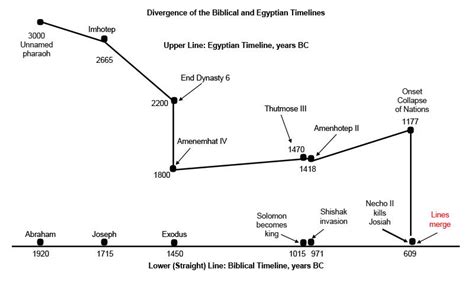
Fig. 1. The biblical and Egyptian timelines showing the seven synchronizations outlined in this paper. The lower biblical timeline is a straight line, while the upper Egyptian standard timeline is strangely shaped because of the variations in its divergence from the biblical timeline. The distance between the two lines at any point is the amount of divergence and is shown approximately in proportion. Drawing by A.
I include crossover points between the two timelines that are solid and well supported. There are not as many of these provable crossover points between Egypt and the Bible as we might think. In Table 1 we list the seven that we will use, and will then lay out the logic behind each of them. These explanations will necessarily be brief to keep this paper from being overlong, as it could easily stretch out to book length if these points were pursued in detail here.
| Synchronization Point | Biblical Timeline (B.C.) | Standard Egyptian Timeline (B.C.) |
|---|---|---|
| Abraham in Egypt | About 1920 | About 3000 |
| Joseph as Imhotep | 1715 | 2665 |
Abraham in Egypt: A Synchronization Point
Some time after Abraham moved from Haran to Canaan, there was a severe famine in Canaan that made him decide to travel with all that he had to Egypt (Genesis 12:10-20). It is important to note that this famine occurred in Canaan but not in Egypt, as there is no biblical mention of famine in Egypt at that time. Although Egypt and Canaan are not geographically far apart, the condition that usually brought on famine in Egypt was a low Nile flow, which meant low rainfall far to the south in Africa where the Nile originates.
On the other hand, famine in Canaan was the result of low rainfall in Canaan itself. In any case, it is unlikely that Abraham would travel from one area that is under severe famine to another that is also under famine. In Egypt, Abraham dealt with a powerful unnamed king or pharaoh, whom he clearly feared. That is why Abraham told the pharaoh that Sarah was his sister, so that the pharaoh would not kill Abraham to take her as his wife. Because this pharaoh was so powerful, we know that Egypt must have been united by this time after the Predynastic period, and was now under the rule of the dynastic pharaohs.
We can determine Abraham’s approximate place in Egyptian history by first establishing Joseph as Imhotep, vizier of the Pharaoh Djoser of the Third Dynasty (see the next section of this paper). The time between Abraham’s visit and Joseph’s becoming vizier would be about 200 years on the biblical timeline; Abraham left Haran in 1921 B.C., and Joseph was promoted in 1715 B.C. (Jones 2004, 278). But the difference between the biblical and standard Egyptian timelines is stretching out at this time as we see in fig. 1, and so we can date Abraham before Joseph a lot more than 200 years on the Egyptian timeline. For this reason we would put Abraham in Egypt around 3000 B.C.
There is a known historical reason to back up our placement of Abraham in Egypt in the early First Dynasty. At this period, there was a lot of traffic in goods between Egypt and Canaan, with colonies of Egyptians living in southern Palestine since Dynasty 0. These Egyptians returned home to Egypt at the end of the reign of King Aha (or Hor-Aha), considered the first pharaoh of the First Dynasty by many scholars.
Historians tell us that this migration from Canaan back to Egypt happened, but do not say why (see Porat 1992; Raffaele 2003; Watrin 1998, 1224-1226.) We might wonder whether this exodus from Canaan was because of the same severe famine that drove Abraham to Egypt. These Egyptians would have needed a very strong reason for them to interrupt their prosperous trade and make such a major move.
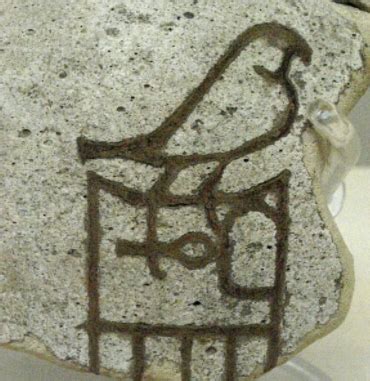
Fig. 2. Serekh (royal crest) of Pharaoh Aha, who was reigning during the First Dynasty at the time that Egyptians living and doing business in Canaan moved back to Egypt. It is on a glazed fragment of a faience vessel, found at the temple of Osiris at Abydos. Captmondo.
One of the implications of this date for Abraham is that it puts the destruction of Sodom back to 3000 B.C. on the archaeologists’ standard timeline. If there are any archaeological remains of Sodom, they should be on the west side of the Jordan River just above the Dead Sea, and they should date to this time. The allied kings of Genesis 14:1, who fought the kings of the land of Sodom, also need to be sought in this time frame of the early First Dynasty.
Joseph as Imhotep: A Controversial Matter
Where Joseph appears in Egyptian history is a controversial matter among scholars, who offer varying opinions. For instance, Courville (1971, vol. 1, 141-142) concludes that Joseph is Mentuhotep, second vizier to Twelfth-Dynasty Sesostris I. Osgood agrees with Courville (Osgood 2020, 204). Stewart (2003, 90-103) believes that Joseph was an unnamed first vizier to Sesostris I. Aling (2003) chooses Sesostris II as Joseph’s pharaoh. Smith (1948, 505) favors one of the Hyksos kings, possibly Apophis, as Joseph’s pharaoh. Bates et al.
Ten years ago, when I published a paper on Egyptian chronology (Habermehl 2013a), I showed why Joseph had to have been the same person as the ancient famed Imhotep, vizier of the pharaoh Djoser of the Third Dynasty of the Old Kingdom. Although I had come to this conclusion on my own, I found that the equivalence of these two persons was not a new idea on my part, as others had thought of it before. The earliest source I found was Tom Chetwynd, who wrote a scholarly paper on the subject in 1987 (Chetwynd 1987, 49-56 ). See fig.
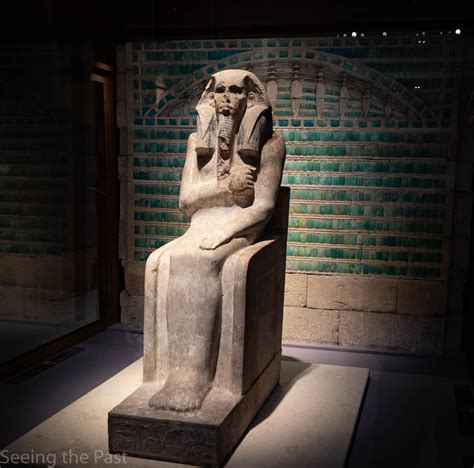
Fig. 3. Limestone statue of Third-Dynasty Pharaoh Djoser, Joseph’s pharaoh, from his funerary temple in Saqqara. Egyptian museum.
This synchronization supports Abraham in the era of the First Dynasty, as I show in section no. 1 above. The evidences for Joseph as Imhotep were clear enough. These started with the obvious one, that phonetically “Joseph” and “. . . hotep” sound similar in English, in spite of their differing language origins (Hebrew and Egyptian). In addition, there are historical reasons that back Joseph as Imhotep. It was in Djoser’s time that pharaohs suddenly could conscript non-slave manpower to do great projects, such as building pyramids (for example, McClellan and Dorn 2006, 42-46). Also we see that the pharaohs of the Old Kingdom had become very wealthy, which enabled them to pay for these projects. Both of these items support Joseph as Imhotep, because the Bible explains clearly how Joseph made these things possible for his pharaoh (Genesis 47:13-26).
During the seven years of plenty, Joseph instituted a rule that a fifth of all the grain grown in Egypt was to belong to the pharaoh. During the seven years of famine, the people ended up selling their land and themselves to the pharaoh in exchange for food.
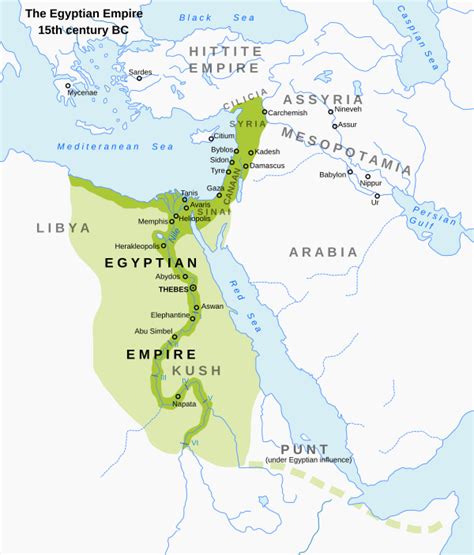
Egyptian Empire during the Eighteenth Dynasty
The 18th dynasty of Egypt was established in Egypt during the middle of the 16th century B.C. by Ahmose. At this time Egypt's New Kingdom took complete control over the land of Canaan, the kingdom lasted over 400 years.
The largest boundaries of the Empire of Egypt around 1450 BC was as follows:
- The Northern Boundary was the city of Carchemish above Damascus in Syria.
- The West Boundary was the Mediterranean Sea which included the cities of Tyre, Sidon, Byblos, Gaza, and in the south the western boundary extended past Tanis in Egypt to Libya.
- The Eastern Boundary was the eastern portion of the Dead Sea, up to Damascus, Kadesh, and Carchemish in the north.
Divisions of Egypt:
- Egypt Under the Old Kingdom: Extending from the foundation of the Kingdom, far back toward the period of the Flood, to the invasion of the Hyksos, or Shepherd Kings, including the Kings of the first fourteen dynasties.
- Egypt Under the Middle Kingdom: This consisted of the Kings of the fifteenth, sixteenth and seventeenth dynasties, comprising the Shepherd Kings.
- Egypt Under the New Kingdom: Beginning with the eighteenth and closing with the thirtieth, dynasty. The Kingdom was consolidated by Amosis, who succeeded in expelling the Hyksos. The first of these was, perhaps, the "new King who knew not Joseph," and began the oppression of the Israelites. During the rule of the thirtieth dynasty the country was subjugated by Persia, and from B. C.
- Egypt Under the Greeks; Egypt was conquered by Alexander the Great. B. C. 331. and passed under the rule of the Greeks, and so remained until B. C.
- Egypt Under the Romans: The Romans ruled the country, with temporary interruptions, until A. D.
- Egypt Under the Arabians : With some interruptions. the country remained under Ai'abian domination until A. D.
- Egypt Under the Turks : Their rule was interrupted at various times by rebellions within and invasions from without, but the Turks have in the main been the controlling power in Egypt until the present time.
Is There Archaeological Evidence For The Exodus? - Ancient Wonders Revealed
Popular articles:
tags: #Egypt
