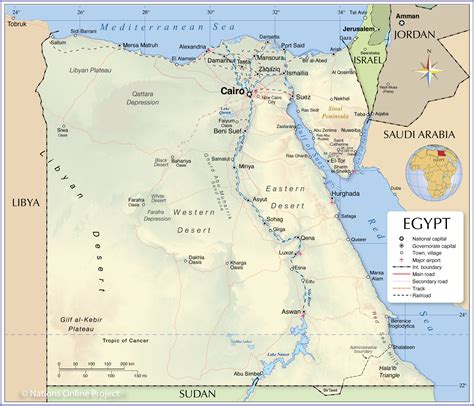
The Arab Republic of Egypt, located in northeastern Africa with the Sinai Peninsula extending into Asia, has a rich history of legal and administrative systems dating back to 3200 B.C. The Egyptian legal system is considered a civil law system, based upon a well-established system of codified laws.
This article provides an overview of the Egyptian legal system, its structure, key institutions, and laws.
Sources of Law
Egypt's supreme law is its written constitution. With respect to transactions between natural persons or legal entities, the most important legislation is the Egyptian Civil Code of 1948 (the “ECC”) which remains the main source of legal rules applicable to contracts. Despite the non-existence of an established system of legally (de jure) binding precedents, previous judicial decisions do have persuasive authority.
Legislations (statutes) constitute the main source of legal rules. Codified statutory rules rank below the Constitution and international conventions. However, they rank higher than executive regulations, decrees, internal regulations, custom, and general principles of law.
According to the 1980 amendment of the Constitution, Islamic Law (Sharia) became the principal source of legislative rules. Such wording simply implies that any new law that is being enacted or considered for enactment should not be in contravention of any prevailing principles of Islamic Law (Sharia). Nevertheless, whilst all statutes regulating personal status issues (such as inheritance, marriage, divorce, alimony etc…) are derived from Islamic norms, penal law rules as codified in the Penal Code are entirely western non-religious oriented rules. It is argued that the 1980 amendment operates with respect to post 1980 legislations and does not have a retroactive effect.
Read also: Egyptian Adventure
Government Structure
The Egyptian government is structured with three main authorities: the Executive, the Parliament, and the Judiciary. The Constitution upholds the concept of separation of powers, balancing the powers of these three main authorities.
The President
Article 75 of the Egyptian Constitution clearly states that a President of Egypt must meet certain requirements. First, he must be an Egyptian national, born to Egyptian parents and enjoys both political and civil rights. According to the Constitution, after being elected by the qualified special majority of the Parliament, the President serves six consecutive calendar years form the date the results of the plebiscite are announced.
The Cabinet
As the chief executive body of Egypt, the Cabinet consists of the Prime Minister and the cabinet ministers. Ministers of State, who have considerably more transient portfolios since positions may be created and dissolved in reaction to a shift in government priorities or a change in the specific qualifications of candidates without altering the departmental structure. The Ministers of State have specific tasks or agencies that they most oversee, e.g. Chairmen of Departments, who are men/women that head important departments which do not fall under the jurisdiction of any of the ministers. Ministers-Delegate, who have been delegated duties by the ministers to assist them in some areas of their departments.
The Parliament
The Parliament of Egypt is geographically located in Cairo. The Parliament is a bicameral legislature which means it has two chambers or legislative houses. Every year, the Parliament meet for one nine-month session, but under special conditions the President may call another session. The People’s Assembly under the new Constitution was founded in 1971 as a result of the adoption of the new Constitution. It is considered to be the lower house of the two, though it has a greater number of deputies, 454 deputies to be precise, 444 of them are directly elected, while the remaining ten are appointed by the President.
The President’s power is demonstrated again, by his promulgate and/or objection to some laws. He can send back the draft law if he disagrees with it, even if it was approved by the People’s Assembly. In such a case in which the draft law is not returned in the assigned time, it is endorsed as a law and promulgated. But if it is returned within the time period, then the People’s Assembly may endorse it for the second time by a majority vote of two-thirds.
Read also: Learn Arabic in Egypt: Guide
The Arabic word ‘shura’ means consultation; in English it is roughly translated as “The Consultative Council”. The term membership of the Shura Council is six years. However, renewed election and appointment of 50% of the total number of members is required every three years, and it is always possible to re-elect or re-appoint those members whose membership has expired.
The powers of the Shura Council are not as extensive or effective as the People’s Assembly, its jurisdiction as provided by Articles (194) and (195) of the Constitution covers the studying and proposing of what is deemed necessary to preserve the principles of the July 23rd, 1952 revolution and the May 15th, 1971 Corrective Revolution.
Drafting the Budget is a serious matter and must be presented to the Assembly at least two months prior to the beginning of the fiscal year and voted upon. On a different note, with respect to taxation, the Constitution states taxes or duties may not be levied, charged, amended or abrogated except by virtue of a statute.
The Constitution also stresses that ministers shall be accountable before the People’s Assembly for the State Policy. Just like any ordinary person, each minister shall be held accountable for his actions that are stated in his portfolio. Though the People’s Assembly cannot disqualify the Prime Minister, they can dismiss or disqualify a deputy of the Prime Minister, a Minister, or a Deputy Minister.
The Egyptian Court System
The Egyptian Court system is composed of a number of tiers: Courts of First Instance, Court of Appeal, and the Court of Cassation at the apex of the judiciary. Generally, the Egyptian judicial system is based on French legal concepts and methods.
Read also: Clothing in Ancient Egypt
The Egyptian judicial system is composed of a number of tiers:
- Courts of First Instance
- Court of Appeal
- Court of Cassation
The classical dichotomy of public and private law has resulted in the establishment of the Council of State (Conseil d’Etat), which are administrative courts vested with the power to decide over administrative disputes pertaining to administrative contracts and administrative decrees issued by government officials and ministries.
Judges are familiar with civil law systems’ concepts, and despite the huge case backlog and time-consuming proceedings, the principles of the due process and judicial review are inherently cherished and respected. Accessibility to justice is an indispensable principle of the Egyptian legal system. Judges are generally independent from the State and enjoy judicial immunity; hence they cannot be dismissed or sacked by the Executive Authority. However, due to the huge amount of cases before the courts, there exists a heavy case backlog, which adversely affects the efficiency of the court system and the judiciary as a whole.
Apart from the heavy case backlog which might cause some delay and inconvenience, judges are competent, able, and impartial, which ensures equality of the parties and justice.
The Supreme Constitutional Court is an independent body in the Arab Republic of Egypt. The Court is undeniably the highest judicial power in Egypt.
In 1931, the Court of Cassation was established to create a central tool to provide exclusive and uniform interpretation and application of the law. The Court of Cassation’s jurisdiction simply includes consideration of challenges brought to it by either adversary or by public prosecution; it also includes the examination of lawsuits that arose from a judge’s action. Another function of the court is to give rulings on requests of reparations for all violated verdicts.
There exist around seven Courts of Appeal in Egypt in major cities. These are second degree courts that review the awards of the courts of first instance. Their review covers questions of fact as well as questions of law.
This court was founded in 2004 to provide a specialized judicial tool for family disputes. This court aims at providing psychological peace and comfort for the children caught in the middle of disputes relating to tutelage, divorce, alimony and custody.
The law states that the Egyptian Lawsuits Authority has the power to plead on behalf of the State. When it comes to the organizational structure of the Egyptian Lawsuits Authority it is divided into seven parts each capable to represent the state in the areas of its jurisdiction.
Moreover, joining the public prosecution is the path to becoming a judge in the Court of First Instance, the Court of Appeal, and the Court of Cassation.
Administrative Courts do have a separate structure, where the Supreme Administrative Court sits at the apex of such structure. There are also departments for opinions and legislation which advises public entities on diverse aspects of public law such as administrative contracts, tenders, ministerial decrees etc.
With respect to jurisdiction, it is necessary to distinguish between national jurisdiction in pure domestic cases and international jurisdiction regarding disputes involving a foreign element.
Trial courts: dealing with disputes of not more than L.E.
Higher courts: (such as the Court of First Instance): dealing with disputes of not less than L.E.
With respect to territorial competence, courts of general jurisdiction are divided according to cities and suburbs.
With respect to the effect of choice of law and exclusive jurisdiction clauses in international contracts, it should be noted that Egyptian law, like most legal systems, upholds the principle of party autonomy to maximum possible extent.
Parallel to court litigation, arbitration has established itself as a prominent method for resolving business, commercial, and investment disputes. A new Arbitration Law No.27 of the Year 1994 was enacted and it governs both domestic and international arbitration.
Courts are increasingly mitigating any form of hostility towards arbitration as an out-of-court dispute resolution system. Thus, if the parties to a contract agree on an arbitration clause or agreement in disputes capable of settlement by arbitration (the criteria for arbitrability under Egyptian Law being the possibility of settlement) Egyptian courts will decline jurisdiction to review the subject matter of the dispute.
However, an arbitral award rendered may only be subject to nullity proceedings in Egypt if:
- the Seat of Arbitration is in Egypt or
- the parties have agreed, if the Seat is in a different State, that the law applicable to the proceedings is the Egyptian Arbitration Law No.27/1994.
With respect to enforcement of judgments and awards, as a general rule, enforcement is possible when an award is final, which is the case for awards rendered by the court of Appeal or final arbitral awards.
The criminal code listed three main categories of crime: contraventions (minor offenses), misdemeanors (offenses punishable by imprisonment or fines), and felonies (offenses punishable by penal servitude or death).
Capital crimes that carried a possible death sentence included murder, manslaughter occurring in the commission of a felony, arson or the use of explosives that caused death, rape, treason, and endangerment of state security.
Egypt's laws require that a detained person be brought before a magistrate and formally charged within forty-eight hours or released.
The Emergency Law of 1958 authorized the judicial system to detain people without charging them or guaranteeing them due process while an investigation was under way. After thirty days, a detainee could petition the State Security Court to review the case.
There are "two levels" of litigation (two trials of fact)" with another appellate level in civil litigation in Egypt. "Larger claims originate with a panel of three Court of First Instance judges, with a right of de novo appeal to a three-judge panel of Court of Appeals judges.
Unlike Saudi Arabia and some other Muslim countries, the Egyptian legal system has no office of hisbah (Islamic religious police force), but it does allows for "hisbah" lawsuits.
Hisbah lawsuits in Egypt are submitted to the public prosecutor, who determines their merit. Amendments to some articles of the 2014 Constitution passed by a public referendum followed on 19-22 April 2019, provide for the president to appoint the heads of the judicial bodies or authorities and to be head of the Supreme Council for the Judicial Authorities.
The Family Court (FC) was established in 2004, motivated by the need to differentiate between family litigations and other disputes. The public prosecution acts as public attorney before criminal courts with the right to file criminal actions.
The following table summarizes the key courts and their functions within the Egyptian legal system:
| Court | Function |
|---|---|
| Court of Cassation | Provides exclusive and uniform interpretation and application of the law. |
| Courts of Appeal | Review the awards of the courts of first instance. |
| Family Court | Provides a specialized judicial tool for family disputes. |
| Supreme Constitutional Court | Highest judicial power in Egypt. |
Egyptians vote 'yes' for constitutional change
Popular articles:
tags: #Egypt
