Crime is a widespread issue in various social strata in Egypt, deeply affecting the well-being of individuals, families, and communities. Daily incidents indicate a recent rise in crime rates in Egypt. According to the 2024 crime index from Numbeo, Egypt ranked 18th among African countries with a crime rate of 47.3 on the index, 65th globally, and third in the Arab world due to the prevalence of various crimes. In 2023, Egypt had a crime index of 47.2, which is to be considered moderate. Overall, Egypt's crime index is averaging between 40-60.
Crime levels lower than 20 are considered to be very low, crime levels between 20 and 40 are low, crime levels between 40 and 60 are moderate, crime levels between 60 and 80 are high, and crime levels higher than 80 are very high. The source explains that the crime index is a measure of the level of crime in a certain city or country. Over the observed period, the index was lowest in 2012, with a score of 44.3.
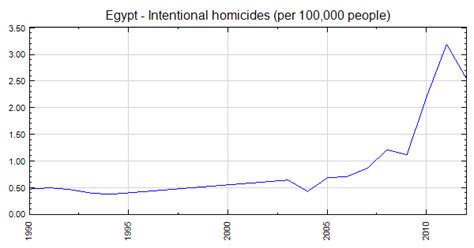
In 2017, Egypt had one intentional homicide per 100,000 people. However, this number peaked in 2011 and 2014, with three intentional homicides per 100,000 people.
Factors Contributing to Crime Rates
Numerous factors can contribute to the increasing crime rates in Egypt, including social, economic, and cultural factors. A study by FasterCapital, a business incubator and accelerator, identified major contributing factors: unemployment, drug and alcohol abuse, mental health issues, social isolation, and economic pressures leading to higher poverty rates and the erosion of social classes. Poor economic and living conditions are significant reasons for the spread of theft and fraud crimes.
According to the labor force survey results for the fourth quarter (October-December) of 2023 by the Central Agency for Public Mobilization and Statistics (CAPMAS), the unemployment rate reached 6.9%. This comes at a time when the unemployment rate in Egypt has reached about 6.9% of the total labor force, with 2.159 million unemployed (1.165 million males, 994 thousand females), according to the latest CAPMAS data. The labor force was estimated at 31.101 million citizens, down from 31.956 million in the previous quarter, a decline of 2.7%.
Read also: Safety Tips for Morocco
Psychologist Walid Hindi explained that the economic situation greatly impacts an individual’s self-perception, ambition, and general behavior, leading to crimes, according to Karl Marx and Engels’ theory on the economic aspects of crime. Hindi stated that inflation, privatization, recession, low wages, and rising prices in Egypt affect the nature and type of crimes due to financial pressures that generate value conflicts, pushing individuals toward criminal behavior. Poverty, deprivation, and limited opportunities are external pressures that drive some to commit crimes. Economic disruption in a country leads to phenomena like rising unemployment rates and the emergence of new social classes, resulting in new types of crimes previously unseen.
Fathi Kanawi, a crime detection professor at the National Center for Social and Criminal Research, agrees with the study, explaining that economic factors are significant in committing crimes in Egyptian society, especially alongside other factors like environment and circumstances surrounding the perpetrator. Kanawi pointed out that most individuals committing crimes for economic reasons suffer from abnormal conditions like drug addiction or unemployment.
Government Efforts and Narratives
Despite Cairo’s ranking as the 18th in Africa and third in the Arab world for high crime rates, official narratives refute international indices. In October 2023, Interior Minister Mohamed Tawfik stated at the “Nation’s Story” conference that crime rates had significantly decreased in recent years. Tawfik added that the detection rate for crimes had risen from 57% in 2013 to 95% in 2023. Misdemeanor crimes had decreased by 58% in 2023 compared to 2013 and by 12% compared to 2010.
However, in 2017, the Ministry of Interior reported that premeditated murder crimes had increased by 130%, armed robbery by 350%, car theft by 500%, and the number of “thugs” had risen to 92,680 individuals, with the number of “dangerous registrants” increasing by 55%, aside from those not officially registered.
Specific Types of Crime
Honor Killings
An honor killing is the killing of an individual (often one's own family member) to protect a family's honor, and as such is often a form of domestic violence. A 2005 report states that between 1998 and 2001, 79% of honor killings in Egypt were done as a result of suspected adultery on behalf of the woman, and 41% of the killings being done by husbands, to their wives. The same report references an estimated 52 out of 819 murders reported in Egypt in 1995 being honor killings.
Read also: Statistics on Crime in Ghana
Honor killings have historically not faced much legal punishment in Egypt, with certain penal codes in Egyptian law allowing for reduced penalties for those committing honor killings, depending on the judge's discretion. Egyptian law also contains measures to reduce the penalties for an honor crime, with men who are able to prove infidelity receiving lighter sentences. An example of this crime can be seen in a court case from 2024, where an Egyptian man was convicted of murdering his sister, and was eventually sentenced to 15 years in prison, after an appeals process.
Corruption
Corruption represents a massive problem for the Egyptian government, with many anti-corruption measures lacking adequate strength. To fight corruption, Anwar El Sadat established commissions in the 1970's for the investigation of corruption among government officials. Hosni Mubarak, who made it a priority to target corruption, later continued anti-corruption efforts by replacing many cabinet members who failed to detect corruption.
Anti-corruption sentiments came to a head among the Egyptian public in 2011, when Egyptians started mass anti-government protests amidst the Arab Spring. A 2017 report discusses corruption levels in Egypt in relation to several other countries, including both immediate neighbors and more distant European ones. In this report Egypt rates as less corrupt than Angola, but more corrupt than Tunisia or the United Arab Emirates, who also underwent the Arab Spring.
The same report also draws the conclusion that part of the reason why anti-corruption efforts haven't born fruit in Egypt, is because anti-corruption forces focus too much on large news-worth instances of corruption, and less on more local, petty ones. Law enforcement has also been reported to be dangerously corrupt, making affiliations with tuktuk and taxi drivers break traffic laws for a charge. Also, making false warrants and unlawful arrests on suspects who are filed with cases made by paying rivals.
Sexual Violence
Sexual violence has been a recurrent problem in Egypt, with rape being one of the most common crimes in Egypt. The Egyptian Centre for Women's Rights (ECWR) has called the problem "social cancer" and suggested that dress code is no deterrent at all. A 2013 United Nations report on Egypt states that 99.3% of women who responded reported sexual harassment, with incidents of female genital mutilation also being very high. Mass rapes have also been known to occur in Egypt, and take the form of the public rapes of women.
Read also: South African Stories
Drug-Related Crime
Egypt is a party to the 1961, 1971, and 1988 international drug control conventions. The use of narcotics such as opium and hashish has been present in Egypt for hundreds of years.
Human Trafficking
Egypt serves as a transit country for women trafficked from Eastern Europe to Israel for commercial sexual exploitation. Men and women from countries in sub-Saharan Africa and Asia are believed to be trafficked through the Sinai Desert to Israel and Europe for labor. In addition to this, victims of human trafficking in Egypt are likely to be Egyptian children trafficked to other areas in Egypt to be put into forced labor such as cleaning, farming, or performing delivery services. Children specifically are targeted for these purposes, especially children living on the street, of which there are an estimated 2 million living in Egypt. In addition to the above types of labor victims of human trafficking have been subjected to, children are especially likely to engage in begging as a form of forced labor.
Terrorism
Egypt suffers from religious violence and terrorism, infrequent attacks both on tourists and religious minorities. Luxor massacre (1997), the 2004 Sinai bombings, 2005 attacks in Cairo and in Sharm el-Sheikh, the 2006 Dahab bombings and the 2011 Alexandria bombing. Roughly 100,000 terroristic attacks have been reported in the middle east since the year 2000, claiming about 240,000 victims. Egypt suffered about 2,100 of those, with 4,200 deaths.
Anne Milgram: Why smart statistics are the key to fighting crime
Human Rights Concerns
The authorities continued to crack down on criticism, stifle civil society and restrict street protests in 2024. Authorities carried out mass arrests to prevent planned anti-government protests and forcibly dispersed the few small peaceful protests that took place. Authorities released 934 prisoners held for political reasons but arrested another 1,594. Those targeted included journalists, lawyers, protesters, dissidents, opposition politicians and those critical of the government’s human rights record and handling of the economic crisis. Dozens of individuals were subjected to enforced disappearance. Torture and other ill-treatment remained routine. Death sentences were imposed, including for crimes other than “intentional killing”, after grossly unfair trials. Executions were carried out. Impunity prevailed for grave human rights violations committed in 2024 and previous years. Women and girls, religious minorities and LGBTI individuals experienced discrimination, violence and prosecution for exercising their human rights.
The government failed to protect economic and social rights in the economic crisis, adequately adjust social security measures or ensure private companies complied with the minimum wage requirement. The government introduced new legislation jeopardizing the accessibility and affordability of healthcare. Forced evictions from informal settlements continued. Thousands of refugees and asylum seekers, most from Sudan, were arbitrarily detained and expelled.
Addressing Crime and Poverty
A study on the impact of economic and social changes on juvenile delinquency, published in the Scientific Journal of Business and Commercial Research, suggested various approaches to address crime and poverty rates. Effective solutions include increasing access to education, vocational training, and resources to help individuals build skills and improve economic prospects. Investment in mental health programs and substance abuse treatment can address underlying issues contributing to criminal behavior.
Heba Al-Issawy, a professor of psychiatry at Ain Shams University, highlighted the importance of emphasizing the punishments for crimes, whether economically motivated or not, to warn those with criminal tendencies. Publicizing punishments plays a crucial role in deterring crimes and regulating them among different groups.
| Year | Crime Index |
|---|---|
| 2012 | 44.3 |
| 2023 | 47.2 |
| 2024 | 47.3 |
Popular articles:
tags: #Egypt
