Bullying is a pervasive issue, affecting children for various reasons, ranging from clothing choices to speech impediments. While all forms of bullying are harmful, the implications differ, particularly for Black African kids who may face xenophobia in schools. As an African kid, I experienced occasional bullying for simply being African.
Hearing people click their tongues at me nonsensically to imitate what they thought all Africans talk like, being asked if my mother lived in a hut, and the infamous insult - being called an "African booty scratcher." And unfortunately, most of the bullying came from other Black kids. I was more fortunate than many African kids, however, because I didn't exhibit the typical physical attributes that people associate with Africans, such as dark skin.
For many African kids though, they don't have the privilege of being able to hide their Africaness, making them a target from the time their classmates look at them.
This article delves into the historical and social context surrounding the objectification and bullying of individuals based on their African physical characteristics. It explores the roots of xenophobia and colorism and examines the historical figure of Sarah Baartman as a symbol of this complex issue.
The TRUE Story of Sara Baartman, The Hottentot Venus Documentary
The Roots of Xenophobia
A major part of what makes the bullying of African kids for their Africaness worse than something like bullying someone for wearing socks with sandals is how this kind of bullying is a direct result of power dynamics. This is the same reason why white kids bullying non-white kids, abled kids bullying disabled kids, and straight kids bullying gay kids for those things that make them different also have deeper ramifications than the inverses of these situations. And when American-born kids who have American-born parents bully African kids for their differences, it becomes more than just bullying, it is xenophobia.
Read also: Uses of black seed oil explained
When talking about the bullying of African kids growing up, many people dismiss it as typical schoolyard behavior that comes with childhood immaturity. While some people grow up and learn from their mistakes, many people never address their mistakes and so xenophobic kids grow into xenophobic adults, just changing the language of it.
Most adults know that calling someone an African booty scratcher or clicking their tongues at someone for no reason, is inappropriate. So adults who did these things as kids, realize not to do it as they grow older and think that because of these changes, they're no longer xenophobic. But often, their xenophobia just presents itself in other ways.
Subtle Manifestations of Xenophobia
- They may not call someone an "African booty scratcher" but they may associate African features or African names with ugliness.
- They may not ask if Africans live in huts but they may be wary of Africans because they think Africans carry certain diseases like AIDS or ebola or malaria.
- They may not click their tongue at Africans when they speak, but they may take on a generic "African accent" when they imitate Africans that sounds nothing like how they actually speak.
- They may not tell an African to go back where they came from, but they may carry this idea that Africans are impeding their progress in some way by occupying American spaces.
- They may even love and respect African culture, but it doesn't mean that they love and respect African people.
And that is how xenophobia transforms itself from something blatant and aggressive to something subtle and disguisable.
Colorism: A Byproduct of Xenophobia and Racism
On many occasions, I've heard colorism being described as a byproduct of racism and it is true, but I also think that racism and colorism are both byproducts of xenophobia. Colorism exists because racism exists and racism exists because xenophobia exists. Centuries ago, in a world where people lived among other people who generally looked the same as them, there was only xenophobia.
Because being African is still often associated with dark skin, many people who aren't even first or second generation Africans have gotten caught in the crossfire of people's xenophobia through colorism. Many dark skinned African Americans were called the same names as African kids growing up, all because of this idea that being dark meant that they were somehow "other" and therefore inferior, just the way that African kids were.
Read also: Black Market in Ethiopia
So the bullying of African children at first glance may just appear as one of those things that kids do out of immaturity but it's much more problematic than that and has lasting affects on not only how African people are treated and looked at within the Black community, but also how darker skinned Black people in general are treated and looked at within the Black community.
The Story of Sarah Baartman: A Historical Perspective
Saartjie “Sarah” Baartman was an African woman who, in the early 1800s, was something of an international sensation of objectification. Baartman, a Khoisan woman from South Africa, left her native land in the early 1800s for Europe; it’s unclear whether she went willingly or was forced to do so.
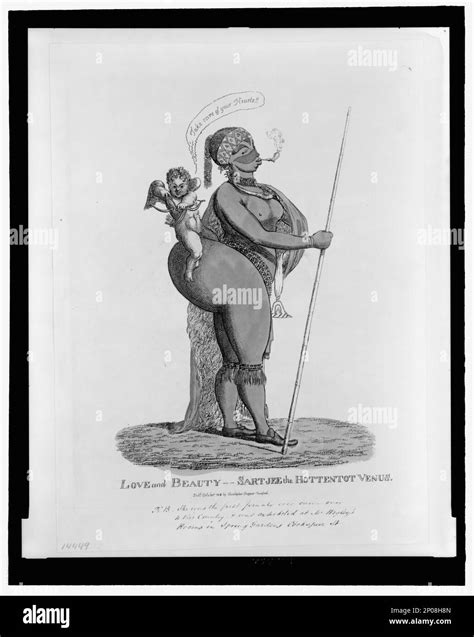
Sarah Baartman Caricature
Showmen exhibited her throughout Europe, where, in an embarrassing and dehumanizing spectacle, she was forced to sing and dance before crowds of white onlookers. Often naked in these exhibitions, Baartman was sometimes suspended in a cage on stage while being poked, prodded and groped.
Her body was characterized as grotesque, lascivious and obscene because of her protruding buttocks, which was due to a condition called steatopygia that occurs naturally among people in arid parts of southern Africa. She also had elongated labia, a physical feature derogatorily referred to as a “ Hottentot apron.”
Read also: Learn About Black Opal Rings
The Baartman Ideal
Of course, Black women’s bodies vary; there is no monolithic - nor ideal - type. Nonetheless, there is a strong legacy of the curvaceous ideal, more so than in other races. It persists to this day.
Today, the Baartman body can be advantageous, especially on social media, where Black women have the opportunity to produce content that’s socially and culturally relevant to them and their audiences - and where users can make money off their posts. On various platforms, women leverage their looks to obtain paid advertisements or receive free gifts, services or merchandise from various beauty and apparel companies.
The white gaze that fetishized Baartman’s body as exotic and overtly sexual was the same one that promulgated the stereotype that Black women were sexually promiscuous, lascivious and hypersexual. While Baartman may not have been able to keep the cash people paid to ogle at her, Black women today can strive for her body type and make money off it.
Lesedi, from South Africa, highlighted this tension. “I feel you do find girls like me who are not proud of what they see when they look in the mirror and they just feel like, ‘I need to drop this off,’” she said. However she added that “you find other girls that are just so happy about it that they twerk.… I guess Sarah Baartman definitely does have an influence, but it’s either positive or negative whether you’re proud to have a bum.”
The Term "African Booty Scratcher"
My name is Moses Manu, and I’ve been called an “African Booty Scratcher” since I was in 2nd grade. I never knew what an African Booty Scratcher meant or where it came from. While we are at it, I am going to shorten the African Booty Scratcher to “A.B.S.” for short.
The first definition of A.B.S. That is definitely a freaky and demeaning use of a stolen individual, but hey, it really speaks to the literal use of the word, right? “…is not someone who scratches his master’s ass but more of an asshole. A snitch.
The term "Hottentot" was a Dutch-colonial era term for the indigenous Khoekhoe people of southwestern Africa, which then became commonly used in English,and was shortened to "hotnot" as an offensive term, the term "Hottentot" refers to the tribe, eg. Zulu, Xhosa.
Baartman spent her childhood and teenage years on Dutch European farms. She went through puberty rites, and kept a small tortoise shell necklace, most likely her mother's, until her death in France.
In 1810 Dunlop exhibited Baartman at the Egyptian Room at the London residence of Thomas Hope at No. 10 Duchess Street, Cavendish Square, London. Dunlop thought he could make money because of Londoners' lack of familiarity with Africans and because of Baartman's pejoratively perceived large buttocks. Crais and Scully allege that: "People came to see her because they saw her not as a person but as a pure example of this one part of the natural world."
She became known as the "Hottentot Venus" (as was at least one other woman, in 1829). Macaulay and The African Association took the matter to court and on 24 November 1810 at the Court of King's Bench the Attorney-General began the attempt "to give her liberty to say whether she was exhibited by her own consent."
She stated that she was not under restraint, had not been sexually abused and had come to London on her own free will. She also did not wish to return to her family and understood perfectly that she was guaranteed half of the profits. The case was therefore dismissed.
In Paris, her exhibition became more clearly entangled with scientific racism. French scientists were curious about whether she had the elongated labia which earlier naturalists such as François Levaillant had purportedly observed other Khoekhoe women to have at the Cape. French naturalists, among them Georges Cuvier, head keeper of the menagerie at the Muséum national d'Histoire naturelle and founder of the discipline of comparative anatomy, visited her.
In Paris, Baartman's promoters did not need to concern themselves with slavery charges. Crais and Scully suggest: "By the time she got to Paris, her existence was really quite miserable and extraordinarily poor". At some points a collar was placed around her neck (although it is unclear whether that was just a prop for the performance).
Baartman died on 29 December 1815 around age 26, of an undetermined inflammatory ailment, possibly smallpox, while other sources suggest she contracted syphilis, or pneumonia.
After the victory of the African National Congress (ANC) in the 1994 South African general election, President Nelson Mandela formally requested that France return the remains. After much legal wrangling and debates in the French National Assembly, France acceded to the request on 6 March 2002.
Baartman is used to represent African discrimination and suffering in the West although there were many other Khoekhoe people who were taken to Europe. P. T. Baartman's tale may be better known because she was the first Khoekhoe taken from her homeland, or because of the extensive exploitation and examination of her body by scientists such as Georges Cuvier, an anatomist, and the public as well as the mistreatment she received during and after her lifetime.
Travelogues and imagery depicting Black women as "sexually primitive" and "savage" enforced the belief that it was in Africa's best interest to be colonised by European settlers.
During the lengthy negotiation to have Baartman's body returned to her home country after her death, the assistant curator of the Musée de l'Homme, Philippe Mennecier, argued against her return, stating: "We never know what science will be able to tell us in the future. If she is buried, this chance will be lost ...
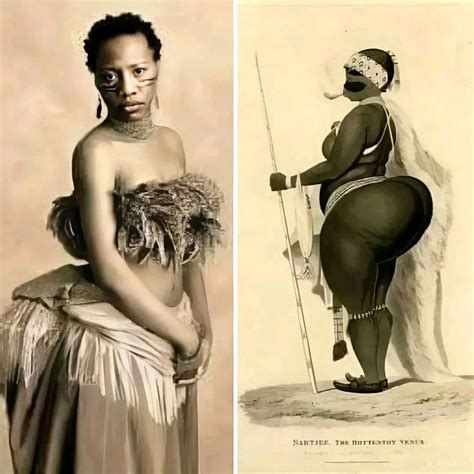
Reburial of Sarah Baartman
Addressing Xenophobia and Colorism
Xenophobia and colorism are not things that should be brushed aside as just kids being kids. Kids should be held accountable and corrected when they say or do problematic things. And that starts with making adults who exhibited these behaviors as kids, recognize the problems with it and actually do the work of learning and reconciling with the groups of people who were targeted by it so that they are not passing these toxic behaviors on to others.
