The population and urbanization rate in Africa are rising simultaneously. This leads to the expansion of existing cities and the emergence of new urban areas. The population of Africa is expected to double by 2050 and to reach more than 2 billion people.
According to the research of the World Economic Forum, the fastest growing cities in Africa are Lagos, Kinshasa, Cairo, Luanda and Nairobi. Here is an alphabetical list of the countries in Africa and their capitals. This map of Africa shares the precise location of the capital cities.
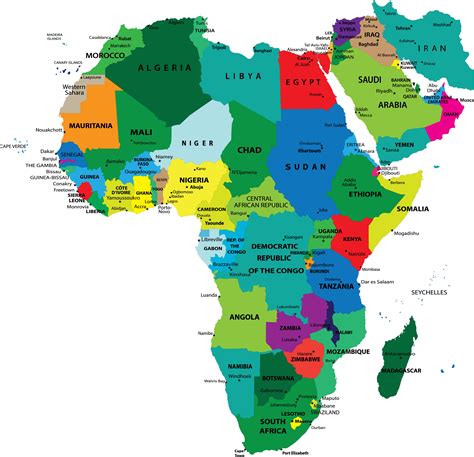
Below you can find the list of the top 25 largest African cities in terms of population and growth rate.
Top 25 Largest African Cities
The size of the population in Africa's major cities is a problematic issue. There are not many reliable sources, and most are rough estimates of the urban population. According to the United Nations, Africa's urban population has been growing at a very high rate. From about 27% in 1950 to 40% in 2015, and projected to reach 60% by 2050 (UN-DESA, 2014). Both underdevelopment (poverty) and development have contributed to migration within African countries. Migration to the cities has encouraged the development of slums around large cities with countless inhabitants. The population figures refer to the metropolitan area of Africa's capitals.
Africa is home to some of the youngest and fastest-growing cities in the world. But Africa has a young population, unlike Europe or Asia. The continent has huge potential if it can correctly harness wealth from its resources.
Read also: W.E.B. Du Bois in Ghana: A Historical Perspective
Finished learning?
| City | Country | Population (Million) | Notes |
|---|---|---|---|
| Lagos | Nigeria | 21 | Financial and business center, largest port of Nigeria |
| Cairo | Egypt | 20.5 | Historic culture, hub for business, finance, and trade |
| Kinshasa | Democratic Republic of Congo | 14.3 | Located alongside the Congo River, economy heavily dependent |
| Giza | Egypt | 8.8 | Located alongside the Nile River, important hub for tourism and trade |
| Luanda | Angola | 8.4 | Largest city in Angola, Port of Luanda contributes greatly to the city economy |
| Dar es Salaam | Tanzania | 6 | Largest city of Tanzania, import, distribution, export and trade activities |
| Johannesburg | South Africa | 5.8 | Largest city in South Africa, financial heart of the country |
| Khartoum | Sudan | 5.3 | Located at the merge of Nile River, banking, trade and manufacturing activities |
| Alexandria | Egypt | 5.2 | Coastal city on the Mediterranean Sea, touristic destination |
| Abidjan | Ivory Coast | 4.8 | Business capital of Ivory Coast, located on the coast of the Atlantic Ocean |
| Cape Town | South Africa | 4.6 | Legislative capital of South Africa, economy heavily relies on tourism |
| Nairobi | Kenya | 4.4 | Many companies and international organizations are headquartered |
| Casablanca | Morocco | 4.2 | Located on the coast of the Atlantic Ocean, renowned for its historic landmarks |
| Accra | Ghana | 4.2 | Most populated city, ministries, banks, corporations and non-governmental organizations are located |
| Algiers | Algeria | 3.9 | Located on the Mediterranean Sea, economic capital of Algeria |
| Kano | Nigeria | 3.9 | Second-largest city in Nigeria, economic heart of Northern Nigeria |
| Douala | Cameroon | 3.7 | Located on the Atlantic Ocean, largest city and the economic heart of Cameroon |
| Addis Ababa | Ethiopia | 3.4 | Headquarters of the African Union and United Nations Economic Commission for Africa, political capital of Africa |
| Durban | South Africa | 3.4 | Located on the coast of the Indian Ocean, vibrant business life thanks to the Port of Durban |
| Kumasi | Ghana | 3.3 | Historic metropolitan city in Ghana, second populous city in Ghana |
| Lusaka | Zambia | 2.5 | Most populous city in Zambia, headquarter of many corporations, financial services firms and government agencies |
| Bamako | Mali | 2.4 | Largest city, textiles, processed meat, and metal goods factories and mining activities |
| Mogadishu | Somalia | 2.4 | Important port on the Indian Ocean, import, export, manufacturing and distribution activities |
| Conakry | Guinea | 1.7 | Located on the Atlantic Ocean, cultural and economic center of Guinea |
| Kampala | Uganda | 1.6 | The population of Uganda is growing rapidly with an annual population increase rate of 4% |
Urban Rail Transit in Africa
Urban rail transit in Africa has emerged as a growing form of transit due to rapid urbanization that has occurred in recent decades across the continent. Some of these transit systems are older and more developed, such as the metro in Cairo which opened in 1987. Others such as the light-rail system in Addis Ababa are much more recent, which opened in 2015.
A variety of technologies are being used ranging from light-rail, bus rapid-transit, and commuter-rail etc. African heavy-rail is an artifact of the colonial period, where colonizing nations built out these networks to further the conquest of Africa. The colonial powers also used these networks to transport resources they extracted from operations they developed. These rail networks criss-crossed major areas of Africa, but with the independence period these networks became splintered due to new borders across the continent. These networks declined over the next few decades, due to lower demand and lower levels of investment.
Egypt is home to the Cairo Metro, the oldest rail transit system on the African continent, which opened in 1987. The National Authority for Tunnels was established in 1983, which oversees the Cairo Metro. It is composed of three lines, the first line opening in 1987.
Evolution of the Cairo Metro 1987-2024 (geographic map)
Algeria has a metro system in Algiers, although it is a very new system. It was originally put forward in 1980, but was put on hold for a couple decades before finally opening in 2011. It is 18.8 km long, and runs on fourteen trains. Algeria has significant oil deposits which cause very low oil prices in the country, leading to high levels of car usage.
Read also: Experience Fad's Fine African Cuisine
The capital of Tunisia, Tunis is home to a developing light-rail system. It existed in the past also, but was removed with the advent of "car culture." The light-rail system returned in 1985. It is composed of five lines, and has undergone improvements in recent years.
Casablanca is more complex than Algiers or Tunis, in order to connect the suburban areas to the downtown of Casablanca, a system of four tramway lines with over 100 km of tracks, and 124 trains as well as two lines of BRT(bus rapid transit) is achieved, the city has future projects of monorail system but no progress so far.
Nigeria's national capital, Abuja, is one of the fastest growing cities in Africa and the world. As of 2015, the city is experiencing an annual growth of at least 35%, retaining its position as the fastest-growing city on the African continent and one of the fastest-growing in the world. As of 2016, the metropolitan area of Abuja is estimated at six million persons, placing it behind only Lagos as the most populous metro area in Nigeria.
Abuja Rail Mass Transit commonly known as Abuja Light Rail is a regional rail transport system in the Federal Capital Territory of Nigeria. It is the first rapid transit system in the country and in West Africa and the second such system in sub-saharan Africa (after Addis Ababa Light Rail). The first phase of the project connects the city center to Nnamdi Azikiwe International Airport, stopping at the Abuja-Kaduna Railway station in Idu. China in its ambitious Belt and Road initiative over the last decade, has been especially prominent in Nigeria.
China's vehicle for this investment is through loans from the Export-Import Bank and China Civil Engineering Construction Company (CCECC). Lagos was projected to hit a population of 25 million making it one of the largest metro areas on Earth. In 2008 Bus-Rapid transit was launched, but this had limited capacity. The first line, The Lagos Blue Line, officially began operation on September 4,2023 and the next line, The Lagos Red Line is 95% complete.
Read also: The Story Behind Cachapas
Dakar, the economic centre of the country, has been facing several mobility problems for the past years. The work has started in 2016 and the line also passes by another relatively recent important centre of the country, Diamniadio.
The largest city and economic center Abidjan, is set to welcome one of the first metro systems in West Africa, signing a deal in 2019 with a French company. France has actually offered to finance the whole project at a cost of 1.4 billion Euros.
The largest city in Cameroon, Douala is home to roughly 2.8 million people; like many other African cities it is undergoing rapid rates of growth and a horrible degree of traffic congestion. Some relief is coming to the residents of Douala, as the Biya government and a Belgian and Turkish company have agreed to build a tramway. The pilot project is set to open in 2021, but is planned to be part of a larger five line tram network. This will create a mixed used network of train and tram to build on the existing rail infrastructure in Cameroon.
Dar es Salaam is the economic center of Tanzania. In 2012, it welcomed the Treni ya Mwakyembe commuter rail system, which can serve a total of 30,000 passengers per day. A one-way ticket costs $0.25, or $0.50 round trip.
The Ethiopian government originally proposed this project in 2006, so this project was rather quickly implemented, opening in 2015. Although opened in 2015 it received little attention until 2017. Addis Ababa, like so many other African cities is undergoing major growth and urbanization. Current international donors and agencies are interested in developing sustainably, so there has been an overwhelming focus on African cities. China, along with France have both been focused in recent years on developing urban rail lines, China actually was very involved in this project. Addis Ababa Light-Rail has two lines currently, with a daily ridership of around 150,000 people.
Kampala, the capital of Uganda, is working to develop a light-rail system similar to Addis Ababa. China in its widespread funding of projects in Africa is also present here. The construction of the first line will cost close to US$700 million, and be entirely financed from the Chinese Export-Import Bank.
Port Louis-Metro Express is a rail network developed in 2016 on the island country of Mauritius. It is a smaller network in comparison to other African nations, but it is planned to have a total of 19 stations once completed.
Luanda is the capital and largest city of Angola, which is the economic, political, and cultural center of the country. Luanda has two different forms of urban rail transit currently.
South Africa has the most extensive urban rail network on the continent. Transnet is the national company that oversees all modes of transport, any railways in South Africa operate under that umbrella organization. Metrorail is a national system with a total of 478 stations, this system though is divided into four different regions. All major regions of the country have some form of Metrorail, for example the Gauteng Metrorail region corresponds to the Gauteng province.
Web Infrastructure in Africa
Although still a “young†technology, the Internet has had a profound impact on the world in the few decades that it has been around. One of the most interesting chapters of this short history has been its development in Africa.
Many international organizations have played an important role in Africa Internet history. NEPAD’s e-Africa programme works in the area of technology to promote Africa as a globally competitive digital society.
Another key project of the e-Africa programme is the NEPAD e-Schools Initiative. The initiative aims to harness ICT technology to improve the quality of teaching and learning in African primary and secondary schools in order to equip young Africans with the knowledge and skills that will enable them to participate confidently and effectively in the global information society and knowledge economy.
Sixteen African countries have signed MoUs with the NEPAD e-Africa Programme and a consortia of private sector companies to participate in the NEPAD e-Schools demo Project. To date over 80 demonstrations NEPAD e-Schools have been implemented. Each school in the demonstration project was equipped with a computer laboratory containing at least 20 PCs as well as a server and networking infrastructure and peripheral devices such as scanners, electronic whiteboards and printers.
Canada is also an active country in cooperation in the field of ICT in Africa, especially in the Acacia project. “Launched in 1997, Acacia is dedicated to experimentation and learning. Each country represents a different laboratory to assess models of community access to ICT and the larger issue of the role of technology in development.
A monitoring program, ELSA (Evaluation Systems for Acacia and learning), will identify successes and failures, which in turn will determine the ongoing operations of Acacia and possible investments in ICTs for development.†The Canadian government has allocated 60 million Canadian dollars for this program over five years.
The United States are also interested in Africa. In 1996, they launched the Leland Initiative which, over five years, must spend $ 15 million to connect to the Internet twenty African countries.
From 1990-1993 PADIS implemented a pilot project in electronic networking in Africa, linking some 18 African institutions in a FIDOnet-based network. It also set up a bulletin board on networking and African development and an electronic conference on information technology in Africa.
The African Information Society Initiative (AISI) is an action framework that has been the basis for information and communication activities in Africa since 1996. The Sustainable Development Networking Programme (SDNP) of UNDP lasted in the main from 1992 to 2000 and reached close to 80 countries in efforts to promote greater use of ICTs for sustainable and human development.
The Association for Progressive Communications (APC), along with other African and international organizations committed to expanding affordable access to information and communication infrastructure and services in Africa, have been engaged in advocacy and policy dialogue with public, private and civil society stakeholders in Africa.
RIO (meaning “Reseau Intertropical d’Ordinateursâ€) was a network of electronic communication developed by ORSTOM, a French scientific research agency working in West Africa. Interestingly, this early network emerged from France’s imperialistic ties to Africa.
The NSRC, which traces its roots to a volunteer effort to support networking in southern Africa in the late 1980s, was formalized in 1992 with support from the National Science Foundation (NSF). The NSRC effectively functions as a virtual global clearinghouse and service center working with individuals, organizations, and governments worldwide.
The International Organization of La Francophonie was created in 1970. Alongside the IOF, the Parliamentary Assembly of La Francophonie and the four direct operators are responsible for implementing the programs decided at the Summits.
The Internet Society is an international, non-profit organization founded in 1992 and believes the Internet is for everyone. ISOC global INET Technical workshops have been very contributive in creating a pool of qualified people in setting up IP networks in developing countries especially in Africa.
The Internet Corporation for Assigned Names and Numbers (ICANN) was formed in 1998. It is a not-for-profit partnership of people from all over the world dedicated to keeping the Internet secure, stable and interoperable.
In 2004, after a selection of potential host countries, AFRINIC was incorporated in Mauritius. AfriNIC is fully serving the Africa region in IP addresses management.
Africa relies on satellites and Very Small Aperture Terminal (VSAT) earth stations for most of its connectivity. Intelsat, the world’s largest commercial satellite service provider, provides full coverage in Africa.
Moves are being made in west, east and southern Africa to increase the international networks. But for now, East and Southern Africa relies on satellites and has just 0.07 per cent of the world’s international bandwidth capacity.
The 10 000 kilometer long East Africa Submarine Cable System (EASSy) was to connect 21 countries from South Africa to Sudan by 2008. While EASSy has been delayed, other projects have advanced. Seacom is a 17 000 kilometer submarine fibre optic cable costing USD 650 million scheduled to launch in June 2009 and link South Africa with Mumbai in India, Marseille in France and London via Kenya, Tanzania, Mozambique and Madagascar.
Kenya is also working with Etisalat to connect its coastal city of Mombasa to Fujairah in the United Arab Emirates. The World Bank has allotted USD 424 million to boosting regional networks in eastern and southern Africa under the Regional Communications Infrastructure Programme (RCIP) which it hopes will increase traffic by at least 36 per cent a year and cut bandwidth costs by one tenth.
By the end of the programme, it is expected that all capitals and major cities in eastern and southern Africa would be linked to competitively priced high bandwidth. The RCIP accounts for more than 10 per cent of total World Bank support to Africa.
On the West coast, Ghana, Nigeria and Senegal have the most significant potential demand for international capacity. Up to seven investment groups have said they would add international capacity in the region but only a few will succeed.
Globacom, the second oldest operator in Nigeria, is expected to lay a 9 500 km fibre optic link to Lagos in 2009 later going to Accra, Ghana and Dakar, Senegal. The GL01 project, costing USD 150 million, is risky as the operator’s current traffic volume in Nigeria, Benin and Ghana does not justify the investment.
MaIN One is another Nigerian project implemented by Mainstreet Technologies to link Portugal with Lagos and Accra by May 2010 with USD 200 MBPS/month wholesale prices. The link is ultimately expected to go on to South Africa and cost USD 865 million. The West African Cable System (WACS) is supported by the largest operators in South Africa, MTN, Neotel, Telkom and Vodacom, which have traffic along the West coast.
The Africa Coast to Europe (ACE) project supported by France Telecom and 14 African operators is expected to connect France to Gabon by 2011. The cable will be built by a France Telecom-managed consortium.
