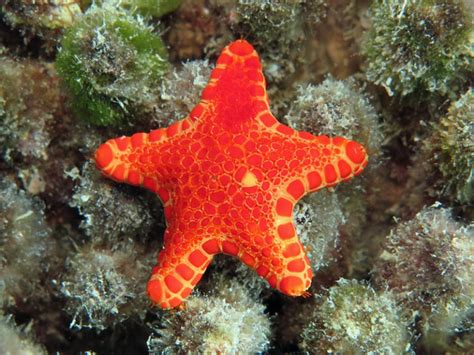
Starfish, also known as sea stars, come in many different colors, patterns, and sizes. There are some amazing-looking species out there, but one of our favorites is the little orange-red biscuit starfish (genus Tosia). The appearance of these sea stars is no doubt what aquarists like most about sea stars of the family Goniasteridae, which also includes such popular aquarium starfish as the red Fromia. They’re generally colorful, with interesting geometric patterns that look somewhat like rows of differently-sized scales. Biscuit starfish are no exception, and their colors and patterns can be highly varied.
What is a Biscuit Starfish?
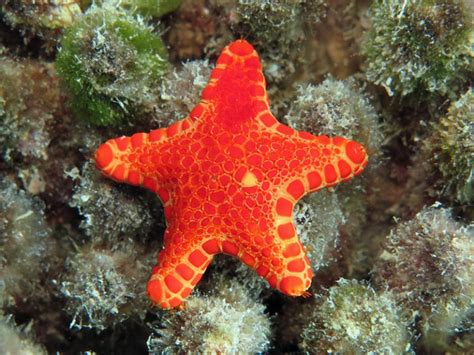
Although the name “biscuit starfish” is used for many members of the large sea star family Goniasteridae, in the aquarium hobby, the name mostly refers to a specific genus in this family called Tosia. Most of the biscuit starfish for sale for the aquarium are orange or red, with lighter veining between the “scales”. They have short, rounded arms that give them a boxy look, and they’re small.
Of the above, T. australis is the one you’re most likely to stumble upon at your local aquarium store. We haven’t seen the other ones for sale ourselves. However, there’s another biscuit starfish often kept in the aquarium that we should talk about here: Anchitosia queenslandensis used to belong to Tosia, but was moved to its current genus, in which it’s still the only species, in 2007. Many aquarists still refer to it by it as a Tosia, and it’s very similar in terms of looks and care. This move wasn’t surprising, by the way. Tosia is redefined regularly, and species may be added or removed as scientists untangle the genetic relationships between the different biscuit stars.
In this care guide, we’ll take “biscuit starfish” to mean Tosia australis and Anchitosia queenslandensis.
Did you know? There’s a third sea star that belongs to the same family and is very visually similar to our biscuit stars: Goniaster tessellatus, sometimes called the West African biscuit starfish. However, since this species occurs in different parts of the world and in a different habitat type, its care isn’t the same and we’re not including it here. If your starfish has spikes, then it’s a G. tessellatus.
Read also: Experience Fad's Fine African Cuisine
Color Variations
While Tosia australis is often orange, it can also sport shades of brownish-purple, white, black, and grayish-plus more different patterns than we can count. Scientists figure that the colors and patterns differ between local populations for camouflage purposes, based on the ecological niche the sea stars fill in a location, and depending on the amount of light that penetrates at the depth they inhabit (among, possibly, other reasons). A sandy substrate, for example, requires different patterns for effective camouflage than a rocky one. Individual stars can’t change color in their lifetime, but the population as a whole can adapt over time.
On top of this, marine biologists are aware that they probably don’t know everything about (Anchi)tosia starfish yet. All those different colors within T. australis, for example, may indicate that there are different species that need to be described and separated. A small sample of the variation in Australian biscuit starfish!
Natural Habitat
As the scientific denominations of “australis” and “queenslandensis” suggest, biscuit starfish are naturally found in Australia. They also occur in New Zealand, and Anchitosia queenslandensis has been found in the waters around Japan and Papua New Guinea.
In their natural habitat, these starfish are considered shallow-water species, typical sights in rock pools, on pier pilings, and similar intertidal zones. They’re not really found on deeper reefs and in more turbid waters.
Aquarium Care
Many starfish have a reputation for being almost impossible to keep alive in the aquarium. Does this also apply to biscuit stars? How do you care for one in your tank? Although these are small creatures, they need a roomy aquarium. For this reason, it’s also important to only introduce biscuit starfish into mature set-ups. The older the better, and as long as the water quality is high, it doesn’t matter if the tank is a bit crummy. Aside from tank size and maturity, your biscuit star won’t need much. It’ll appreciate the presence of some crevices to hang out in, but that’s about it.
Read also: The Story Behind Cachapas
As we mentioned earlier, most starfish are difficult or even impossible to keep in the aquarium (that’s also why we compiled a special list of the easier starfish species). They tend to be difficult to feed and end up starving.
One of the reasons we only recommend these starfish for seasoned aquarists is the fact that they’re quite sensitive. Keep water quality, pH, and salinity under control! Also be mindful of temperature. This species isn’t for the toasty tropical aquarium; it likes things cooler and will likely start to struggle above 75 °F.
Tankmates
Most aquarium inhabitants will leave starfish alone, although there are some exceptions. The most notable is the harlequin shrimp, whose entire diet consists of sea stars! Aggressive fish like puffers and triggerfish don’t make good tankmates either, nor do some large wrasses, and large hermits. The green brittle star, which looks like a starfish but isn’t, might also hunt biscuit starfish. Additionally, you should avoid species that require hot, tropical water temperatures. As we mentioned in the section on water quality, biscuit stars like things a little cooler.
As for whether a biscuit star will pose a threat to its tankmates, the answer is usually no. Unlike most starfish, which hunt clams and snails, this species will leave shell dwellers alone. It’s also not prone to nibbling on corals like some of its cousins, such as the beautiful but fussy chocolate chip starfish. Are biscuit starfish reef safe or not? We’d say 90% yes. Although some aquarists have seen their biscuit stars sitting on coral, most report this only happens if the coral is already dead or dying, and it’s rare to see it unless the starfish is very hungry.
Tip: Try not to keep more than one starfish per tank unless you’ve got a LOT of space available. It’s already hard to get them enough to eat without two or more stars competing with each other.
Read also: Techniques of African Jewellery
Feeding Biscuit Starfish
Most starfish, including these, are constantly slowly starving in our tanks and likely to kick the bucket in under a year. Researchers have found that biscuit starfish feed on sessile invertebrates. Their favorite meals in the wild include sponges, bryozoans, sea squirts, and tunicates.
Now, aquarists have mentioned that their biscuit stars also appear to eat algae and sometimes encrusting corals. We think this is the result of hunger: they’d probably much rather feed on encrusting sponges and the like. Unfortunately, it’s not really clear what kind of sponges these starfish prefer. The only named species in the studies we read was Aplysilla rosea; the rest of the sponges the biscuit stars were seen eating weren’t named or may not even have names. Aquarists’ experiences suggest they’re not too picky, although folks are generally still kind of groping in the dark when it comes to biscuit starfish diet.
We recommend breeding a steady supply of easy sponges like pineapple sponges (Sycon sp.), blue sponges (Haliclona sp.), and the various random encrusting sponges that tend to pop up on live rock. You can do so in your tank’s sump or a small separate set-up. You can try bryozoans as well, but those are a bit more challenging to grow.
Request: If you see your biscuit starfish eat an identifiable sponge or bryozoan, please let us know!
Breeding
Unfortunately, we don’t know of anyone who has successfully bred biscuit starfish. In fact, we can’t find any information on the reproduction of Anchitosia queenslandensis, one of our two biscuit starfish species, at all. It may be a free-spawning species like its cousin Tosia australensis.
Red Biscuit Sea Star (Goniodiscaster scaber)
The Red Biscuit Sea Star Goniodiscaster scaber presents itself in a striking mosaic pattern of red and white that is sure to create bright contrast in your marine aquarium. A member of the Asteroidea class, these sea stars can reproduce both asexually and sexually. Embryos hatch into larvae and later morph into juveniles that will go on to develop into young sea stars with stubby arms. Growing in nature in areas of seagrass with low canopies, they are more commonly seen during the night. A member of the Oreasteridae family, this Sea Star is an omnivore that scavenges on coral rubble and feeds on tubeworms in nature. In an aquarium, it can be fed zooplankton, very finely chopped meaty foods, and liquid invertebrate food.
Episode 18 - How to care for a chocolate chip starfish
Tips for Keeping Biscuit Starfish
- Mature Tank: Introduce biscuit starfish only into mature aquarium setups.
- Water Quality: Keep water quality, pH, and salinity under control.
- Temperature: Maintain cooler temperatures, ideally below 75 °F.
- Feeding: Provide a varied diet of sponges, bryozoans, and other sessile invertebrates.
- Tankmates: Avoid aggressive fish and invertebrates that may prey on starfish.
Tip: Although it’s not technically a true starfish, the superficially similar banded serpent star makes a much better choice for small tanks than a biscuit starfish.
Experiences from Aquarists
Having done some extensive study on different starfish (and a limited number of sponges), this starfish actually seems to be a relatively good aquarium candidate at the moment when compared to other starfish. However, that doesn’t make it an actually good candidate overall when looking at keeping it long term (i.e. for ~2+ years) - at least not yet. You’d need to figure out a solid diet for it first. For one thing, figuring out which sponges it’ll actually eat may be tricky, as a number of different sponges produce chemicals specifically to try and drive predators (like this starfish) away, and you’d want to grow the sponges it will eat yourself so you can be sure you’re able to keep it fed.
Beyond that, it might need more variety than just a sponge species or two to keep it healthy, so you’d probably want to figure out what tunicates and other things it’ll eat too - and you likely need to grow those out yourself as well. Assuming you’re up for trying though, I’d recommend starting with a handful of different sponges - photosynthetic plating sponges, ball sponges, tree sponges, Haliclona sponges, crumb of bread sponges, chicken liver sponges, etc. are a few you could try - and seeing how you do with them first, then add the starfish. If it eats any of those, make a note of it and see what else it eats. If not, find something else to offer it and try that until you get it eating. Once you’ve got something you feel confident it is eating growing, you can keep offering it new things to try and expand its diet (and I’d recommend doing so), but, most importantly, you’d want to see how it does long term.
Anchitosia queenslandensis - the “Red Biscuit/West African Biscuit Starfish” - definitely an attractive species. Formerly known as Tosia queenslandensis, and still better known by that name. MadCity Corals kept one for about two years by letting it eat algae in the tank and supplementing with algae wafers before it apparently started eating their encrusting corals (I’m not sure if this applies with this species/situation or not, but many carnivorous starfish species actually start off herbivorous and only turn carnivorous as adults - the Crown Of Thorns Seastar is an excellent example of this). They may have gotten the star young enough that it hadn’t transitioned fully to “adult” foods when they first got it (I’m not sure when this species matures, but this strikes me as possible yet unlikely), or it - like many fish in the hobby - may have just developed a taste for them randomly.
Cliff here aka MadCity Corals. I did keep one for probably close to 5 years or longer. Attractive species easy to keep in my opinion. I try to keep my tank around 75-76 not for ther starfish health but corals health. Lower temp less bacterial infections. However my tank would hover around 80-81 during the summer months and I didn't have any problems with the African Biscuit star in warmer temps.
References
- Keough, M. J., & Butler, A. J. (1979). The role of asteroid predators in the organization of a sessile community on pier pilings.
- Mah, C. (2007). Systematics, phylogeny and historical biogeography of the Pentagonaster clade (Asteroidea: Valvatida: Goniasteridae).
- Naughton, K. M., & O’Hara, T. D. (2009). A new brooding species of the biscuit star Tosia (Echinodermata: Asteroidea: Goniasteridae), distinguished by molecular, morphological and larval characters.
| Species | Common Name | Natural Habitat | Aquarium Requirements |
|---|---|---|---|
| Tosia australis | Biscuit Starfish | Australia, New Zealand | Mature tank, stable water quality, cooler temperatures |
| Anchitosia queenslandensis | Biscuit Starfish | Australia, Japan, Papua New Guinea | Mature tank, stable water quality, cooler temperatures |
| Goniodiscaster scaber | Red Biscuit Sea Star | Seagrass areas | Omnivore diet, stable water quality |
