The history of T-shirts in mainstream society is well documented, with numerous articles and books detailing their origins, popular designs, printing methods, and technologies. However, the unique story of Black Culture T-shirts remains largely untold. This article aims to chronicle the evolution and significance of African American T-shirts, highlighting their role in self-expression, activism, and cultural identity.
Black self-expression through clothing is not a new phenomenon. In the 1960s, dashikis gained popularity, while the Black Panther Party adopted military-style berets and leather jackets. Even Ike Turner was ahead of his time with his distinctive sense of style. With the advent of silk screening in the 1960s, printing graphics on T-shirts became more accessible, leading to a surge in pop-culture T-shirts representing musical artists and corporate logos.
Early attempts to cater to Black audiences involved the "Blackification" of non-black images, such as Looney Tunes characters dressed in hip-hop attire. Eventually, clothing retailers began producing T-shirts featuring prominent figures like Malcolm X, Martin Luther King Jr., and Rosa Parks, often without authorization from their respective estates.
The Black T-shirt space has since undergone significant changes. Mainstream graphic T-shirts have always been popular, but Black Culture T-shirts have become increasingly prevalent. Today, a plethora of options are available, covering every subject imaginable, including politics, sports, art, music, history, and entertainment.
The emergence of hip-hop in the 1980s and 1990s further fueled the popularity of fashion and streetwear-oriented T-shirts. Brands like FUBU ("For Us By Us") and Maurice Malone Designs integrated fashion with Black pride and Black identity. T-shirts inspired by hip-hop culture have since become mainstream, with designers incorporating the aesthetics and messages of Black culture into high fashion. T-shirts have evolved into symbols of both style and social commentary.
Read also: Experience Fad's Fine African Cuisine
African American T-shirts have also played a crucial role in activism and protest. For example, T-shirts bearing the message "I Can’t Breathe," in reference to the death of Eric Garner, became national symbols in the fight against police brutality.
In this article we will look at:
- Iconic Designs and Messages
- Impact on Identity and Empowerment
- Quality, Price and Authenticity: Things That Make A “Good” T-shirt
Iconic Designs and Messages
Certain T-shirts are instantly recognizable and symbolic, honoring special figures in Black history and reminding us of important events. Their impact has special significance:
- Angela Davis, Huey Newton, and the Black Panther Party: Challenged systemic oppression, fought for Black liberation, advocated for racial justice, self-defense, and community empowerment. At its inception on October 15, 1966, the Black Panther Party's core practice was its armed citizens' patrols to monitor the behavior of police officers and challenge police brutality in Oakland, California. In 1969, community social programs became a core activity of party members.
- "Black Lives Matter", "I Can’t Breathe", and "Say Her Name": These messages and slogans resonated because of the mistreatment Black people have endured at the hands of law enforcement.
- Booker T. Washington: Was the foremost black educator and founded the Tuskegee Institute.
- Fannie Lou Hamer: Fannie Lou Hamer was a civil rights and voting rights leader in Mississippi. She continuously fought even while receiving brutal injuries.
- Martin Luther King Jr.: "There is nothing more dangerous than sincere ignorance and conscientious stupidity" When Martin Luther King Jr.
These T-shirts serve as powerful tools for Black expression, often providing a voice when traditional media overlooks injustices.
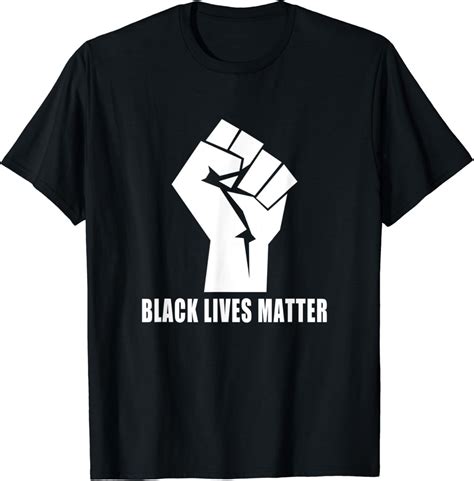
Impact on Identity and Empowerment
One of the most significant aspects of African American T-shirts is their role in self-expression. They provide a platform to celebrate heritage, reclaim narratives, and assert a presence in a world that often marginalizes people of color. They remind the wearer and those around them of the strength, resilience, and beauty of the African diaspora. Whether worn casually or in protest, these shirts offer a form of visual storytelling, allowing the wearer to express their values, beliefs, and cultural identity without saying a word.
Read also: The Story Behind Cachapas
Black People were stripped of our identities when we were brought here, and it's been a quest since then to define who we are.
Meet the Smithsonian Curator Who Turns Protesters’ T-Shirts Into National Treasures
Quality, Price and Authenticity: Things That Make A “Good” T-shirt
Here are a couple of things that we believe are important:
Quality
This includes both the T-shirt and the printing method. Although these things matter, they aren’t the most important things to consider.
Screen Printing is the oldest and most commonly used method used for printing graphic t-shirts. It’s also been the most reliable in terms of print quality and durability. Other technologies such as Heat Transfers, Direct-to-Garment (DTG) Printing, or Dye Sublimation have traditionally been inferior to Screen Printing.
Read also: Techniques of African Jewellery
The technologies for all of these alternative printing methods has improved greatly and rival Screen Printing. Some of these methods are so good now, it’s hard to tell how a given t-shirt was printed. The accuracy has improved and the durability of the prints has gotten better.
The quality of the printer determines everything. Good quality control will determine how the final product looks and how long it will last. In a nutshell, quality will be determined by the business you purchase your t-shirts from. It’s in their best interest to purchase inventory from reputable manufactures and ensure quality prints. Otherwise, customers will be dissatisfied and never come back and buy from that retailer again.
Price
Good t-shirts aren’t cheap, but they shouldn’t be overpriced either. Let’s use concert T-shirts as an example: they usually cost $5.00 or $6.00 dollars to print (sometimes cheaper), and it shows. They usually don’t fit properly, the design cracks and fades, they shrink to the point they can’t be worn again, and they fall apart after a few rounds in the washing machine. Yet, people can pay upwards of $40.00 or $50.00 for one of those T’s.
The average price for a quality t-shirt, in our humble opinion, is anywhere from $20 to $30 dollars each. Quality t-shirts are priced a little more just because they are good quality t-shirts. (We’re not talking about cheap t-shirts that are overpriced because somebody just wants to make a profit.)
Legal
We wish we could print everything we wanted. But intellectual property, copyright, and trademark law are serious things.
Also, with regards to famous people and characters, we only sell licensed T-shirts. This is important because that means the respective estates that own the rights to the images and designs profit from these t-shirts. Bob Marley’s children, for example, owns the rights to their father’s image. Their estate approves of any t-shirt that bears his image.
We only deal with licensed manufacturers and distributors that provide us with truly authentic T-shirts. This also helps with quality control: licensed manufacturers must produce quality T-shirts. Poor quality t-shirts would put a manufacturer’s license at risk.
In our opinion, businesses that sell unlicensed t-shirts should be avoided. Bootleg (unauthorized) t-shirts are a fact of life and will always be around unfortunately. Legitimate retailers do not (knowingly) carry them.
Conclusion
The heart and soul of African American T-shirts is the message. Good T-shirts must speak to your beliefs, express your thoughts, and tell your story. Good Black Culture T-shirts should educate the viewer. And they should always tell the truth.
Does the T-shirt you’re considering accurately reflect your thoughts and feelings? Does it make you happy? Does it represent what’s on your mind?
We believe any t-shirt that speaks to you and you choose to wear is a good t-shirt. Others may have their preferences and opinions, but so what. T-shirts at their core are personal.
Urban Profile focuses on T-shirts that accurately chronicle Black history and Black culture. That’s always been our mission. We wanted to create t-shirts that provided the best outlet for Black expression that we could.
