The tradition of Christmas villages has a rich history, evolving from simple decorations to elaborate displays cherished by collectors worldwide. In this article, we delve into the origins of these miniature worlds, with a special focus on the emergence of African American Christmas village figurines. We'll explore the historical context, the key players in the industry, and the passion that drives collectors to create their own tiny, festive worlds.
Two names are foremost to be credited with the origins of our American Christmas holiday trappings: The Butler Brothers of Chicago, who in the 1860s invented the concept of the low-priced open display counter from which all “dimestores” sprang; and F.W. Woolworth.
Prior to WW I, most everything toy and holiday was German. Traveling Europe extensively in the 1890s in search of merchandise for his stores, Woolworth came upon a small glass Christmas ornament cottage industry in the Thuringen Valley region of Germany, sent some home for a trial, and the rest is history. Germany was already famed for cheap and charming toys and cuckoo clocks, but America had not seen the glass Christmas tree ornaments. Demand was instantaneous and insatiable.
WW I changed everything. Even several years before America entered the fray, the supply of German goods became unreliable and then totally dried up. Woolworth again set out for foreign shores, but in the opposite direction - this time to Japan, with whom we were not at war. It is fascinating to speculate on the obstacles he surely had to overcome, trying to communicate the kinds of things he wanted to a vastly different culture that had had no idea of Christmas whatsoever.
Germany was long steeped in Christmas traditions and had practically invented the Holiday, but to the Japanese it was alien and new. History proves F.W. Woolworth's success in this endeavor.
Read also: Experience Fad's Fine African Cuisine
In the 1920’s, as inexpensive series lights lit up the average American Christmas tree with blazing color, the middle-class American Christmas came alive with unprecedented electric light and sparkle. Delighted to discover the sheer size of their new marketing opportunities, the Japanese expanded explosively into all holiday product areas and were anxious to sell to anybody. Thus, the phrase “Made in Japan” came into the American common vocabulary in the “Roaring Twenties,” and German things began to creep back in again during that decade.
Sometime around about 1927-28, the ever-innovative Japanese came up with the little cardboard houses - a logical, but brilliant outgrowth of the candy/surprise-box houses they’d been making for some time. There was such an explosion of creative genius and innovation put into these little dimestore notions that it is hard to comprehend! So many different kinds came out in such a short amount of time! It was unbelievable what you could buy for a quarter or a dime, so blissfully unaware what great suffering lay behind our delight in bright and inexpensive things.
But they have forever made a place in the Christmas memories and traditions of so many American families. I am sorry if I darken the bright joy of these things for you. But these are the facts of it, and I believe the hundreds of dollars that serious collectors now pay for exceptional examples are quite justified. They cannot be produced again for anything like the pittance they brought to their creators then. That people suffered and perhaps even died in sweat-shop conditions producing them imparts a significance undeniable. It couldn’t have been total darkness, though. Not altogether.
WW II put the second bookend on this shining row. The period of the truly finest houses was less than ten years. By 1937, war was looming in minds everywhere. The trend was toward the “realistic,” and one sees it in the toys and model trains. Less the whimsical bright fantasies of earlier that decade, they were becoming models, now, and trending ever more toward scale and accurate detail. We had to be “realistic,” now.
Through the War and to the present day, Christmas village houses have continued in some form. They make some really nice ones even now, but it is not the same.
Read also: The Story Behind Cachapas
The late Ted Althof, known as Papa Ted, provided an in-depth history of decorative dimestore Christmas village houses and other vintage Christmas decorations. It’s a tall chore, because these were small-change notions, not expensive nor considered serious enough to impart model numbers, cataloging, and so forth by those who made them. Even the cheapest 59-cent Christmas light sets had numbers collectors could refer to. Not so the little Christmas houses - especially the Japanese houses.
Because of the doors and windows, styles and methods of construction, I’m convinced that a single Japanese company made them all. I cannot find the name of that company, even with a solid contact in the Japanese Business Embassy in Detroit. But I think I have managed to gather a fair amount through little clues and evidences that have provided telling insights along the way.
If anything of this kind turns up for you, I hope you will share! The sleuthing has been addictive and I cannot lay it down.
The Great Depression, for all its strife, was absolutely rich with Christmas - to say nothing of radio, fabulous cars and electric trains and talking motion pictures.
In the 1700s, people in Poland and parts of central and western Europe incorporated small, handmade buildings into their Christmas decorations, creating what historian Karal Ann Marling calls “a microcosm of the world in which the celebrants lived."
Read also: Techniques of African Jewellery
In the second half of the 18th century, German members of the Moravian church in Pennsylvania began setting up a “putz” (a decorative scene) around their Christmas trees.
In the late 19th and early 20th centuries, Christmas train sets began their steady chug toward icon status and American department stores started transforming their window displays into beautiful doll-sized scenes that delighted both children and adults each December.
Walk-through Christmas villages that were just a little smaller than scale - just enough to make visitors feel like they were in a storybook - followed.
And in 1976, Bachman's, a retail florist in Minneapolis, launched Department 56, a line of light-up miniature ceramic houses, buildings, and accessories with a nostalgic Christmas theme. In the years following, the company regularly introduced a handful of new buildings and retired others, turning each set into limited-time-only collectibles.
And boy, do people collect them. The company declined to share current sales figures and is no longer publicly traded, but according to Marling, Department 56 brought in $134 million in profit in 1996. And although a company spokesperson said they are no longer doing those kind of numbers, Department 56, the hobby, is still going strong. Along with the classic Snow Village, the company produces several licensed villages, including Disney, The Nightmare Before Christmas, Elf, Margaritaville, Jack Daniel’s, and Harley-Davidson.
In August 2017, trade magazine Gifts & Dec ranked Department 56 villages the No. 1 collectible.
Building a village also requires a fair amount of space (as one of my friends put it, “this is a hobby for people with basements”) and time. Most enthusiasts aren’t just setting out a few buildings on Black Friday and calling it a day (though that’s how most people begin); they are creating elaborate tabletop displays with multiple levels and topographic details - and a lot of wires.
A big part of what makes Christmas villages so lovely is the beautiful golden glow they emit, and that glow comes from the individual light bulb and power cord that’s inside every building and street light.
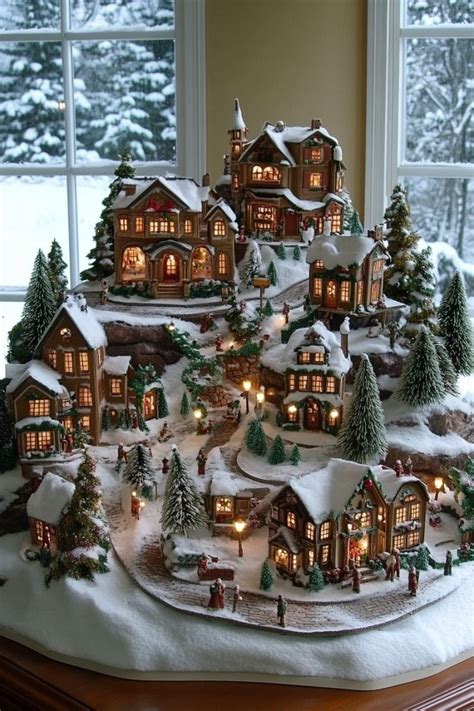
So what, exactly, has motivated people for four decades to spend so much time and money building tiny representations of imaginary Christmases past? Well, as Marling writes, “Christmas is a time when utter perfection seems within human reach: Family members come home again, gifts bring joy to both donor and recipient, and goodwill pours from every lighted window. The imaginary village scene could almost be real. The village lets the collector refashion this world according to his own wishes, remake her memories of the Christmases that should have been.”
All creative hobbies and DIY projects are pretty satisfying, but gazing upon your own beautiful miniature world - where it’s always the holidays! - brings a special kind of next-level pleasure.
Department 56 isn’t cheap. The buildings - which are hand-sculpted, hand-cast, and hand-painted - range from $45 to $250 each, with most costing around $100. And, of course, a village isn’t comprised of just one house. (That said, the resale market is thriving, and many younger hobbyists start with collections they inherited from older relatives. There are also numerous miniature Christmas villages, at varying price points, made by other companies, and not all collectors limit themselves to just one brand.)
It's also a hobby that crosses gender lines, with a huge active male audience - something that has surprised every single noncollector I’ve told about this story. So much of Christmas is normatively feminine - shopping, cooking, decorating, organizing family gatherings - in a way that can leave some men feeling like they aren’t “allowed” to celebrate it; but, as Marling writes, “greens, lights, and villages add a slight masculine scent to the proceedings.
Going all in with Department 56 isn’t cheap.
(I’d be remiss if I didn’t point out that the world they are refashioning will likely be one with no people of color. In the entire 131-page Department 56 winter 2017 catalog, which featured several dozen people figurines, I counted only five POC, and all were black.)
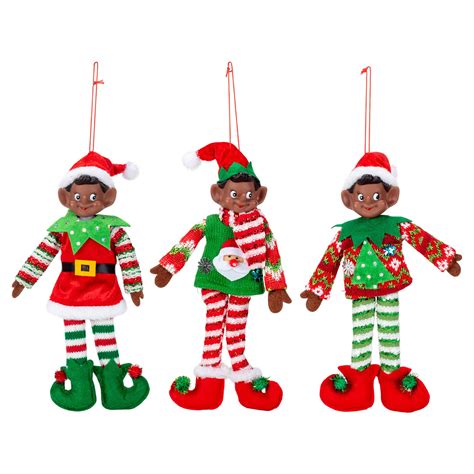
Bring a playful touch to your holiday décor with these charming African American elf ornaments from Kurt Adler!
Here is a table summarizing the key milestones in the history of Christmas villages:
| Period | Event | Significance |
|---|---|---|
| 1700s | Small handmade buildings in Poland and Europe | Early incorporation of miniature structures in Christmas decorations |
| Late 18th Century | Moravian church in Pennsylvania sets up "putz" | Integration of decorative scenes around Christmas trees |
| Late 19th - Early 20th Century | Christmas train sets and department store window displays | Popularization of miniature scenes and train sets |
| 1976 | Department 56 launched | Introduction of light-up miniature ceramic houses and accessories |
Collector Stories
To gain a deeper understanding of the appeal of Christmas villages, let's explore the experiences of several dedicated collectors.
Anna
Anna's love of villaging started when she was 12. Her family bought four buildings, some people, and a few trees, creating their first Lemax village. Her collection has grown to roughly 150 buildings and 550 accessory sets. The basic appeal of the village goes back to my love of building, creating, and being a generally crafty person. "The focus for me is the creative outlet. I love the little details that make everyone’s villages unique, and I love sharing with others to teach and learn new tips and tricks to breathe life into the scenes.
I’m a member of the Ducky 56ers, which is part of the National Council of Department 56 Clubs. We meet monthly to chat about display ideas and charity events, and plan upcoming events. Each year the gathering is held in a different city, and supports a host club-chosen charity.
Scott and Nicholas
Scott bought a Department 56 piece as a gift for his wife. Once you have one house, you need another house, and then another house. Now they have around 70 houses. Nicholas: So I started liking my dad’s village, and then I found out there’s a Halloween village and my Nana and Pop-pop bought me a few pieces. They belong to a local club, and attend the Department 56 collectors national convention. Scott: Our club meets once a month, the third Thursday of the month. We do a holiday luncheon and a barbecue in the summer at someone’s house.
There’s no politics! Our meeting is a two-hour meeting. We go over what’s new in Department 56, what new buildings are coming out. A lot of people may not be near a collectors club. People will just go on and just ask a question, and within minutes [get answers]. Best of all, there’s no politics!
Dennis
Dennis and his wife started collecting Snow Village around 1980. In our travels we saw some of the pieces and they reminded us of our hometowns and where we grew up; some buildings even had the same names as some places in our hometowns. These houses and people were like little cities. We liked Department 56 best and started collecting a few pieces to set up at Christmas.
He built a shelf around the whole room. Snow Village was then set up on this shelf going all the way around the room. It is a great city going all the way around the porch. Currently this city consists of 45 houses, complete with cars, people, and all the things found in a small community. The total size of the city going around the wall is approximately 100 feet in length.
Blake
Blake and his partner started collecting last year when my partner’s mother, Dorothy, gave us her collection of about 30 buildings that she had been collecting for years. The village, as of today, is over 100 square feet and 4 feet tall at the highest point. We currently have 60 lighted buildings, 10 animated pieces, 100-plus accessories/people, and 200-plus trees. I hand-carved each section of the mountain, plastered it, and painted it. We do a majority of our shopping on eBay. On average I spend 8-10 hours a week building and decorating the village.
