The Zambezi River is one of Africa’s most powerful and life-sustaining rivers. It is one of the finest Big water runs in the world. Together with its tributaries, it forms the fourth largest river basin of the continent.
The river flows eastward for about 2,200 miles (3,540 kilometres) from its source on the Central African Plateau to empty into the Indian Ocean. With its tributaries, it drains an area of more than 500,000 square miles (1,300,000 square kilometres).
The Zambezi (meaning “Great River” in the language of the Tonga people) includes along its course the Victoria Falls, one of the world’s greatest natural wonders, and the Kariba and Cahora Bassa dams, two of Africa’s largest hydroelectric projects.
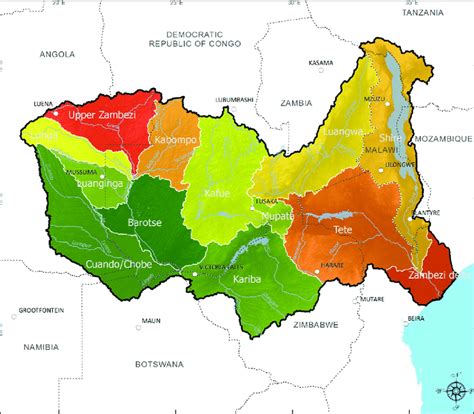
Map of the Zambezi River Basin
An Awe-Inspiring River
This river runs on a scale few ever get a chance to - or perhaps want to - experience. Flows range from 20,000 cfs, which is considered low (Yes, low. 20,000 cfs is considered low, that is not a typo) to high flows of 300,000 cfs (Yes, that is three hundred thousand cfs.
Read also: Luxurious Zambezi Experience
The Zambezi has possibly the single most spectacular put-in of any run I have ever seen. Just upstream of the regular run Victoria Falls thunders down into the Batoka Gorge. These massive towers of water plunge into the river year-round in a spectacular display of power. The river is over a mile wide at the falls, and the steam rising from the falls can be seen over ten miles away.
Navigating the Zambezi: Rapids and Challenges
Downstream of Number One the river forms a small wave train with some good surfing at the right flow. It was borderline too high when I was there but occasionally we could get some fun fast surfs in. This rapid is known as 'Number Two', or 'The Bridge'.
Downstream of Number Two is Number Three, a big green tongue leading into a massive pile on the left or a crashing lateral on the right. The first 'big' rapid is Number Four, also known as 'Morning Glory'. At Morning Glory there are big holes on the left and right and a crashing wave in the middle.
Just downstream is Number Five, also known as 'Stairway to Heaven'. This is the first rapid that has the massive, intimidating features that the Zambezi is known for. At Number Five a big pourover on both the right and left lead most to the middle green tongue and through a series of massive, crashing waves.
Just below Number Five is Five and a half, which has some little waves leading up to Number Six, also known as 'Devils Toilet Bowl'. The next big drop is Number Seven, also known as 'Gullivers Travels'. Here the river divides around several midstream rocks before tearing through a channel with several obstacles.
Read also: The Nile River's Influence
On river left there is a large hole known as 'The Crease', and on river right is 'The Gap', a narrow slot between two boulders which has caused serious carnage in the past. A clean run through Number Seven requires you to eddy out behind a boulder, then charge right through some laterals to just catch the right corner of The Crease while driving back left to avoid The Gap.
If done successfully, these opening moves deposit you straight into 'The Land of Giants' where big haystack waves appear and disappear while you try and navigate them. At this level, Number Seven was by far the most difficult and consequential rapid on the river ( excluding Number Nine of course ).
Just downstream is Number Nine, also known as 'Commercial Suicide'. Number Nine is one of the most fearsome and infamous rapids on the Zambezi. At the healthy flows we had, the majority of the river pours over a ledge into a massive hole in the middle and right at the top.
Beginning on the left bank a huge lateral crashing diagonal provides a potential line through an eight-foot wide slot. Just behind the lateral is a large hole on river left. Downstream most of the flow dropped into the largest wave-hole I've ever seen.
The line is to partially punch the curler then let it take you towards the middle and through the slot between the two massive holes then sort yourself out and hang on for a ride ( or try and dodge right ) of the massive wave-hole waiting at the bottom.
Read also: Geography of the Chari River
Just downstream of Number Nine is Number Ten, also know as 'Gnashing Jaws of Death'. We usually stopped below Number Ten for lunch ( hauled in by porters down a trail to the canyon rim ).
After lunch there isn't much warm up before Number Eleven, also known as 'Overland Truck Eater'. Eleven is yet another fun wave train we ran down the left, avoiding the big hole on the right. Just downstream is Number Twelve, which is broken into 12A, 12B, and 12C, also known as 'The Three Sisters'.
At certain flows the play wave in 12B is one of the finest in the world, with spinning sections, a large pile, and front-surfing sections. The Twelves are are all in a short canyon section and blended together at the high flow we had. We entered this series of rapids in a river left channel, crashed through some curlers and waves, then tried to stay upright while navigating big boils and eddylines down through 12B and C.
The Three Sisters flush straight into Number Thirteen, also known as 'The Mother'. Mother is another massive massive wave train. Number Fifteen ( also known as 'Washing Machine' ) is up next. Here a green tongue leads into some crashing waves then into a boat-eating hole which can be dodged either on the left or right ( or not dodged.. ) Some boily eddylines on both sides made this a bit tricky.
Just below Number Fifteen is Rapid Number 16 A, B, and C, also known as 'The Terminators'. The Terminators feature more clean read and run fun with big waves. Below The Terminators are rapids Seventeen through Twenty-Five, where the river calms down somewhat.
Mostly these rapids are smaller with the occasional bigger wave but nothing compared to the upper section. There are still plenty of big boils and tortuous eddylines to manage though. Number Seventeen is also known as 'Double Trouble', and Number eighteen is known as 'Oblivion'.
Most commercial raft trips take out either at Number Ten ( a half day trip ), or at either Number Twenty-Three or Twenty-Five ( a full day trip). We did one multi-day trip, which continued downstream another day from Number Twenty-Five through more mellow whitewater punctuated with a few massive rapids.
On this lower section there are three really big ones: First is The Narrows, a long, deceptive rapid which consists of battling lots of boils and eddy-lines. Next up many smaller rapids lead to Chumumba, another large complex rapid. Here much of the flow crashes into the right wall forming some powerful seams. Portaging is easy on the left.
Just downstream of Chumumba is upper and lower Moemba falls. The upper 'falls' is similar to the larger rapids upstream. Lower Moemba is a river wide ten-foot ledge with massive boils to negotiate and looked extremely difficult to me at the flows we had. Purportedly, kayakers run this drop but it carries a fair amount or risk. At least one person has died here.
Downstream the river flattens for a ways before crashing through Ghost Rider and son of Ghost Rider, another large, complex wave train. After our multi-day trip they helicoptered the equipment and clients out of the gorge while I hiked out at lower Moemba with much of my gear.
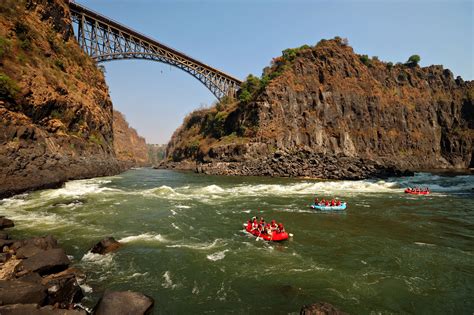
Rafting on the Zambezi River
Logistics and Accommodations
You can access the Zambezi from either the Zimbabwean or Zambian side of the river. Be sure to check before you fly, because right now Zimbabwean side of the river is in political turmoil and relatively unsafe for traveling. I accessed the river from the Zambian side, which is much safer for foreign nationals.
From the Zambian side you can fly to Lusaka and bus to the city of Livingstone ( eight hours, $23 ) or fly to Livingstone. Zambia also shares a border with Botswana and Namibia near Livingstone.
In Livingstone there are two popular guest housess - Faulty Towers and Jollyboys. Jollyboys is a little nicer and had a better social scene. Both have individual rooms, dorm rooms, and camping on the lawn ( $5-30 / night ).
Livingstone is about five miles from Victoria Falls, which is also the put in. Most of the times I ran the river, I caught a ride with Bundu Rafting, a local company run by french kayaker Nico Chassing. Alternatively, some taxis have roof racks and for $7-$10 offer a ride to the put-in.
However, be forewarned, finding a taxi driver who knows the location of the take-outs can be more challenging. Gear is available from several sources. Nico has a few sets of gear he rents out (bunduadventures.com). Grubby from Raft Extreme has some boats and paddles and Hamish from thezambezi.com also had gear for rent. I paid about $120 a week for a full setup.
Gear Rental Options:
- Nico (Bundu Adventures): Full gear rental available.
- Grubby (Raft Extreme): Boats and paddles.
- Hamish (thezambezi.com): Gear for rent.
The Zambezi is one of Africa’s most powerful and life-sustaining rivers. With many areas along its banks enjoying protected status in Zimbabwe, there are superb game-viewing opportunities to be had. Venture into this epic wilderness area on a Zambezi River safari and discover Africa at its most untouched.
The Zambezi River is usually low during December, rising steadily as the rain water starts to arrive from the Angolan highlands. As the early summer rains arrive in about November, so the current gains momentum and the water surges.
High-water levels mean the current is too fast for water-based activities like swimming in Devil's Pool or rafting. The Falls' lunar rainbows or ‘moonbows' are rare atmospheric phenomena that occur when the bright glow of a perfect full moon reflects and refracts off the mist created by the waterfall.
Low-water season runs from about September or October to about January when levels drop over the dry winter. Excellent visibility of Victoria Falls from Zimbabwe and Zambia sides - lower water levels mean less spray and mist.
Devil's Pool is probably the most extreme infinity pool in the world. This natural rock pool sits at the very edge of Victoria Falls, only accessible when water levels are at their lowest, from about August to December.
If you're looking to stay within easy walking distance of the waterfall, then Zim is a good option. If you're looking to stay a little further away from the hustle and bustle, then head for the Victoria Falls Zambia side. Whichever side you choose (why not both?), it's virtually impossible not to have fun in Vic Falls.
Full day-trips to Chobe, Botswana's elephant kingdom, are available from Victoria Falls in Zimbabwe and Zambia. Hwange, Zimbabwe's biggest national park, is about 104km (65mi) from Vic Falls and famous for its vast numbers of buffalo and elephant herds.
Absolutely! There are daily flights from South Africa's international airports to Livingstone Airport (LVI) in Zambia and Victoria Falls Airport (VFA) in Zimbabwe. A road transfer from VFA to Vic Falls Town will take you about 20 minutes.
White Water Rafting on the Zambezi river | BBC Studios
Best Time to Visit Victoria Falls:
- Safari Season (June to October): Good time to combine a safari with a visit to Victoria Falls.
- July and August: A very popular time to visit for a good safari and great views.
- October: Hottest month with the lowest water levels.
- February to July: The waterfall is at its most thunderous, peaking between March and April.
Activities Available:
- White-Water Rafting: Known as the wildest white-water in the world, best during low-water season (August and September).
- Gorge Swinging: A giant swing 120m (393ft) above the water.
- Helicopter Flight: Known as the ‘Flight of Angels', a thrilling flip over the waterfall.
- Steam Train Dining: Dress up and head out to the steam train that takes fine dining to a new level.
The grandeur of Africa seldom stands still. Seasons change, animals migrate and rains bring new life to the otherwise arid landscape. Victoria Falls, too, is constantly in motion.
The UNESCO World Heritage Site was originally called Mosi-oa-Tunya, or Smoke That Thunders, by the Makololo people. At the peak of the rainy season, 130 million gallons of water tumble over the falls every minute, and columns of midst rise more than a thousand feet in the air.
Victoria Falls and the Zambezi River act as literal and symbolic gauges of the environmental health of the continent as a whole. Droughts and flooding are part of the natural cycle of Africa and, consequently, part of the natural cycle of the continent’s wildlife and people.
Nat Hab & WWF guests experience magical wildlife encounters in the Okavango Delta with the help of our Expedition Leaders and local guides! Another adventure that delves deep into Africa’s wilderness is Nat Hab’s Southern Africa Odyssey.
Lake Kariba is the largest manmade lake in the world, created when the Kariba Dam was built in the late 1950s. The lake holds as much as 185 billion tons of water. The waters here harbor hippos and crocodiles, while land excursions take you to Matusadona National Park.
Our river boat is a sustainable mode of transportation, allowing us to get close to wildlife without disturbing their habitat. And, of course, all of our Africa safaris combine adventure and conservation.
There’s something about the Zambezi river that lures me as much as the abundant wildlife that comes to drink at its banks. Perhaps it’s all that power and life force, thundering down into the mighty Victoria Falls like a crescendo.
As the mighty Zambezi River crashes over a basalt rock ledge and drops 108 metres (354 feet) down into a powerful whirlpool, it forms the largest sheet of falling water on the planet: the Victoria Falls.
Popular articles:
tags:
