The South African rand (ZAR) is the official currency of South Africa. The South African rand is legal tender in the Common Monetary Area member states of Namibia, Lesotho, and Eswatini, with these three countries also having national currencies: (the dollar, the loti and the lilangeni respectively) pegged with the rand at parity and still widely accepted as substitutes.
The South African rand is made up of 100 cents and is often presented with the symbol R. ZAR is an abbreviation for Zuid-Afrikaanse Rand, which means South African rand in the Dutch language. The ISO code of the South African rand is the ZAR, which is an acronym for the Dutch words “Zuid-Afrikaanse rand”.
The rand takes its name from the Witwatersrand ("white waters' ridge" in English, rand being the Afrikaans (and Dutch) word for 'ridge'), the ridge upon which Johannesburg is built and where most of South Africa's gold deposits were found.
If you’re planning on a trip in South Africa, it is important to know its currency. Maybe you’ve decided to take an excursion to the adventure capital of the world that is South Africa. Or maybe you’ve decided that Europe, Asia, and the Americas are too conventional, and South Africa calls to you as thoughts of camping under a picturesque, safari night sky and surfing in Cape Town make the country irresistible.
History of the South African Rand
The South African rand (ZAR) was introduced in February 1961, just before the Republic of South Africa was established. The rand was introduced in the Union of South Africa in 1961, three months before the country declared itself a republic. A Decimal Coinage Commission had been set up in 1956 to consider a move away from the denominations of pounds, shillings, and pence; it submitted its recommendations on 8 August 1958.
Read also: Yen to Rand Exchange Rate Analysis
Since 1961, the South African rand has reigned as the country’s main currency. It replaced the South African pound as legal tender, at the rate of 2 rand to 1 pound, or 10 shillings to the rand.
The government introduced a mascot, Decimal Dan, "the rand-cent man" (known in Afrikaans as Daan Desimaal). This was accompanied by a radio jingle to inform the public about the new currency.
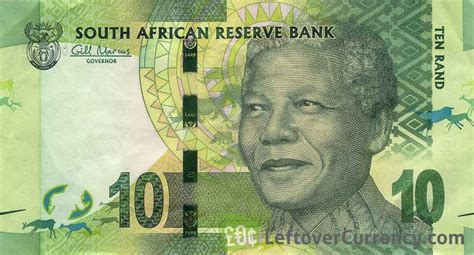
Up until the 1990s, the rand was illustrated with images of white Europeans from South Africa's colonial past. Post-apartheid banknotes featured photos of the country's treasured wildlife. In 2012, the South African Reserve Bank created a series of banknotes embellished with Nelson Mandela’s face to honour his role and dedication to creating peace throughout the country. Exciting news from South Africa! New currency released today features Nelson Mandela on every note.
История расизма в Южной Африке
Evolution of the Rand's Value
The rand saw a fairly auspicious beginning, trading at an exchange rate of 1.40 US dollars to 1 rand for its first ten years in existence. dollar became stronger than South African currency for the first time on 15 March 1982.
By the early 1980s, high inflation and mounting political pressure combined with sanctions placed against the country due to international opposition to the apartheid system had started to erode its value. The currency broke above parity with the dollar for the first time in March 1982. It continued to trade between R1 and R1.30 to the dollar until June 1984, when the currency's depreciation gained momentum.
Read also: Understanding the South African Rand
By the time that State President P. W. Botha made his Rubicon speech on 15 August 1985, it had weakened to R2.40 per dollar. The currency recovered somewhat between 1986 and 1988, trading near the R2 level most of the time and breaking beneath it sporadically.
As it became clear in the early 1990s that the country was destined for Black majority rule and one reform after the other was announced, uncertainty about the country's future hastened the depreciation until the level of R3 to the dollar was breached in November 1992. A host of local and international events influenced the currency after that, most notably the 1994 general election, which had it weaken to over R3.60 to the dollar, the election of Tito Mboweni as the governor of the South African Reserve Bank, and the inauguration of President Thabo Mbeki in 1999, which had it quickly slide to over R6 to the dollar.
This sudden depreciation in 2001 led to a formal investigation and a dramatic recovery. By the end of 2002, the currency was trading under R9 to the dollar again, and by the end of 2004, it was trading under R5.70. The currency softened somewhat in 2005, trading around R6.35 to the dollar at the end of the year. At the start of 2006, however, the currency resumed its rally and, as of 19 January 2006, was trading under R6 to the dollar again.
From 2001 to 2006, the rand recovered about half of its value relative to the US dollar, moving back to an exchange rate of approximately six-to-one (rand to dollar). But then, in 2012, a decline in the key South African industry of mining sparked a fresh decline for the rand. A stalled mining industry in late 2012 led to new lows in early 2013.
In late January 2014, the rand slid to R11.25 to the dollar, with analysts attributing the shift to "word from the US Federal Reserve that it would trim back stimulus spending, which led to a massive sell-off in emerging economies." In 2014, South Africa experienced its worst year against the US dollar since 2009, and in March 2015, the rand traded at its worst since 2002.
Read also: ZAR to USD history
From 9-13 December 2015, over four days, the rand dropped over 10% due to what some suspected was President Jacob Zuma's surprise announcement that he would be replacing the Finance Minister Nhlanhla Nene with the little-known David van Rooyen. The rapid drop in value stemmed when Zuma backtracked and announced that the better-known previous Minister of Finance, Pravin Gordhan, would instead be appointed to the post.
Following the United Kingdom voting to leave the European Union, the rand dropped in value over 8% against the US$ on 24 June 2016, the currency's largest single-day decline since the 2008 economic crash. In April 2017, a Reuters poll estimated that the rand would remain relatively stable for the rest of the year, as two polls found that analysts had already factored in a possible downgrade to "junk" status. At the time, Moody's rated South Africa two notches above junk status.
When President Jacob Zuma narrowly won a motion of no confidence in South Africa in August 2017, the rand continued to slide, dropping 1.7% that day. In September 2017, Goldman Sachs said that the debt and corruption of Eskom Holdings was the biggest risk to South Africa's economy and the exchange rate of the rand. In October 2017, the rand firmed against the US dollar as it recovered from a six-month low.
Coins of the South African Rand
Coins were introduced in 1961 in denominations of 1⁄2, 1, 2+1⁄2, 5, 10, 20, and 50 cents. In 1965, 2-cent coins replaced the 2+1⁄2 cent coins. The 1⁄2 cent coin was last struck for circulation in 1973. The 1 rand coin for circulation was introduced in 1967, followed by 2 rand coins in 1989 and 5 rand coins in 1994.
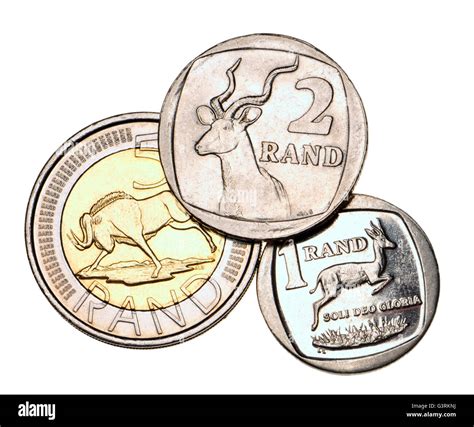
The rand also has coins in 6 different denominations: 1, 2, 5, 10, 20 and 50 cents. Along with 1, 2, and 5-rand coins in circulation.
To curb counterfeiting, a new 5-rand coin was released in August 2004. On 3 May 2023, the South African Reserve Bank announced that a new series of coins would be released. These will have the same denominations as the previous series.
Banknotes of the South African Rand
The first series of rand banknotes was introduced in 1961 in denominations of 1, 2, 10, and 20 rand, with similar designs and colours to the preceding pound notes to ease the transition. They bore the image of what was believed at the time to be Jan van Riebeeck, the first VOC administrator of Cape Town. In 1966, a second series with designs that moved away from the previous pound notes was released.
Notes with 1, 5, and 10 rand denominations were produced with predominantly one colour per note. A smaller 1 rand note with the same design was introduced in 1973, and a 2 rand note was introduced in 1974. The 20 rand denomination from the first series was dropped.
The 1978 series began with denominations of 2, 5, 10, and 20 rand, with a 50 rand introduced in 1984. This series had only one language variant for each denomination of note. Afrikaans was the first language on the 2, 10, and 50 rand, while English was the first on the 5 and 20 rand.
In the 1990s, the notes were redesigned with images of the Big Five wildlife species. 10, 20, and 50 rand notes were introduced in 1992 & 1993, retaining the colour scheme of the previous issue. Coins were introduced for the 2 and 5 rand, replacing the notes of the previous series, mainly because of the severe wear and tear experienced with low-denomination notes in circulation. The 2005 series has the same principal design but with additional security features, such as colour-shifting ink on the 50 rand and higher and the EURion constellation.
In 2011, the South African Reserve Bank issued defective 100 rand banknotes which lacked fluorescent printing visible under UV light. The South African Reserve Bank shredded 3.6 million 100-rand banknotes printed by Crane Currency because they had the same serial numbers as a batch printed by the South African Bank Note Company.
On 11 February 2012, President Jacob Zuma announced that the country would be issuing a new set of banknotes bearing Nelson Mandela's image. They were entered into circulation on 6 November 2012. In 2013, the 2012 series was updated with the addition of the EURion constellation to all five denominations.
On 18 July 2018, a special commemorative series of banknotes was released in commemoration of the 100th anniversary of Nelson Mandela's birth. This series includes notes of all denominations, 10, 20, 50, 100, and 200 rand. These notes will circulate alongside the existing notes. The notes depict the standard face of Nelson Mandela on the obverse. Still, instead of the Big Five animals on the reverse, they show a younger Mandela with different iconic scenes relating to his legacy.
On 3 May 2023, the South African Reserve Bank announced that a new series of banknotes would retain the image of Nelson Mandela on the obverse while showing the Big 5 in a family depiction on the reverse.
Inflation and the Rand
The South African rand has experienced inflation, leading to a decrease in its purchasing power over the years. Between 1958 and today, the rand had an average annual inflation rate of 7.55%, resulting in a substantial increase in prices. For instance, R100 in 1958 is now equivalent to about R11,353.17.
According to the OECD and the World Bank consumer price index for South Africa, today’s prices are 113.53 times higher than average prices since 1958. In 1958, the inflation rate was 3.46%, contrasting with the current rate of 5.45%. To counter inflation and maintain the same purchasing power of rand, one would now need R11,353.17.
The Rand Today
On May 3, 2023, the South African Reserve Bank (SARB) introduced improved Mandela banknotes and a new fourth decimal coin series. The redesigned banknotes continue to honor Nelson Mandela, South Africa’s first democratically elected president, featuring his portrait on the front of all five denominations.
- The 10 rand banknote features a green color with Nelson Mandela on the obverse and a Rhinoceros on the reverse.
- The 20 rand banknote features a brown color with Nelson Mandela on the obverse and an Elephant on the reverse.
- The 50 rand banknote features a purple color with Nelson Mandela on the obverse and a Lion on the reverse.
- The 100 rand banknote features a blue color with Nelson Mandela on the obverse and a Cape buffalo on the reverse.
- The 200 rand banknote features an orange color with Nelson Mandela on the obverse and a Leopard on the reverse.
Exchanging Currency in South Africa
When traveling to South Africa, it’s important to understand the currency used in the country. While the South African rand is the official currency of the country, the US dollar (USD) is also widely accepted in many places, especially in tourist areas. However, it’s important to note that you may not get the best exchange rate when paying with USD, and some places may not accept USD at all. It’s recommended to exchange some money into South African rand before traveling to the country.
You can exchange your currency at banks, exchange offices, and some hotels. Banks usually offer the best exchange rates, but they may charge higher fees. Exchange offices and hotels may offer more convenient locations and longer hours, but they may have less favorable exchange rates and higher fees. Before exchanging your currency, you should be aware of the current exchange rate.
When choosing between USD and ZAR in South Africa, it’s important to consider the exchange rate. The exchange rate for South African rand (ZAR) fluctuates daily. It is important to check the current exchange rate before exchanging your currency. While USD is widely accepted in South Africa, it is recommended that you use the local currency for most transactions. This is because some vendors may offer unfavorable exchange rates or charge high fees for USD transactions.
Exchange rates can also affect the fees and tips you pay when you travel. For instance, if the rand is weak, you may need to pay more fees to convert your money into the local currency. This can increase your travel expenses. Similarly, if the rand is weak, you may need to pay more tips to service providers such as hotel staff, taxi drivers, and restaurant servers.
Tips for Exchanging Currency
When exchanging currency in South Africa, it’s essential to follow a few tips to ensure a smooth transaction. Start by checking the current exchange rate to have an accurate understanding of the value of your currency. Be cautious of any additional fees associated with using credit or debit cards for currency exchange. To further assess the exchange rate and service, consider exchanging a small amount of currency initially before proceeding with larger transactions.
Cost of Living in South Africa
When it comes to the cost of living in South Africa, it is generally considered to be quite affordable. According to Expatistan, a single person’s estimated monthly costs are around R22,800, which is cheaper than in 81% of countries in the world. One of the biggest factors that can affect your cost of living in South Africa is housing. Rent prices can vary greatly depending on the location, size, and quality of the property.
According to Numbeo, the average rent for a one-bedroom apartment in the city center is around R7,500 per month, while outside of the city center it’s around R5,000. Food and groceries are generally affordable in South Africa. You can find a variety of fresh produce, meat, and dairy products at reasonable prices in supermarkets and local markets.
Transportation costs can also vary depending on your location and mode of transportation. Public transportation in major cities like Johannesburg and Cape Town is relatively affordable, with a one-way ticket costing around R10 to R15.
Avoiding Scams When Exchanging Currency
When exchanging currency in South Africa, it is important to be aware of scams. Some exchange offices may offer high exchange rates to lure customers in, only to charge high fees or provide counterfeit currency. Stick to well-known banks, official foreign exchange bureaus, or authorized currency exchange providers. They are more likely to offer fair and transparent rates while minimizing the risk of fraud.
Make sure you are aware of the current exchange rates before you arrive in South Africa. This will help you determine if the rates offered to you are fair or if you are being scammed. Always ask for a receipt when exchanging currency. Avoid exchanging currency on the street or with unauthorized individuals. Learn how to identify the security features on South African banknotes to avoid receiving counterfeit money.
When using ATMs, be aware of your surroundings and check for any suspicious devices attached to the machine, particularly card skimmers. Cover your hand while entering your PIN and avoid assistance from strangers. When making purchases or paying for services, consider using credit cards or digital payment methods like mobile banking apps.
Exchanging currency in South Africa is relatively easy, but it is important to choose the right place to exchange your currency and be aware of potential scams.
Krugerrand
First minted in 1967, krugerrands are gold coins that raise the profile of the South African gold trade in international markets and make it possible for individuals to own gold as an investment. Krugerrands are designed to derive their value exclusively from the price of gold at the time they are traded. The krugerrand and the rand are both South African but they are not the same currencies.Krugerrands are gold coins that are bought primarily by investors in the precious metal. Their value is based entirely on their gold content and fluctuates with the price of gold.
South African Reserve Bank
Modeled on the Bank of England (BoE), the South African Reserve Bank (SARB) is the monetary authority for South Africa and issues its currency. Above all else, the central bank is in charge of the achievement and maintenance of price stability. This is to ensure that the interests of the economy precede those of any private individual.
To maintain this policy, the governor and 14-member board head the bank's activities and work toward monetary goals.
Common Monetary Area
The establishment of the Rand Monetary Area (RMA) in 1974 allowed Swaziland, Botswana, and Lesotho to issue currencies unique to their nations. Through the RMA agreement, the South African rand remained legal tender in all member nations and circulated alongside the national money of the member nations.
In 1986, following the substantial depreciation of the rand, the countries replaced the RMA with the Common Monetary Area (CMA) to manage monetary policy. The terms of the new agreement provided Swaziland with additional flexibility in its monetary policy.
Rand and Gold
For the most part, the rand's value has been linked to the price of gold, South Africa's main export during its early days. Gold is the country's most exported product, representing 14% of total exports in 2021 or $20.1 billion. However, major world developments have also determined ZAR's price trajectory.
Historical USD/ZAR Exchange Rates
The all-time low exchange rate for the rand relative to the US dollar was reached in 2016 when it hit an exchange rate of just below 18 ZAR/1 USD. As of 2020, the USD/ZAR exchange rate is approximately 15 ZAR/1 USD.
