Perfume has been a cherished luxury item for millennia, and ancient Egypt was no exception. The Ancient Egyptians loved beautiful fragrances. At least 5,000 years have passed since the Ancient Egyptians first produced perfume, according to hieroglyphics found in Egyptian tombs as early as 3,000 BC. In Egyptian culture, the usage of fragrances like perfume and incense was quite widespread.
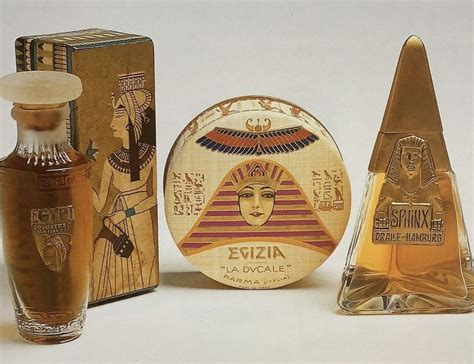
The Uses of Perfume in Ancient Egypt
Perfumes served multiple purposes in ancient Egypt. Initially, the rarity of perfume made it a product reserved for the gods. In ancient Egypt, incense was revered as the “Fragrance of the Gods.” Making incense implied, in some unfathomable manner, constructing the gods’ bodies and interacting with them.
The Pantheon of Gods and Scents
The pantheon of Gods is a significant fact that demonstrates the significance of scent in ancient Egypt. Egyptians really associated a number of divinities with scent and perfume. The Egyptians revered a number of deities associated with smell, such as Nefertum, the goddess of the lotus flower, Merehet, the goddess of unguents, and Chesmou, the god of perfume manufacture. Nefertum was typically shown as a handsome young guy with blue lotus blossoms around him. A kind of lotus flower called a water lily opens in the morning and closes at night, signifying rebirth and renewal. Egyptians believed that all beautiful scents originated from the bodies of the gods. Furthermore, according to the Egyptians, resinous substances like myrrh and frankincense were the resinous “tears” and “sweat” of the gods, which emerged from the trees. For instance, they thought that the best myrrh came from Re’s eye. The Eye of Horus was also associated by the Egyptians with incense, and more particularly, with the gummy fluids of labdanum incense.
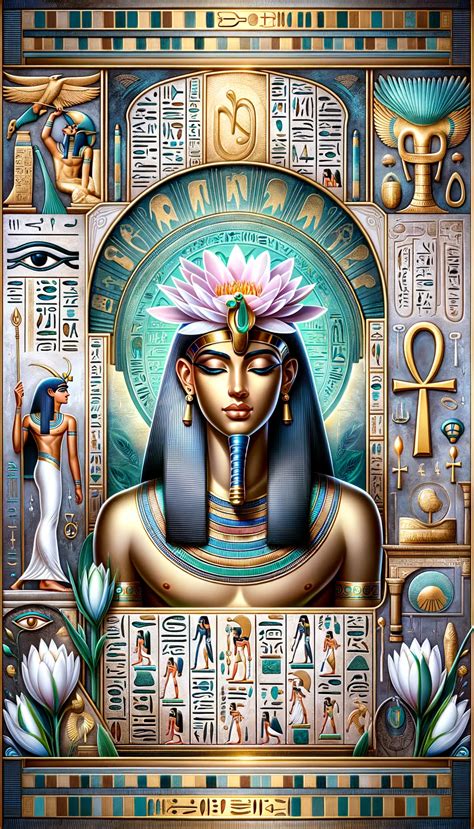
Nefertum, the god of perfume
The Manufacturing of Perfume in Ancient Egypt
It would seem that the Egyptians of the ancient era did not master distillation. Even though Cleopatre likely produced the first alembic prototype, the distillation process had not yet been established, therefore they developed the “enfleurage” technique to extract essential oils. As a result, this procedure allowed for the mixing of oils or fats with scent. For instance, some depictions feature ladies with wax cones perched on their heads. They are become experts of the technique of enfleurage.
Read also: Ancient Egyptian Perfume
The principles of their technique weren’t written down in order to keep their knowledge secret. Egyptian fragrances weren’t like those available today. The perfumes of the era were thicker than those of today, with a consistency similar to olive oil rather than water. In order to create the old scents, ingredients like cardamom, olive oil, and cinnamon were used. These perfumes were often considerably heavier and stickier than the stuff we spray on today.
Kyphi: The Most Famous Ancient Egyptian Perfume
The most well-known perfume is Kyphi, composed of resins of terebinth, saffron, raisins, cinnamon, wine, myrrh, honey, and other products. The Greek translation of the Egyptian term Kapet, which became the name Kyphi, is really written in Latin. Kyphi was a unique incense made from a blend of pricey resins that were brought from other nations, honey, spices, roots, and wine.Kyphi was used for ceremonial rituals in ancient Egypt, and it was often burned in temples at dusk. You were able to speak with God and unlock the door to your imagination thanks to the smoke and scent of the encens. It was related to dreams and visions. This incense was created from a complex mixture of ingredients, including raisins, honey, and myrrh.Making kyphi required careful attention to detail, took up to six months, and involved the use of spells and magic formulas. The recipes remained secret because they were used to honor the gods. Do you know that one of the oldest perfume compositions ever documented in history was made by the earliest perfumers, the Egyptian priests? They utilised fragrant resins like frankincense, myrrh, and benzoin to both smell the temple and make a perfumed mixture used as sacrifices and ceremonial offerings. Additionally, these resins were used by the Egyptians as a kind of olfactory clock, with the odours signifying the passage of time. In fact, the priests burned three separate smells in the temple throughout the day.
The Trade of Ingredients
Not all of the raw ingredients used in the odourous daily routine were grown in Egypt. In reality, a strong commerce and storage infrastructure was required because of the need for these materials. Frankincense was brought in from abroad, notably from the Punt region. Drawings on the Deir el-Bahri temple, Hatshepsut’s funeral temple, depict one journey for incense and myrrh. Hatshepsut was Egypt’s female pharaoh. In 1478 BC, she ascended to the Egyptian throne. She was in charge of organising and sponsoring an expedition to Punt. Even today, historians, academics, archaeologists, and other experts disagree on the precise location of the Land of Punt. Over the years, it has been referred to as a region of Somalia or Arabia, although some academics place Punt’s homeland in either Eritrea or east Africa.
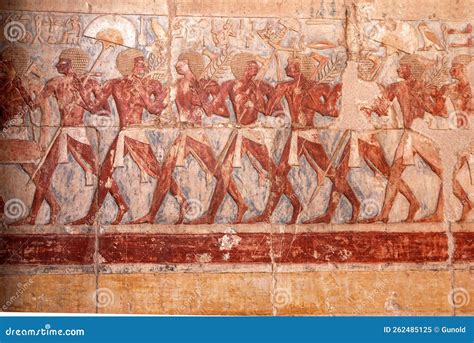
Relief from Hatshepsut's temple depicting the expedition to Punt
Five large ships and at least 200 sailors were part of the operation. The expedition’s was enormous. With little success, they attempted to grow about 30 live myrrh trees to begin their own myrrh production. However, they also brought back rare metals, exotic creatures like giraffes, and several fragrant herbs and spices. Today’s warehouse was formerly the temples.
Read also: Popular Red African Oil Perfume Scents
Recreating Cleopatra's Perfume
As with all the important periods in world history, ancient Egypt still holds many secrets. A team of researchers has launched a formidable challenge: to recreate a perfume worn by Queen Cleopatra herself. How is this possible? The amphorae were analyzed by scientists, with the help of experts in Egyptian perfumes. And through the study of ancient Greek texts to find the formulas of the famous ancient perfumers, Mendesian and Metopian, they arrived at a conclusive result. It is, of course, impossible to know if Queen Cleopatra wore such a perfume. And according to some sources, she had personal workshops for the creation of her fragrances. Impossible to become Pharaoh? Perhaps, but wearing a perfume that incorporates the essences of ancient Egypt is possible.
Read also: The Scent of Morocco: Rose
Popular articles:
tags: #Egypt
