The Moroccan flag is more than just a bright piece of fabric. It is a profound symbol representing the Kingdom of Morocco’s history, culture, and identity. The "Flag of Morocco" or “Al-Istiqlal Flag,” as it is also called, holds immense meaning and symbolism within its bright red background and the distinctive green pentagram at its center.
This article will break down the different layers of meaning that make up the Moroccan flag. It will also look at the meaning of the star on the flag and the bigger ideas that it represents.
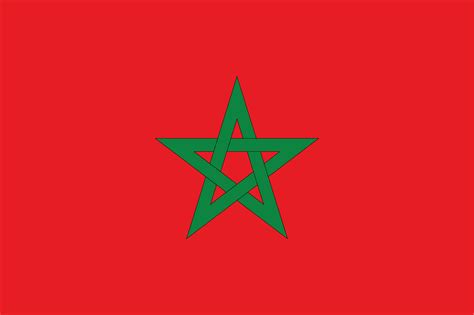
Design and Symbolism
Article 4 of the Protection of the National Symbols Act 2005 prescribes the characteristics of the flag. The flag shall be red with a green five-pointed star in the middle. The legal definition of the flag specifies that the colors are bright red and palm green.
The flag is made with a piece of fast fabric, bright red, opaque, and rectangular in shape. The star shall be voided, of green palm-tree color, made of five continuous branches and woven in the fabric used for the flag . The star must be visible on both sides of the flag. One of its points must point upwards. The overall ratio of the flag shall be 2:3. The star is inscribed in an invisible circle whose radius equals 1/6th of the flag length and whose centre is the intersection point of the invisible diagonals of the flag.
Red Background
The colour red stands for bravery and honor. It is a color that is linked to Morocco and a lot of other Arab countries. In Morocco, the color red also has historical meaning. Indeed, the red background of the Moroccan flag symbolizes strength, bravery, valor, and hardiness.
Read also: "Sabi" Meaning Explained
Green Pentagram
An important part of the Moroccan flag is the green pentagram, which looks like a five-pointed star. This green star, which is a big part of the national emblem, brings the sign of the Moroccan flag to life. Each spot on the star represents one of the five pillars of Islam.
Here are the five pillars of Islam:
- The statement of faith (Shahada)
- Daily prayers (Salat)
- Giving to charity (Zakat)
- Fasting during the holy month of Ramadan (Sawm)
- The journey to Mecca (Hajj)
In addition, the color green symbolizes hope, peace, love, wisdom, and joy. Additionally, the star on the Moroccan flag represents hope and wealth. These good qualities are often linked to the green color of the star. Green in Morocco means growth, rebirth, and the hope of a better future.
The green pentagram shown on the national flag of Morocco is often called Solomon’s seal. Its origin might date back to the Babylonian Empire, c. 2000 BC. The pentagram might have represented goddess Ishtar, assimilated by the Muslims to Fatima, the Prophet’s daughter. On the Moroccan flags, the pentagram represents the link between God and the nation.
Being an Arab state, the choice of the star by Moulay Youssouf aims to remind Moroccans of the five pillars of Islam. Even the coat of arms of Morocco symbolizes an Islamic phrase. This set of characters translates to “God, Fatherland, King.”
Read also: Understanding Nigerian Slang: Idan
The Moroccan flag brings the people of Morocco together under a single sign that shows what the country stands for and who it is. It brings the Moroccan people together and gives them a feeling of national pride and identity. This flag shows that Moroccans are united by their shared past and ideals, which go beyond language, area, and culture.
Fun With Flags - Morocco
Historical Significance
The Moroccan flag has always been a symbol of the country’s identity and its fight against foreign forces. Morocco’s past, culture, and sense of self are all strongly represented by its flag. The meaning of the star on the Moroccan flag has deep roots in the Islamic faith. It stands for the five pillars of Islam and the country’s dedication to its religious and cultural history.
The flag of Morocco has quite a significant history. The latter also marks the independence of November 17, 1915. Before the 8th century, the people living in Morocco had no flag. It was with the Muslim conquest and its reign that the first came into existence. On the other hand, this flag was a simple white banner used on the battlefields.
Then, the Almoravid Amazighs established the political and military use of a flag in 1062. This is how the troops kept the white banner, the emblem of the Almoravids, on the battlefields. From 1121 to 1269, it was the reign of the Almohads. During the latter, the Moroccan flag had a red background representing the blood shed for religion. It was placed in the center of a white and black chessboard, symbolizing Islam’s victory.
Following this reign, the Wattassides and the Saadians dominated Moroccan lands for several years. These three empires kept the same meridian flag. The latter had a red background with a star formed by two superimposed squares in the flag’s center.
Read also: "Ire": A Deep Dive into Yoruba Meaning
This period was marked by two distinct Moroccan flags. Indeed, from 1350 to 1895, it was composed of a red background with a border of red and white triangles. It felt like scissors for a long time. However, both swords were Yatagans, a mark of the Alaouite dynasty. From 1895 to 1905, Morocco found itself in full societal change. This period marked a reconversion of the Moroccan flag.
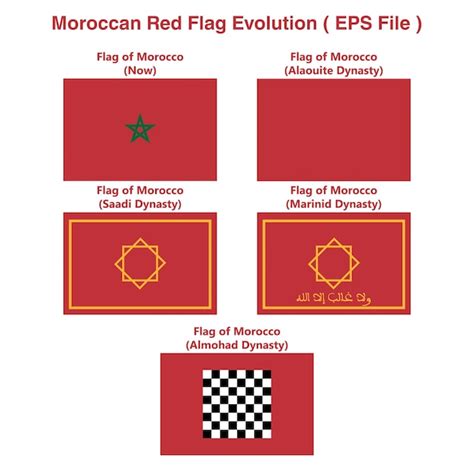
Over time, it was found that the all-red model was quite similar to those of sailors. A green star has been added to the red background since 1895. The Moroccan flag became a strong sign of resistance against foreign rule. It gave people who wanted freedom and authority hope.
When France and Spain ruled over Morocco as protectorates, the flag was a sign of struggle and a memory of the country’s will to take back its independence. In this time, the colonial powers forced their own colors and symbols on Morocco, which made it harder for the country to have its own identity. Even though Morocco was a colony at the time, the people there were very determined to fight back.
Freedom and the Modern Era
In 1956, Morocco got its freedom from France and Spain, and the Moroccan flag became the official national flag. The Moroccan flag became the official national flag when the country got its freedom from France in 1956. It was a recognition of years of hard work that had led to this moment.
Following Morocco’s declaration of independence from French and Spanish rule, the flag became the official symbol of the country. It took years of hard work and suffering to make this important event happen. After Morocco was no longer a colony in 1956, the flag took on an even deeper meaning.
Because of its historical importance and part in the fight for freedom, the flag is a beloved symbol for Moroccans that brings them together and makes them feel proud. The past and meaning of the Moroccan flag are still very important to the country’s character today.
Variations and Usage
The size of the Moroccan flag varies according to its use and the place where it will be hoisted. The flag can also be made with much larger dimensions. You have 150 x 225 cm with a height of 300 cm for a shaft of 25 mm.
Two common materials used for making the Moroccan flag are Ecofix and Polyspun Marine. Ecofix is a 110 gr/m² polyester fabric with an average lifespan of 3 to 6 months. Polyspun Marine is considered the best and most recommended material. In addition, the Moroccan flag is made with a double-stitched hem around the edge, providing it with more solidity.
The flag can also be used as a wall decoration on a facade or for an interior layout. Thus, it is possible to embellish schools, town halls, communities, businesses, etc.
On 8 May 2010, a Moroccan flag with a size of 60,409.78 square metres (650,000 sq ft; 14.9 acres), weighing 20,000 kilograms (22 short tons), was set in Dakhla, a city in the disputed territory of Western Sahara.
In conclusion, the Moroccan flag is a beautiful sign that shows what the Kingdom of Morocco is all about. The Moroccan flag is more than just pretty to look at; it brings Moroccans together and gives them a feeling of national pride and identity. The Moroccan flag has a lot of historical meaning and deep symbolic meaning. It is a strong symbol of a country that has been through a lot and come out on the other side with its culture and historical heritage intact. We can read about the past of the Moroccan flag and see a story of struggle, strength, and finally, the country’s successful fight for freedom.
Popular articles:
tags: #Morocco
