Morocco's educational landscape is shaped by a complex interplay of historical legacies, linguistic diversity, and evolving national priorities. The teaching of English, in particular, faces unique challenges rooted in the country's colonial past, the dominance of French, and the ongoing efforts to promote Arabic and Amazigh languages. This article delves into these challenges, exploring the historical context, current policies, and the perspectives of students and educators.
Entrenched in a Colonial Past
Before the First World War, overlapping European spheres of influence in Africa made Morocco into a battleground of geopolitical rivalries. Following numerous infringements on Moroccan sovereignty-including a secret 1904 treaty between France and Spain dividing Morocco between their spheres of influence and the 1907 occupation of Oujda by French forces-the Treaty of Fez on March 30, 1912 established Morocco as a French protectorate.
French control in Morocco was modeled after the French protectorate of Tunisia, which had a similar legacy of colonialism. Although the sultan maintained some of his powers through decrees and seals of religious status, the French constructed a separate government of colonial bureaucracy that held superior jurisdiction. This extensive French bureaucracy included institutions for native affairs-which monitored Moroccans’ daily life and civil society-and legal matters. A native population with religious and cultural practices and a dominant French administration constituted a complex, dual-power system.
The French first oversaw only finance and public works, but their jurisdiction eventually expanded into eight departments, including education. Systems of education were established through the protectorate and originally segregated, with Muslim- and Jewish-run schools and separate schools for French and Europeans. Between 1926 and 1936, only 51 Moroccan Muslim students graduated from higher education institutions in the protectorate. The graduation figures underscore how higher education remained nearly inaccessible due to the segregationist policies of French colonizers.
One factor that explains the historical and modern discrepancies between Moroccan social mobility and that of predominantly white European countries is language. Under the protectorate, the French language was viewed as superior to Arabic, and the establishment of elite private schools with full French instruction superseded public schools taught in native languages. Moroccans thus faced monetary and linguistic barriers to higher education.
Read also: Decoding "Oloribu Omo Ofo Yoruba"
The reduction of native linguistic influence and the prominence of French was thus a colonialist method of cultural suppression and forced assimilation. Adhering to the colonial agenda of cultural assimilation, social control, and economic exploitation, the French administration implemented policies aimed at eradicating indigenous languages and traditions, substituting them with French language and culture.
However, resistance to these colonial educational policies emerged from nationalist movements, intellectuals, and grassroots initiatives. Moroccan education remains a battleground for preserving cultural heritage and asserting national identity. These forces face a monumental task, as the inequalities stemming from French colonial rule are deeply ingrained in the Moroccan education system.
“Arabization” and Linguistic Reconstruction
The ongoing debates surrounding which language to teach in Moroccan education persist, echoing the pendulum of language policies that characterized the mid- to late-20th century. Following Moroccan independence in 1956, Morocco launched an “Arabization” initiative aimed at reclaiming linguistic sovereignty and dismantling French hegemony in public institutions. This effort marked a definitive break from the influence of la francophonie, or countries in which the French held significant cultural sway due to colonization. Consequently, the medium of instruction shifted from French to Standard Arabic.
Critics of Arabization lament the “neglect” of the Amazigh language, suggesting that this attempt to decolonize Moroccan education has failed to uplift indigenous voices. Other critics emphasize the potential disruptions that abrupt shifts away from French cause. The policy’s sudden reversal of French linguistic influence had both immediate and long-lasting negative effects on the Moroccan population.
Despite Arabization on other levels of education, French remained the main language of science instruction in higher education; therefore, students struggled to transition from primary and secondary schools taught in Standard Arabic to higher education taught in French. Linguistic inconsistency across different levels of Moroccan education therefore poses challenges for students seeking careers in science.
Read also: Voice Translation: Igbo to English
Socioeconomic disparities ingrained in Moroccan society also highlight the policy’s failures, as public schools serve a wider population of economically disadvantaged students. Wealthy and elite members of Moroccan society bypass the initiative through private education and schools abroad, motivated by better language instruction.
For years after independence, educators were frequently French nationals or locals educated in French institutions. This involvement speaks to the atrophy of the Moroccan education system under the French protectorate. Sudden Arabization was ineffective in eradicating French influence. Morocco boasts a comprehensive and structured education system consisting of six years of primary school, three years of intermediate school, and three years of upper secondary education, followed by tertiary studies. However, traces of French colonialism persist.
Notably, prestigious French mission schools-in which French serves as the primary language of instruction-remain attractive to Moroccan elites. Furthermore, within the realm of public administration, there has been a resurgence of legal proposals reminiscent of the pre-Arabization era. More recently, a 2024 joint education program between France and Morocco-in which France pledged a loan of 130 million euros (US$140.9 million) and a grant of 4.7 million euros (US$5.1 million)-is especially focused on French instruction in secondary schools.
Upward Mobility or Cultural Sustenance
Defense for the emphasis on French is partly due to its reputation as a “[language] of commerce,” with fluency seen as advantageous in the job market. To some, French enables upward mobility; historically, skilled workers often secured positions in the French-trained civil service or within sectors engaged in trade with French-speaking nations.
The view of French as a language of commerce, however, still traces its roots to socioeconomic disparities created by colonization and the limitations of Arabization. Arabization-by creating a linguistic fissure between primary and secondary education (Arabic) and higher education (French)-undermined higher education opportunities for secondary school students taught solely in Arabic. Moroccan schools must create an education system that acknowledges the value of French while strengthening Arabic proficiency and promoting linguistic inclusivity.
Read also: GBP/MAD conversion
That said, the increasing emphasis on English as the new global lingua franca further complicates the linguistic conundrum in the Moroccan education system. In 2023, the Moroccan government began to incorporate English into public primary and secondary schools-English was previously only available in private schools-to improve students’ professional opportunities. These developments suggest that Morocco faces a linguistic crossroads, as French and English contend for prominence.
Against the social mobility argument for French or English, the current linguistic composition of Moroccan schooling strays from the mother tongue of the native people. With French entrenched in Morocco's linguistic landscape, there is a clear interplay of cultural authenticity and colonial legacy in the evolution of the country’s vernacular. Native languages anchor a child to their sociocultural heritage, and an erasure prevents an “intellectual and aesthetic creativity” that is synonymous with the mother tongue.
It is therefore imperative for Moroccan education to instill Amazigh, Arabic, and native dialects. Though the inclusion of French or English may promote economic mobility, it should not overshadow the importance of cultural continuity. The prioritization of native languages in education facilitates reconciliation with the past and cultivates a culturally rich and inclusive future for Morocco.
The Role of Project Work in English Language Teaching
Project work is used in several educational settings, including foreign and second language teaching contexts. In the Moroccan English as a foreign language (EFL) classroom, the Moroccan Ministry of Education recommended implementing project work, and it is a common component of the Moroccan textbooks of English. Yet, there is a scarcity of studies conducted on the use of project work in Moroccan EFL classrooms.
A study conducted with sixty students and eight teachers belonging to two different high schools (Moulay Rachid and Abbas Sebti high schools) in Tangier aimed to investigate students’ and teachers’ attitudes towards project work. The results of the study showed that both students and teachers had positive attitudes towards project work. The results also revealed that not all teachers follow the steps of using project work. Based on the results, it was clear that the lack of technology is one of the most severe challenges that hamper the use of project work.
The Future of English in Morocco
The Current State of English Language Development
Unfortunately, the state of English language development in Morocco is woefully inadequate. This failure to grasp the imperative is due to a myriad of reasons. Moroccans are experiencing the results of these delays. First and foremost, Moroccans have a too heavy reliance on social media to develop and practice English. While these platforms can provide some exposure to the language, they are far from sufficient for achieving true proficiency.
Parents also play a significant role in this debacle. Because they, themselves, suffered from poor English training when they were at school, far too many parents are blissfully unaware of the appallingly poor standards of English training given to their children in the elite French schools they pay exorbitant fees for. The Moroccan government is taking some steps to develop the English skills of its citizens, through its expansion of English learning hours in middle schools (or colleges), these efforts are far from adequate. The current initiatives lack a sense of urgency.
It is high-time Moroccan citizens, the government and businesses stop doing the minimum, stop hoping for some language miracle and start to proactively address these issues head-on. To begin with, the government should mandate that all new street signage and tourist information be written in English alongside French and Arabic, or even better, have English replace French. Making English visible throughout Morocco would enable faster learning and acceptance.
The Education Ministry also must also embrace and utilize the English-speaking expatriate community in Morocco. Businesses must also recognize the marketing advantages of incorporating English. Companies that use English demonstrate a forward-thinking attitude and a commitment to the future of modern Morocco.
In conclusion, only with concerted effort and commitment from all sectors of society can Morocco hope to overcome the harmful deficiencies in its current approach to English education in order to secure a prosperous future for its citizens.
Challenges and Opportunities
Thus learning a third or even fourth language for a Moroccan learner is not a big challenge, however, there are some difficulties to learn a language efficiently and accurately.
One of the fundamental problems of learning a foreign language in Morocco is the lack of accuracy and efficiency of teachers in the public sector. Also, the socio-economical situation of teachers in Morocco is not satisfactory, and it is claimed and advocated along the school year through advocacy and manifestations of the teachers syndicates, this fact encourage teachers in public school to work also in the private sector because of encouraging salaries and conditions, and also giving tutoring classes for groups and individuals. Another main problem that concerns the learner in the class, is the overcrowded classrooms, whereas the teaching methodologies becomes almost hard and inapplicable for a group of different student's levels and number.
Private schools are much better than public school because they afford material and pedagogical supports and supply teachers with a monitoring system and a quality assessment, while in public school the only monitoring system is the head of school and parents indirectly and also student's family institution that advocates to improve the quality of education and negotiate with stakeholders to intervene in the education of their children.
Therefore teacher in public school is left limited in term of using new pedagogical approaches, and methods, which force the Moroccan learner to work with undesirable materials, and a very structured curriculum to follow.
Marrakesh: A Unique Opportunity for TESOL Teachers
For TESOL teachers seeking a unique and adventurous teaching experience, Marrakesh, known as the “Daughter of the Desert,” offers a journey filled with vibrant culture, history, and opportunities. From the bustling markets to the aroma of traditional spices, every corner of the city has something to offer.
Marrakesh’s booming economy has given rise to a new and expanding English teaching industry. As Morocco positions itself as a hub for international tourism and trade, English language skills are increasingly valued, especially in the business and hospitality sectors. English language schools, private institutions, and tutoring opportunities are growing, making it easier for TESOL-certified teachers to find teaching positions. The demand for English teachers is driven by the desire of many Moroccans to learn English for career advancement and travel.
English teaching positions can be found in language schools, universities, international schools, and private tutoring. Language schools often seek TESOL-certified teachers, making certification a valuable asset for landing a job. The teaching culture in Marrakesh may differ from what you are used to. Flexibility and adaptability are key, as schools may have different approaches to classroom management and curriculum standards.
While Arabic and French are the primary languages spoken in Morocco, learning some basic phrases in these languages can help ease communication. To make the most of your teaching experience, take time to understand the cultural context. To teach English in Marrakesh, having a TESOL certification is highly recommended. It will make you more competitive in the job market and help you understand the nuances of teaching English as a second language.
Teaching English in Marrakesh is not just a job; it’s an adventure in itself. The city’s rich history, lively atmosphere, and growing demand for English education make it a rewarding destination for TESOL teachers. With its unique blend of cultural heritage and modern development, Marrakesh is a place where you can immerse yourself in the language and culture while gaining valuable teaching experience.
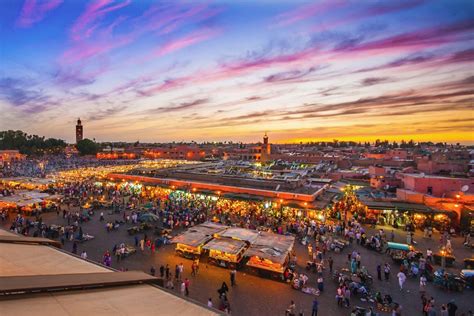
Jemaa el-Fnaa Square in Marrakesh
In conclusion, a Moroccan Learner should not be only relying on formal education and inputs acquired in the school, but a great effort is awaiting him/her, and active participation in a civic organization in Morocco is advised, as in Morocco there are plenty of civic association and clubs which offers voluntary teaching programs for free, and host foreign teachers to provide a non-formal education course, based on energizers, games, role play, working groups, presentation and public speaking and also theater sessions…etc where the Moroccan learner feels more comfortable, and motivated to actively participate and engage in his/her learning process.
| Challenge | Description |
|---|---|
| Colonial Legacy | French influence persists in education, creating linguistic barriers and socioeconomic disparities. |
| Linguistic Diversity | Balancing the promotion of Arabic, Amazigh, French, and English poses a complex challenge. |
| Teacher Quality | Lack of accuracy and efficiency of teachers in the public sector. |
| Socio-economic Factors | Disparities in access to quality education between public and private schools. |
| Overcrowded Classrooms | Large class sizes hinder effective teaching and individual attention. |
Popular articles:
tags: #Morocco
