The name “Little Egypt” evokes images of exotic dance and veiled mystery. This moniker can be attributed to at least three specific performers of the late 19th and early 20th centuries: Ashea Wabe, Farida Mazar Spyropolous, and Fatima Djemille. Donna Carlton adds Saida DeKreko, Catherine Devine, and Gertrude Warnick as other performers who claimed to be “the original.” Two dancers who appeared on early film recordings, Fatima and Raja, are also sometimes referred to as “Little Egypt,” and were quite possibly from the Middle East.
In addition to these three performers, the name “Little Egypt” became a term for any solo female performer of the hootchy-cootchy, no matter how inauthentic or corrupted the actual dance was from its Middle Eastern roots.
One of the most famous of these performers was Fahreda Mazar Spyropoulos, also known as “Fatima” and later “Little Egypt.”
Fahreda Mazar Spyropoulos: The Original "Little Egypt"
Fahreda Mazar Spyropoulos, aka “Fatima” and later “Little Egypt,” was born in Syria in 1871. She first performed in the United States at age 10 at a saloon called the Bird Cage Theatre in Tombstone, Arizona, but she didn’t rise to public attention until 12 years later, at her performance at the 1893 World’s Columbian Exposition in Chicago, Illinois.
Though not of Egyptian or Algerian descent, Spyropoulos appeared in the Exposition at the “Egyptian Temple” attraction in a show called “The Algerian Dancers of Morocco.” In complete defiance of standard women’s dress of the period (full skirts, corsets, hair-covering hats…) Spyropoulos appeared on stage in a gauze shirt, vest, and an ankle-length skirt.
Read also: Egyptian Adventure
Though well received by the American public, Spryopoulos’s performance sparked heavy controversy among critics. Anthony Comstock, a government inspector dedicated to the ideals of “Victorian Morality,” deemed the dance “indecent” and demanded that Spyropoulos’s exhibition at Chicago Fair be shut down.
In protest, women’s’ rights advocate Ida Craddock wrote a four-page letter (later published in the Sunday edition of New York World) to the president of the Fair’s board, arguing that the dance was not indecent, but rather, its opposite: “a religious memorial inculcating purity and self-control.” Craddock labeled the performance nothing more than a “public dance,” and that public dance, or “prolonged pleasure” goes hand-in-hand with “sexual self-control and spiritual bliss…if husbands and wives engaged in such self-control,” she wrote, “it would end the horrors of accidental or forced maternity, without violating the natural law.”
Craddock then advocated that because the “dance du ventre” promoted such valuable marital ideals, it should not only be allowed continue at the Chicago Fair, but also toured across the country. The immense popularity of Fahreda’s belly dance at the 1893 World’s Columbian Exposition in Chicago brought about an increasing public demand for this form of “exotic” entertainment.
Much to her later disgust, however, Spyropoulos was unable to control how her style of dance evolved beyond her own lifetime. The dancer inspired dozens of imitators, all of who went by the stage name “Little Egypt,” and billed themselves as indistinguishable from the original. Their dances, however, were far more revealing than Fahreda’s dance at the 1893 Chicago Fair.
These imitators were commonly arrested for appearing nude in public, and over the years, their dances became so provocative that the term “exotic dancing” started to become colloquially synonymous with sexual availability. By the 1910s, Fahreda’s “danse du ventre” had transformed into the substantially nude “Oriental Dance,” and after WWI, the “Oriental Dance” had evolved into today’s “bump and grind” - a dance that doesn’t just involve movement of the hips, but a quick thrust of the abdomen and rotation of the hips- a visual picture that suggested sex in a bolder way than it had ever been represented on stage before.
Read also: Learn Arabic in Egypt: Guide
In 1936, Fahreda went so far as to sue the Metro Goldwyn Mayer movie Company for portraying “Little Egypt” in the film The Great Ziegfield as a costumed Oriental dancer with a naked midriff - a costume she never wore, claiming the movie had slandered her reputation and carefully crafted stage persona.
The evolution of "Little Egypt" from a Syrian dancer to an icon of exotic entertainment is a fascinating journey that reflects changing social mores and the enduring allure of the "mysterious East."

Little Egypt
Dance in Ancient Egypt
Dance was an integral part of ancient Egyptian life, encompassing religious rituals, social events, and entertainment. It served as a means of expression, communication, and spiritual elevation.
“Dance was an important part of religious and life-span events as well as a popular form of entertainment in ancient Egypt. Dance themes from prehistory, such as fertility, weapons, and funerals, intertwined into ancient Egyptian religious and secular dance themes, each with different purposes, performers, and movements.”
Read also: Clothing in Ancient Egypt
“Dance was the chief means of expression in Egyptian religious services, which emphasized life after death and a vehicle for perpetuating mysteries and teaching people about ancient myths. Mysteries and secret doctrines about the rise and fall of the Nile were communicated through symbolic dance-dramas.”
“As ancient Egyptian society became more complex, dance expanded beyond religious rites and communal participation to entertainment. In the New Kingdom the dancing became more refined, with trained dancers providing entertainment for their masters and guests. Servants, slaves, and pygmies often performed dance entertainment. As slaves came from various countries into Egypt, they melded their dance styles. Movement became more flowing in closed-type dances.”- History of Dance, by Gayle Kassing
Performances were held at festivals, banquets, in the temple, and at funerals, but could take place anywhere. The upper classes regularly employed musicians for entertainment at evening meals and for social gatherings. All of these dances, for whatever purpose, were thought to elevate the spirit of the dancer and of the audience of spectators or participants.
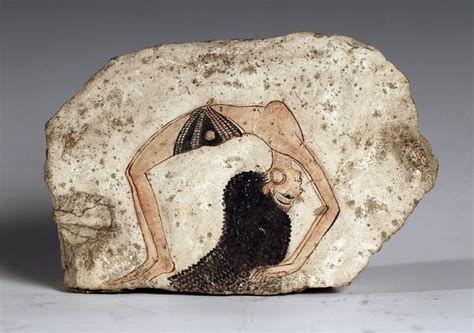
Ostracon of a Dancer in an acrobatic position
The artistic quality of the design is exceptional and is erotically charged. Female dancers can be seen depicted not only on tomb walls but also on temple walls. The liveliness and quality of draughtsmanship of this semi-erotic sketch, demonstrate a high level of skill and certainly suggests that it was the drawing of a royal artisan working in the Valley of the Kings.
Ostraca are simple splinters of limestone or shards of pottery, on which the ancient Egyptians wrote or drew. This type of support was used because it was plentiful and of no material value, unlike papyrus, which was much more expensive. The ancient Egyptians drew on ostraca for a variety of reasons; for example, while planning work on tombs or as exercises.
Papyrus was an expensive medium reserved for official documents, so that potsherds and flakes of limestone (ostraca) were normally used instead. The uses were disparate such as for contracts, receipts, letters, stories, writing exercises and even doodles provide an insight into daily life.
The Dancer of Esna and the Ghawazee
The Ghawazee were different from Egyptians, living apart from the general population, with separate customs, their own social structure, and perhaps even speaking a different language. Lane made clear the difference between the 'awalim, the educated female singers, and the ghawazee, distinctly a lower class. This distinction was not always understood by foreigners and the two terms were sometimes used interchangeably in travelers' accounts.
Lane's description of the provocative dance of the ghawazee is admirable for its restraint."They commence with a degree of decorum; but soon, by more animated looks, by a more rapid collision of their castanets of brass, and by increasing energy in every motion, they exhibit a spectacle exactly agreeing with the descriptions which Martial and Juvenal have given of the performances of the female dancers of Gades."
In a time when the "unprintable" parts of the classics were rendered in Latin, it is not surprising that Lane relies on the ancient authors for the detail he could not commit to print. In the Roman Empire, Gades (Cadiz) in Spain was notorious for its provocative dancers. The passage from Juvenal contains description of immodest dances and song, , clattering castanets, "quivering" buttocks, and foul language.
Lane continues about the modern dancers ‑‑ "I need scarcely add, that these women are the most abandoned courtesans of Egypt. Many of them are extremely handsome; and most of them are richly dressed. Upon the whole, I think they are the finest women in Egypt."
The ghawazee were hired to perform in the streets before houses on special occasions such as weddings, but were not allowed inside a respectable harem. They were available for all‑male private parties where their performance, as described by Lane, was "yet more lascivious," he makes it clear that they were little better than common prostitutes raised in "the venal profession."
Prostitution was outlawed in Cairo in June 1834, as a part of the social reforms of Mehemet Ali. The ghawazee were exiled as a class to Upper Egypt, especially to the towns of Kena, Esna and Aswan. The European traveler who sought the entertainment provided by these dancer/prostitutes could no longer find them as easily in Cairo but the facts of their displacement were well known and the determined tourist was only obliged to postpone the satisfaction of his curiosity until his voyage south.
The resettled ghawazee of Esna were those best known to travelers. Accounts of them turn up regularly in nineteenth century travel memoirs and in some of the popular guidebooks. The earliest published reference to the ghawazee by a contemporary westerner I have been able to discover is in Eliot Warburton’s The Crescent and the Cross, published in 1844, only ten years after the women were expelled from Cairo.
Of the European travelers to Egypt at mid‑century, the account of Gustave Flaubert provides one of the most vivid records of the male European in pursuit of a preconceived romantic notion of exotic Egypt. Flaubert's descriptions echo the work of "Orientalist" painters such as Vernet, Fromentine and Gerome, equally romantic in conception, and as exquisite in detail.
In Esna Flaubert and du Camp arranged to be entertained with music, exhibitions of dancing and sex with the dancers, particularly Kuchuk Hanem. The name Kuchuk Hanem is, in fact, not a name at all. In Turkish it translates as simply 'little lady', a term of endearment that might be applied equally to a small child, a lover, or a famous dancing girl.
Kuchuk Hanem had some fame in her own day. This is attested by a reference totally unrelated to that of Flaubert and Du Camp. George William Curtis, an American journalist and friend of Emerson and Lowell, traveled in Egypt in the same year as Flaubert. Curtis published his Nile Notes of a Howadji (foreigner) in 1851.
Flaubert and Curtis both visited Kuchuk Hanem within a short time of each other, and both left written accounts of her suggesting either an amazing coincidence or that she must have been one of the most sought‑after entertainers in Upper Egypt.
The orientalism of several of his works is very much dependent on the first‑hand experiences he had in Egypt . Two descriptions can be directly traced to the influence of the Dancer of Esna. In the novella Herodias the dance of Salome evokes the memory of Kuchuk Hanem. In the longer Temptation of Saint Anthony the Queen of Sheba actually executes a dance called "the bee". Warburton described what must have been a popular pantomime, but he called it "the wasp", probably the same dance that Flaubert had heard of and demanded of Kuchuk Hanem.
That Kuchuk Hanem made a vivid impression on Flaubert is evidenced by the fact that she was later the subject of a poem by Louis Bouilhet, inspired by Flaubert's accounts in letters and doubtlessly from his descriptions after his return to France.
The Dancer of Esna, the "little lady", has become a part of history through the writing of the American journalist and the French novelist, probably beyond any place or time that she could have imagined.
The evolution of dance in Egypt, from ancient religious rituals to the performances of the Ghawazee and the rise of "Little Egypt," offers a glimpse into the rich cultural history of this fascinating land. It also highlights the complex interplay between tradition, modernity, and the ever-changing perceptions of exoticism and sensuality.
Little Egypt Dances for Edison (1896)
Popular articles:
tags: #Egypt
