Among all of Israel’s neighbors, Egypt is the most prominent one in the Bible, especially in relation to Moses in the Old Testament, and in the New - to Jesus. The land of Egypt is mentioned by the Jewish people on a regular basis because the story of Passover begins in Egypt. Most notably, Mount Sinai is likely located in present-day Egypt, on Sinai Peninsula, where Moses received God’s commandments.
Egypt’s remarkable historical heritage is a major part of her people’s identity even today, which is easily noticeable at every step, with ancient symbols appearing on items of common use. Some may think of hieroglyphs of slender men and women with neatly shaved or trimmed hair. Others will immediately think of pyramids and the Sphinx. Still, some may associate Egypt with the kingdom described in the Old Testament - the enemy that oppressed the Jewish people. If you follow modern-day events, you may think Egypt is a turbulent country that was at the forefront of the Arab Spring in early 2010s.
Christmas Story for Kids: Mary and Joseph's Flight To Egypt - Matthew 1 and 2 | SharefaithKids.com
We know from the Bible that Egypt had wealth, a strong army and powerful kings. Already in antiquity Egypt became known for its advancements in construction, medicine and agriculture. Their achievements are recognized to this day in mathematics or literature including early paper production. On top of that, Egypt had an elaborate religious system. The pagan nature of the land was very evident. Kings were considered to be gods and superstition was common. After the Israelites escaped slavery in Egypt, the Bible instructed them not to follow the ways of Egypt (Lev.
Historically, Egypt was known for cooperating with other tribes and kingdoms, even allowing foreigners to take high positions in governance. Joseph, son of Jacob, did not end up in Egypt by choice (Genesis 37), but God raised him to hold a very influential position in this foreign land. In the end, the entire family of Jacob moved to Egypt, escaping famine and drought. For as long as Joseph was remembered by the rulers in the country, the Hebrews led a peaceful and good life among the Egyptians.
Life conditions became progressively worse for the descendants of Abraham, Isaac, and Jacob. This situation deteriorated to the point that a few generations later, they became slaves to the Egyptians. But then, we read that God heard their cry (Exodus 3:7-8) and raised up Moses to lead them out of this land and into freedom. Despite Moses being raised in the Pharaoh’s house, it was no easy task to set his people free. It took some intense negotiations, ten plagues and the death of Pharaoh’s own son for the Israelites to finally leave Egypt. Moses is considered to be the most important prophet in Judaism. And the Exodus from Egypt was undoubtedly the most significant event on the Nile that is mentioned in the Bible.
Read also: Egyptian Adventure
It may seem that a lot of Egypt’s involvement in Biblical history was rather grim. But there are a few instances that paint a different picture. Joseph’s story paints Egypt as a land of plenty and of success. To the local Christians, Joseph is not just a hero they can relate to. He is a redemptive archetype that foreshadowed Jesus.
But it is far from the last one. What may have seemed like a good political move did not turn out to be a good one spiritually. The many wives of Solomon weakened his devotion to the Lord. One of his biggest downfalls was building altars to other gods for his wives. His rulership ended with the Kingdom of Israel being split into two. “Rehoboam, son of Solomon and the first king of Judah, was attacked in the fifth year of his reign by an Egyptian pharaoh. As a result of his defeat, Judah became a vassal state, subordinate to Egypt. The Israelites had forsaken the LORD and so, the LORD left them to the hands of Pharaoh.
The family of Jesus was instructed to seek shelter in Egypt when His life was in danger (Matt. 2:13). God Himself instructed them to find refuge in the south. We don’t know much about the time they spent by the Nile, but we can assume they were safe. But this remains true: the Jewish Messiah, our Savior and Son of God, lived for a short season in Egypt. What an exceptional fact to have as a part of your nation’s history!
It is legal to be a Christian in Egypt, as long as you are born one. Every citizen has their religious affiliation specified on their identity card. This means that the right to choose what to believe is practically withdrawn from you at the moment of birth. So, are there no people in Egypt who consciously chose to accept Jesus as their Savior? There are. My Egyptian host explained to me how significant the stories of Joseph and baby Jesus are to the believers in his country. It is what unites them all across Egypt.
I asked my host how the Egyptian Christians look at some of the prophecies and harsh words about Egypt in the Old Testament. After enslaving the Hebrews and because of idolatry, Egypt became synonymous with sin and bondage. Compelling the Jewish people to choose life, God cautions them about returning to Egypt and living in sin (Deut.
Read also: Learn Arabic in Egypt: Guide
Since the days of the Old Testament’s prophets, many of the prophecies about Egypt have been fulfilled. The glory of the Pharaohs is long gone, and Egypt is not as powerful as it was in antiquity. But just as God said Egypt will be smitten, He also promised that she will be healed. Christians in Egypt hold on to this promise and continue to pray for their nation.
In response to my question, my host smiled with understanding. He humbly replied, “This country probably deserved great damnation in the past. But Jesus came to earth for that very reason. Thanks to the prophet Isaiah, we know that to be true. “And when the Lord will strike Egypt, strike and heal, then they will turn to the Lord, and He will turn to God, let them plead and heal them.” (Isa.
Following the visitation of the Magi, Joseph is instructed to take Jesus and Mary to Egypt to avoid Herod’s attempts to kill Jesus. Egypt was not very far away from Judaea, in comparison to other provinces with a large number of Jews such as Babylonia or Persia. There were still many Jews living in Egypt, dating back to before the Babylonian exile, so the family may have sought help from relatives or family friends.
As Egypt was a part of the Roman Empire, it was easy for Joseph and Mary to travel there. However, Egypt was outside of Herod’s rule, so Jesus would be safe from Herod’s death squad. At the time, Egypt was an imperial province ruled by the Roman Emperor himself, Augustus.
Jews were respected in Roman Egypt, but they were also constantly clashing with the Greeks. Hellenism marked the period of Greek cultural influence throughout Europe, Africa and Asia between the death of Alexander the Great in 323 BC and the emergence of the Roman Empire. In Egypt, this period ran through the conquest of the Ptolemaic Empire in 30 BC.
Read also: Clothing in Ancient Egypt
Jesus and his family likely lived among a Jewish community and enjoyed a degree of anonymity and separation from Hellenistic culture. Herod the Great died in March of 4 BC and Jesus’ family returned to Nazareth soon thereafter. This moment in history connected Jesus to the prophecy, “Out of Egypt I called my Son.”
Almost immediately after their departure, Joseph, warned by Matt. ii. 13-15. God in a dream, takes Mary and Jesus and goes down into Egypt. Herod, so soon as he finds himself mocked Matt. ii. 16-18. by the wise men, gives orders that all the children in Bethlehem of two years and under be slain. Joseph with Mary and Jesus remains in Egypt till he hears through Matt. ii. 19-23. an angelic messenger of Herod's death. He designs to return to Judea, but is directed by God to go to Nazareth, Luke ii. 39-40. where the Lord remains during His childhood and youth. The time of the sojourn in Egypt was not probably of long duration, although extended by some of the early writers to several years.
Considering how numerous were the Jews in Egypt, and the constant communication between the two countries, the news of Herod's death must soon have reached him in the ordinary way; but it was first made known, to him by the angel, and no long interval, therefore, could have elapsed. That he made no delay but hastened his return, is implied in the fact that he did not know that Archelaus was Herod's successor till he came to the land of Israel. We infer, then, that the return was in the summer of 750, after a sojourn of three or four months.
Tradition marks out the route which Joseph took into Egypt to have been by way of Hebron, Gaza, and the desert; which, as the most direct wray, is very likely the true one. At Hebron is still pointed out upon a hill the spot where the family rested at night, and a similar one at Gaza. The place of their sojourn in Egypt was the village Metariyeh, not far from the city of Heliopolis on the way toward Cairo. An old sycamore is still shown as that under which they rested in their journey.
In the village of Nazareth the Lord spent the larger part of his earthly life, and it therefore deserves our special notice. By many it is derived from ISTetser, the Hebrew for sprout, or twig, either because of so many thickets upon the adjoining hills, or because the village itself was small and feeble, like a tender twig. So Jesus is called (Isaiah xi. 1) a Branch. Others derive it from ISTotser, that which guards or keeps; hence Nazareth, the protecting city. Jerome interpreted it as meaning a flower.
Nazareth lies in a small valley a little north of the great plain of Esdraelon, from which it is reached by very rocky and precipitous paths. Around it rise many small hills of no great height, the highest being on the west or southwest. They are of limestone, and give to the scenery a grayish tint, and are covered thickly with shrubs and trees.
The village itself lies on the western side of the valley upon the side of the hill. The houses are in general of stone, and more substantially built than most of the towns of the region, and from their whiteness it has been called the white city; the streets or lanes are, however, narrow and filthy.
The time from Abraham to the time of the early church spans a period of about two thousand years. Peter fished. Matthew was a tax collector. The Bible describes a wide range of cultures and lifestyles. Some people were nomads, living in small groups, keeping flocks of sheep and goats, and traveling from place to place in order to feed and protect their animals. Others lived more settled lives, growing crops or providing services to people in towns and urban areas.
The Bible describes the many different kinds of jobs people had in the ancient world, but caring for land and animals are two of the central jobs mentioned. Genesis reports that one of Adam and Eve’s sons herded sheep while the other farmed the land (Gen 4.2). The earliest ancestors of the people of Israel, including Abraham and Sarah, traveled from place to place and survived by keeping herds and flocks of animals (Gen 13.1-3). Keeping herds of animals like sheep and goats was common among the many generations of the people of Israel. At first, these herders (shepherds) were wandering nomads who lived in tents and had very little personal property.
When the Israelites settled in Canaan after leaving their life of slavery in Egypt, farming became a more important way of making a living for them. Grains, such as wheat and barley, were used for making bread, and were the most important crop. Grains, as well as lentils and peas, are known to have been cultivated in Palestine since prehistoric times. Unlike farmers in Egypt and Mesopotamia, Israelite farmers did not need to depend on irrigation for water.
Fishing was a far less important source of food and income for the people of Israel, since the Philistines and others controlled the seacoast. What fish were available usually came from Lake Galilee and the Jordan River. The most common fish was a type of sardine. According to the Law of Moses, the Israelite people were not to eat fish that lacked fins or scales (Deut 14.9), but the Bible does not mention specific kinds of fish.
As the Israelites became more settled in and near cities, they became involved in many other types of work. Some men and women became skilled workers, or artisans, who worked on various crafts, very often at home. Many times parents taught their children these skills so they could also use them to make a living. Skilled workers were highly respected, since people needed their skills and products to live comfortably. After the time of the exile (around 538 B.C.; see the mini-article called “Exile”), artisans in the same type of craft began to form into professional groups.
The Bible tells us that Jesus grew up helping his father Joseph, who was a carpenter (Matt 13.55). And the apostle Paul apparently made a living at the craft of tentmaking (Acts 18.3). Many people, free and slave, provided personal services as laborers. These servants included household servants, employed by royalty and other wealthy people. Loyal household workers were highly valued.
A number of jobs were related to maintaining governments and kingdoms. At the top of the social structure were kings, queens and emperors, diplomats and ambassadors, senators and governors (Acts 13.7). The interests of the leaders and the nation were protected by armies which were made up of military officers (Matt 8.9; Acts 21.32), soldiers, and armor-bearers (Judg 9.54; 1 Sam 14.6). To maintain the government, additional workers were needed, such as tax collectors (Luke 19.1,2), keepers of records and secretaries (2 Sam 8.16,17), and lawyers (Acts 24.1; Titus 3.13).
The Jewish people in Jesus’ day were ruled by the Roman government, which appointed a Roman governor (or procurator) to oversee the collection of taxes and keep order in the land (Matt 27.2; Acts 24.1). For years, the temple in Jerusalem was the center of the religious life for the people of Israel. It took many people to see that its important work was carried out properly. According to the Law of Moses, the members of the tribe of Levi were to work as priests, serving all the people of God. Since the Levites were not given their own land, they were allowed to keep a portion of the sacrifices that the Israelite people offered to God (Josh 13.14). A high priest was in charge of the temple, and he was supported by chief priests, gatekeepers (1 Chr 9.17-32), temple workers (Ezra 2.43-54), and guards (1 Chr 9.17-32).
Most of Israel’s neighbors had their own temples and religious practices. Although the sacred tent and temple were the center of religious life for the people of Israel, many of the kings of Israel and Judah also employed prophets (1 Chr 21.9; 2 Chr 19.1,2) who helped them make decisions based on God’s will, and who warned them of the consequences of their actions.
Unskilled workers were often poor and did difficult jobs like mining, cutting rocks, digging wells, building roads, cleaning streets, training and driving camels, loading and unloading goods along trade routes, working as a crew member or rower on a boat, and tending and harvesting crops. Still others worked as dancers, musicians, and even as professional mourners. Some of these mourners were paid to cry and wail during funeral processions (Jer 9.17; Matt 9.23); others played sad music on flutes, beat their chests with their hands, and wore rough clothing called sackcloth (Gen 37.34).
Merchants and traders bought and sold all sorts of items, carrying them from town to town to offer for sale in outdoor marketplaces. Some wealthy merchants owned ships or large numbers of camels, which they used to transport goods across long distances.
By the time of Jesus, various kinds of coins were commonly used to pay for goods and the services of workers. The story Jesus told in Matthew 20.1-16 describes vineyard workers being paid the amount of one day’s wage, which was one denarius.
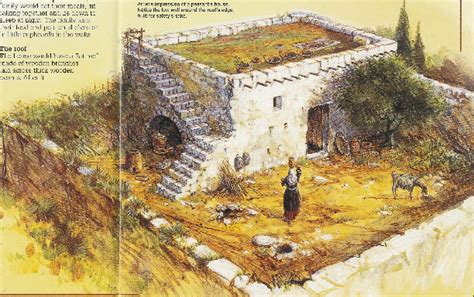
In Palestine in the time of Jesus, houses were made of clay bricks or stones held together with mud and straw, and had dirt floors. The average family lived in one-room, two-level dwellings with living quarters separated from and raised above the animal stalls. Jewish extended families often lived together. The poor lived in one-room houses built of mud brick on a stone foundation. External steps led up to the flat roof which provided storage space and somewhere to sit. Inside the house a raised platform at one end of the room provided quarters for eating and sleeping.
Men’s jobs were typically farmers, craftsmen, or fishermen. Women learned cooking and household duties. The range of food was much more limited in New Testament times than it is today. Seasonal vegetables were common.
Clothing in the first century was much simpler than it is in our lands today. Most garments were made from wool, though linen was also used (made from flax grown in the Jericho area or imported from Egypt). Both men and women would normally wear an ankle-length tunic next to the skin, often held at the waist by a belt (which could also be used as a purse). A cloak could be worn over this, especially at night or if the weather was cool during the day. Jewish law required the cloak to have tassels attached to its four corners.
Although life was hard for the ordinary people of Jesus' day, it had its lighter moments. Feasting, singing, story-telling and dancing all had their place as recreational activities. Games, both indoor and outdoor, were also popular.
| Occupation | Description |
|---|---|
| Shepherds | Nomadic herders who kept flocks of sheep and goats, providing meat and milk. |
| Farmers | Cultivated grains and other crops, adjusting to the yearly cycle of rainy and dry spells. |
| Fishermen | Fished in Lake Galilee and the Jordan River, providing a less important source of food. |
| Artisans | Skilled workers in various crafts, often forming professional groups. |
| Servants | Provided personal services, including household tasks and royal duties. |
| Government Officials | Maintained governments and kingdoms, including kings, diplomats, and soldiers. |
| Temple Workers | Served in the temple, including priests, gatekeepers, and guards. |
| Unskilled Workers | Performed difficult jobs such as mining, construction, and harvesting. |
| Merchants and Traders | Bought and sold goods, transporting them across long distances. |